
7 minute read
.png)
Quick answer
Reliable AI agents need more than data. They need context. And that context starts with AI-ready data that is structured, connected, contextualized, and governed so AI can use it reliably.
A semantic foundation connects enterprise data, knowledge, relationships, business rules, and organizational context, giving AI a deeper understanding of how the business operates. By bringing together semantic layers, knowledge graphs, and governed metadata, organizations can create a Company Brain, a connected foundation that enables AI agents to move beyond information retrieval toward more reliable, explainable, and business-aware outcomes.
Introduction
AI agents are rapidly moving from experimentation into business-critical workflows. They are being used to retrieve information, automate processes, support decisions, and increasingly act on behalf of employees and customers.
As this adoption accelerates, a fundamental question emerges: what does it take to make AI trustworthy at enterprise scale? The answer is not simply more data or more powerful models.
It starts with AI-ready data — data that is structured, connected, contextualized, and governed so AI systems can understand what information means, how it relates to other information, and whether it can be trusted.
Enterprises already have enormous volumes of information across applications, databases, documents, knowledge repositories, and specialized systems. The challenge is that this information often exists in isolation, with different definitions, relationships, business rules, and levels of governance.
An agent may retrieve the right document or identify the right record without understanding how that information fits into the broader business context.
This is the next challenge for enterprise AI: moving from data access to contextual understanding.
Organizations, therefore, need a foundation that connects AI-ready data with meaning, relationships, knowledge, business rules, and governance. This is what enables AI to understand not only what the enterprise knows, but how that knowledge connects and why it matters.
That foundation can become the Company Brain behind enterprise AI.
From data access to business understanding
Most enterprises do not have a shortage of data. They have a shortage of connected understanding.
Customer information may reside in CRM platforms. Product information may sit across operational systems. Policies and procedures may be documented. Scientific knowledge may span research systems and publications. Regulatory requirements may change continuously, while critical business rules may exist within applications or institutional knowledge.
These systems serve important business functions, but they were not necessarily designed to give an AI agent a unified understanding of how the enterprise operates.
For an AI agent operating in a complex environment, knowing that a piece of information exists is only the beginning. The agent also needs to understand:
- What an entity means in the context of the business
- How entities and concepts relate to one another
- Which definitions and sources are authoritative
- Which business rules and constraints apply
- Where the information originated and whether it is current
- When human oversight is required
These are not simply retrieval challenges. They are context and reasoning challenges.
From RAG to reasoning over enterprise knowledge
RAG helps AI retrieve relevant information, but enterprise decisions often require more than retrieval. They depend on understanding the relationships, rules, and context connecting information across systems.
A financial decision may involve customers, accounts, transactions, products, and policies. A life sciences workflow may connect compounds, targets, research, and regulatory evidence.
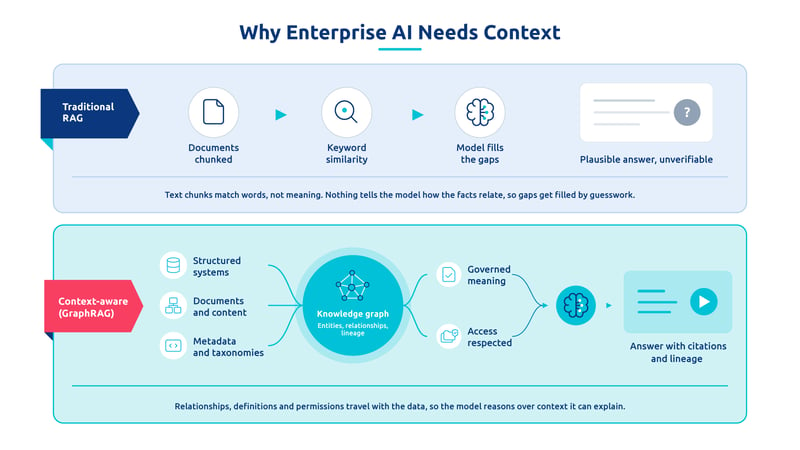
This is where knowledge graphs and GraphRAG add value. By making relationships and semantic connections explicit, they give AI agents richer context to reason over, moving enterprise AI from finding information to understanding how information connects.
Datavid’s recent work exploring GraphRAG for AI-powered products shows how this approach can connect fragmented biobank data into reusable, governed research workflows. Read the article GraphRAG for AI-powered products: lessons from biobank data.
The goal is not to replace RAG, but to extend it with the context required for more informed, business-aware reasoning.
AI-ready data, therefore, needs a semantic foundation around it — one that makes relationships, definitions, rules, and business meaning explicit.
For a deeper look at what makes enterprise data AI-ready, see How to make your enterprise data AI-ready: a practical framework.
The semantic layer: giving enterprise data meaning
This is where the semantic layer becomes a critical part of the enterprise AI architecture.
A semantic layer establishes a shared understanding of the entities, concepts, and relationships that matter to the business. It provides the meaning that allows information from different systems to be understood within a common business context.
Enterprise entities have meaning beyond their individual records.
A customer exists within relationships, transactions, policies, products, and business processes. A product exists within a broader commercial and operational context. A regulation carries obligations that may vary by jurisdiction, entity, and circumstance.
AI needs access to these relationships to reason effectively.
The value of semantic context is that it gives AI a structured understanding of how the business works, rather than requiring the model to infer that understanding from disconnected sources each time it encounters a new question or decision.
The company brain for enterprise AI
The concept of a Company Brain represents the next evolution of the enterprise data foundation.
A Company Brain is not another data repository. It is a connected, governed knowledge foundation that brings together:
Data + Knowledge + Relationships + Business Rules + Context + Governance
and makes that understanding usable across AI-driven workflows.
AI-ready data provides the foundation. The Company Brain connects that data with the knowledge, relationships, rules, context, and governance that make it useful for AI.
Knowledge graphs provide a way to represent entities and their relationships. Ontologies establish shared meaning and definitions. Governed metadata provides provenance, ownership, lineage, and accountability.
Together, these capabilities create the semantic foundation AI agents need to operate with a deeper understanding of the enterprise.
Datavid Rover: the company brain for enterprise AI
This is where Datavid Rover comes in.
Rover is Datavid's implementation accelerator for building a connected enterprise knowledge graph that brings together scattered data, documents, systems, and domain knowledge into a governed, AI-ready context layer.
In other words, Rover turns the Company Brain concept into an enterprise reality.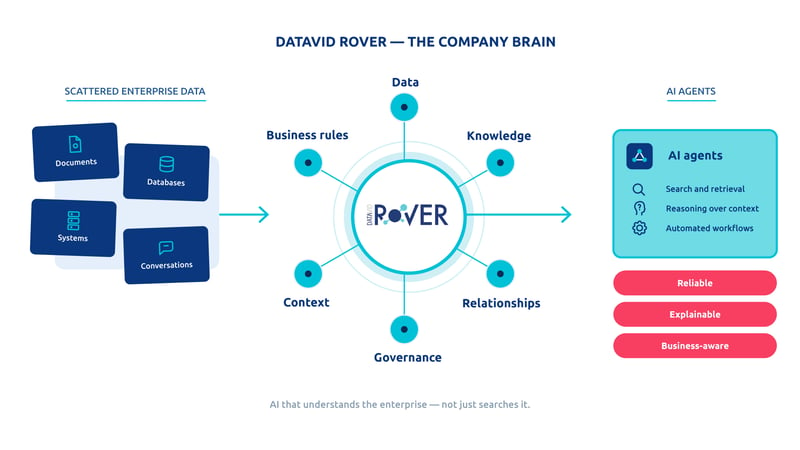
It connects knowledge distributed across an organization, gives it semantic meaning, maps relationships between entities and concepts, and provides the governed context AI agents need to reason over the business.
Rover is not another data silo, and it does not require organizations to replace their existing platforms. It works across existing enterprise sources to create a connected knowledge foundation that can serve as the context layer for AI.
The result is a Company Brain that helps AI understand the enterprise, rather than simply search it.
The goal is not to give agents access to more information. It is to give them access to the right information, in the right context, and governed by the right rules.
Why semantic context matters for AI agents
Consider an AI agent supporting a complex enterprise decision.
A conventional retrieval-based approach may identify relevant documents, retrieve passages, and provide them to a large language model. That can work well when the answer exists directly within the retrieved content.
Enterprise decisions, however, often depend on relationships and rules that span multiple sources.
- What happens when two systems use different definitions for the same entity?
- What if a policy applies only to a particular geography or customer segment?
- What if a regulation has changed? Or what if the agent needs to explain the reasoning behind its recommendation?
These are situations in which semantic context becomes part of the trust architecture.
A connected semantic foundation gives an agent greater visibility into what it is looking at, how information relates, which rules apply, and why a particular conclusion may be appropriate.
That creates four important enterprise benefits.
1. More reliable outcomes
Grounding AI in governed enterprise knowledge can reduce the risk of hallucinations and unsupported conclusions.
Rather than relying entirely on an AI system to infer business meaning from disconnected information, enterprises can provide explicit relationships, definitions, rules, and context.
This creates a stronger basis for AI-generated answers and recommendations.
2. Greater explainability
Enterprise AI increasingly needs to operate in environments where decisions must be understood and defended.
Knowledge graphs, provenance, metadata, and semantic relationships can provide the foundation for tracing an output back to the relevant information and relationships that informed it. Every statement can be traced back to the source data, so a human can verify its correctness.
Explainability, therefore, becomes part of the architecture, rather than something added after deployment.
3. Business-aware decision making
Enterprise decisions rarely depend on a single piece of information. They depend on relationships, policies, exceptions, organizational structures, and domain-specific rules.
Semantic context enables agents to move beyond asking “What information did I find?” toward understanding “What does this information mean in this business context?”
You can make automatic decisions for small-impact tasks with high confidence, or add a human in the loop to review important decisions quickly by presenting all the context.
That distinction becomes critical when AI moves from information retrieval to supporting business decisions and actions.
4. Governed AI at scale
As enterprises deploy more agents across more workflows, governance becomes increasingly important.
Organizations need visibility into the knowledge an agent uses, where that knowledge comes from, how definitions are maintained, who owns them, and how changes are managed.
A governed semantic foundation brings these considerations into the architecture itself, creating a more sustainable path to scaling AI across the enterprise.
As Deloitte notes, governance remains a significant concern as organizations scale AI agents:
“Each worry is a billable workstream, secure tool access, compliance controls, governance frameworks, evaluation & explainability, against only 21% with mature agent governance today.” Deloitte, 2026.
For organizations operating in high-stakes environments, this also means deciding where AI can act independently and where human oversight remains essential. See our guide to AI knowledge management: what to automate vs. keep human.
The enterprise AI advantage is context
The industry has understandably focused on model capabilities, from larger, more capable models to advances in reasoning and inference.
But model performance is only one determinant of enterprise AI outcomes.
A highly capable model working with fragmented, outdated, or poorly understood enterprise information can still produce an unreliable result.
A more useful way to think about enterprise AI is:
Reliable AI = AI-Ready Data + Model Capability + Enterprise Context + Governance
AI-ready data gives AI systems a usable foundation. Model capability provides the intelligence. Enterprise context gives information meaning. Governance provides the trust and accountability required to use AI at scale.
The competitive advantage will increasingly come from how effectively organizations combine these elements — turning AI-ready data into a trusted enterprise context that AI systems and agents can actually use.
A strong semantic foundation gives AI access to the relationships, rules, definitions, and organizational knowledge that give information its meaning.
That is what makes context a strategic asset.
Continuing the conversation
This is the thinking behind Datavid's upcoming conversation at the Progress Data Platform Summit, where Datavid will explore how semantic context can become the trust layer for enterprise AI.
Datavid CEO Balvinder Dang will share this perspective in his session:
“The Trust Layer for Enterprise AI: How Semantic Context Powers Reliable Agents.”
The session will explore how organizations can move from traditional operational data hubs toward a connected semantic foundation that brings together data, knowledge, business rules, and organizational context — giving AI agents the foundation they need to deliver more reliable, explainable, and business-aware outcomes.
Ready to turn your enterprise data into a trusted AI context?