
Bring accuracy, explainability, and trust to enterprise AI
Datavid’s GraphRAG services connect large language models (LLMs) with your enterprise knowledge graph - delivering AI that’s explainable, factual, and grounded in your own data.

Challenges we solve
Our approach
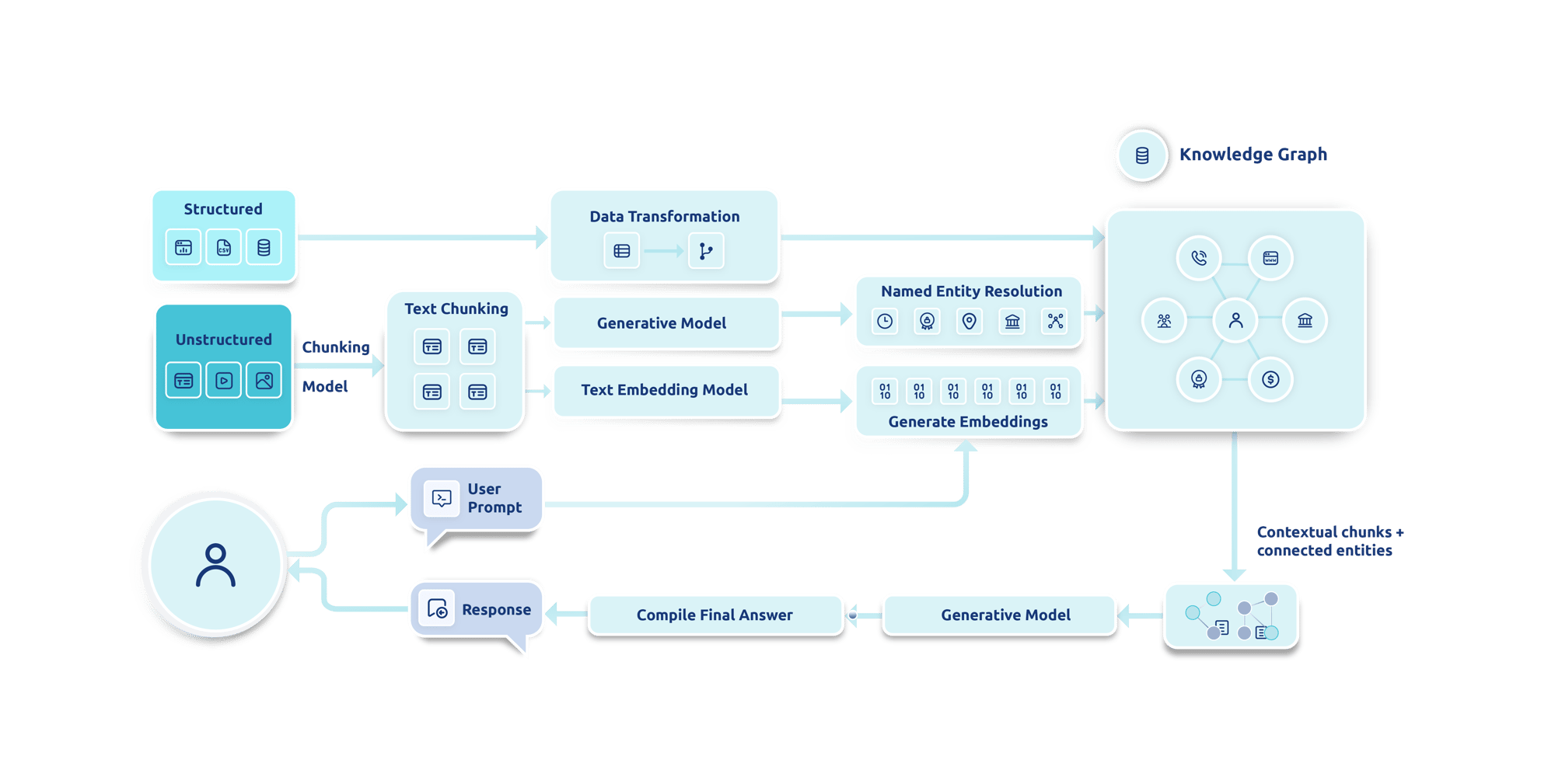
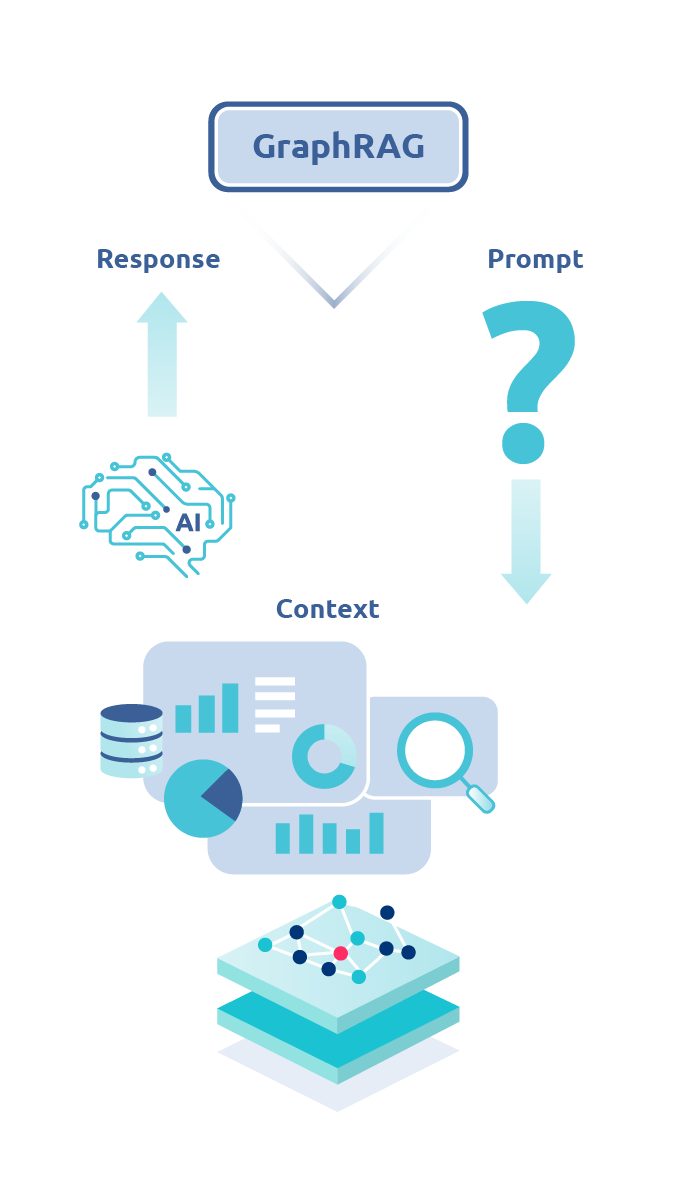
We combine knowledge graphs, vector retrieval, and generative AI into a single, explainable workflow - powered by Datavid Rover.
Our approach ensures that AI doesn’t just generate answers. It shows exactly where those answers came from.
The GraphRAG reference architecture
By linking your knowledge graph to an LLM through Datavid Rover, every model output becomes traceable, contextual, and verifiable - reducing hallucinations while enhancing insight depth.
Ready to build a trustworthy AI foundation?
Explore how GraphRAG powers explainable AI across industries.

Our GraphRAG capabilities

Knowledge & semantic foundation
GraphRAG pipeline engineering
Governance, compliance & explainability
Insights, analytics & agentic workflows
GraphRAG in action
Life Sciences
Agriscience
Publishing
Why Datavid?
Deep expertise
Proven accelerators through Datavid Rover
ISO 27001 & Cyber Essential Plus certified delivery
Seamless integration
Trusted by global leaders
130+ experienced data and AI professionals
How Datavid compares
Feature |
Traditional Service Providers |
Datavid |
|---|---|---|
GraphRAG architecture |
Vector-first RAG with optional graph add-ons |
Native GraphRAG: entity-centric knowledge graph + ontology-driven reasoning + LLM grounding |
Retrieval depth |
Single-hop semantic similarity on document chunks |
Multi-hop graph traversal (entities, relationships, constraints) + supporting evidence |
Explainability & provenance
|
Document-level citations or none |
Claim-level citations, entity lineage, relationship paths, and source documents |
Semantic & ontology engineering |
Minimal metadata tagging or schema-on-read |
First-class capability: domain ontologies, taxonomies, controlled vocabularies, semantic alignment |
Enterprise platform integration |
Partial integration, often requiring data duplication |
In-place integration across Neo4j, MarkLogic, Databricks, Elastic, and cloud LLMs |
FAIR & metadata governance
|
Not explicitly supported |
Designed-in: metadata harmonisation, persistent identifiers, reuse by design |
Access control & auditability |
Application-level controls only |
Federated RBAC, permission-aware retrieval, full audit trails |
Security & compliance delivery |
Security posture varies by project |
Delivered under ISO 27001 & Cyber Essentials Plus |
Agentic workflows |
Experimental agents without validation layers |
Governed agents for reasoning, validation, orchestration, and rejection |
Time to enterprise value |
3–6 month PoCs with limited production readiness |
6–8 weeks using reusable accelerators and reference architectures |
Regulated-industry experience |
General-purpose, consumer-oriented focus |
Proven delivery in Pharma, Life sciences, Standards & Regulated Publishing |
Datavid’s GraphRAG framework turned our generative AI prototypes into an enterprise-grade intelligence layer. Every insight is now sourced, verifiable, and audit ready.
Head of Data Strategy, Global Pharmaceutical Client
Your Questions. Answered.
What is GraphRAG?
GraphRAG (Graph Retrieval-Augmented Generation) connects large language models to a governed knowledge graph, enabling the AI to reason over structured entities, relationships, and metadata—not just raw text.
This results in factual, contextual, and fully traceable answers grounded in your enterprise knowledge.
How is GraphRAG different from traditional RAG?
Traditional RAG uses flat text embeddings, which often leads to hallucinations and shallow context.
GraphRAG enriches retrieval with semantic structure, ontologies, and graph context, allowing the model to understand domain concepts and provide explainable, evidence-backed answers.
Datavid specializes in building the semantic foundation that makes this possible.
Can GraphRAG integrate with our existing data and content platforms?
Yes. GraphRAG is designed to integrate in-place with existing enterprise data and content platforms, without requiring rip-and-replace migrations.
We routinely integrate GraphRAG with platforms such as MarkLogic, Neo4j, GraphDB, Neptune, Databricks, and Elastic, as well as all leading cloud LLM providers.
Datavid Rover acts as the semantic and governance layer, providing reusable ingestion, entity enrichment, ontology alignment, and access-controlled retrieval. GraphRAG queries are grounded using subgraphs, metadata, and source documents drawn directly from your existing systems, ensuring answers are explainable, permission-aware, and auditable.
This approach accelerates GraphRAG deployment while preserving your current data architecture and governance investments.
Integration supports hybrid retrieval (graph + vector + keyword), RBAC enforcement at query time, and source-level citation for every generated response.
Is GraphRAG suitable for regulated and high-compliance environments?
Absolutely.
Datavid designs GraphRAG architectures with auditability, data lineage, access control, and FAIR principles built in.
Our delivery is ISO 27001 and Cyber Essentials Plus certified, and we have a proven track record with life sciences, standards organizations, government, and scientific publishing.
How long does a GraphRAG project take with Datavid?
Most enterprises see a working, explainable GraphRAG pipeline in 6–8 weeks, thanks to reusable semantic accelerators and lean, senior-led delivery teams.
Our pilots are structured to deliver business value early while ensuring long-term scalability.
Do we need a knowledge graph before starting?
Not necessarily.
Datavid can help you design or modernize your ontology and knowledge graph or enrich your existing content into a semantic layer as part of the GraphRAG engagement.