
9 minute read
Quick answer: Knowledge management is the systematic practice of capturing, organizing, sharing and applying what an organization knows so people can act on it. In 2026, it has become the foundation whether enterprise AI produces grounded, usable answers or creates additional verification work. The work is no longer about storing documents. It is about connecting knowledge so humans and AI can use it together.
For chief data officers (CDOs), the stakes around knowledge management have shifted sharply over the past two years. Generative AI made knowledge retrieval appear easier, but it also exposed gaps in the quality, context, and governance of enterprise knowledge.
This guide covers the types of knowledge inside your organization, the process for managing them, the systems that hold them together, and where the field is heading next.
At a glance
- Organizations create value through the knowledge of their people - not just the data in their systems.
- Modern knowledge management captures, connects, and preserves human expertise so it can be trusted, reused, and shared.
- AI is only as reliable as the knowledge and context people provide, govern, and validate.
- Knowledge graphs and semantic layers help connect expertise, data, and business context without losing provenance.
- The strongest knowledge management programs empower people to make faster, better-informed decisions while giving AI trusted knowledge to work with.
What is knowledge management?
At its core, knowledge management gives an organization a practical way to turn what people know into knowledge others can find, trust, and use.
For a CDO running a regulated enterprise, knowledge management is what turns scattered expertise and millions of documents into a working capability that supports research, compliance and decision-making at speed.
It is worth distinguishing knowledge management from the practices it gets confused with. Information management deals with documents and how they are stored. Data management deals with records, tables and pipelines. Knowledge management sits above both, focused on meaning and context.
Knowledge graphs are not knowledge management themselves; they are the connective tissue that increasingly powers it.
Three components determine whether a knowledge management program actually works:
- People matter first, because knowledge only has value when humans contribute it and apply it.
- Process matters second, because knowledge has to move through the organization without friction.
- The connected layer matters third, because in any enterprise with multiple systems, isolated knowledge is invisible knowledge.
That third component is where most data leaders are now investing, and it is where the gap between mature and immature programs is widest.
The connected layer is not something that exists by default in most enterprises. It has to be modeled, governed and built against a specific business domain, which is why it tends to take dedicated semantic and data engineering work rather than arriving with a platform purchase.
The types of knowledge inside your organization
Before designing a knowledge management program, a CDO has to know what kind of knowledge is in play. Inside any enterprise, knowledge exists in three forms, each with its own capture challenges.
Most knowledge management platforms only handle one of them well, which is why the other two so often slip away unnoticed. When data silos break knowledge into disconnected pockets, even well-funded programs end up rebuilding the same insights again and again.
Tacit knowledge
Tacit knowledge is the expertise, intuition and professional judgment that people carry in their heads. A clinical research lead who can tell at a glance which protocol variants tend to fail audits is using tacit knowledge.
It is the hardest type to capture, the most valuable to retain and the most likely to walk out the door when senior staff retire. Capturing it usually takes structured interviews, expert observation or guided documentation work, supported by tools that can extract patterns from the artifacts these experts already produce.
Implicit knowledge
Implicit knowledge sits between tacit and explicit. It could be documented, but no one has done the work yet. A Slack thread where a compliance officer explains a regulatory edge case to a junior analyst is implicit knowledge.
It lives in chat logs, email threads and informal workflows that newer employees never see. Turning it into formal knowledge is one of the higher-return activities for any KM program, because it captures hard-won lessons before they fade.
Explicit knowledge
Explicit knowledge is codified and shareable: reports, standard operating procedures, manuals, ontologies and regulatory submissions. This is what most knowledge management systems were built to handle.
The central job of any KM program is converting tacit and implicit knowledge into explicit knowledge that can be searched, governed and reused. In regulated industries, that conversion also has to preserve provenance so every answer can be traced back to its source, which is why data lineage and audit trails sit at the center of enterprise-grade KM design.
The knowledge management process
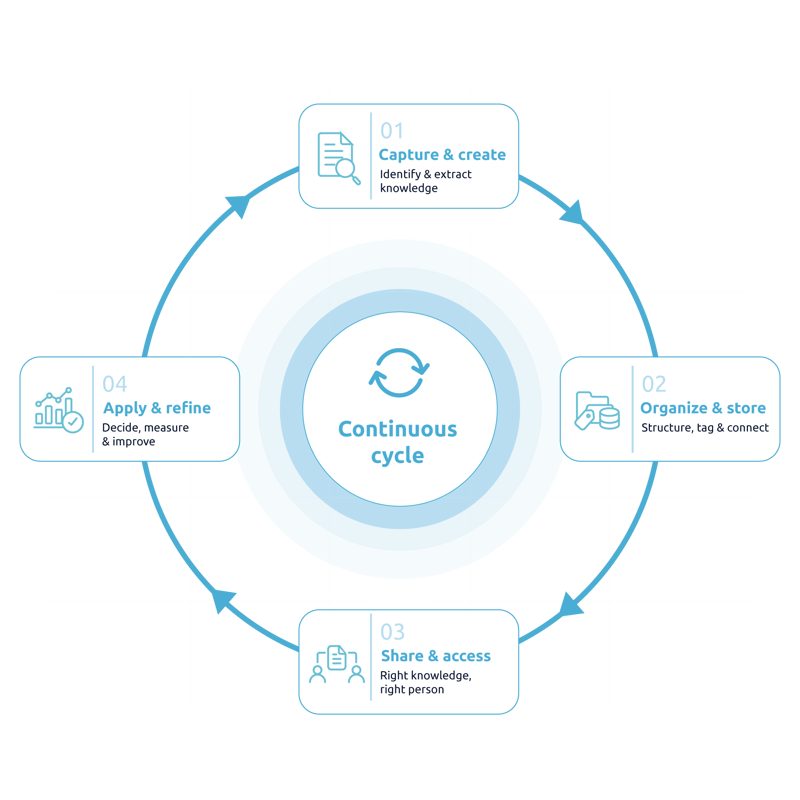
A working knowledge management process needs more than a content library and good intentions. For data leaders, the most useful way to think about KM is as a four-step cycle.
Each step has a concrete deliverable that can be planned, staffed and measured against business outcomes. Under-investing in any one step breaks the whole cycle and stalls the return on investment.
 Capture and creation
The first step is identifying what knowledge exists, who holds it and which knowledge is at the highest risk of being lost.
This often involves structured interviews with senior experts, documentation sprints and automated extraction from existing systems, supported by strong data integration capabilities that can pull knowledge out of fragmented source systems without losing context.
Organization and storage
Once knowledge is captured, it has to be structured so it can be found later. This means ontologies, taxonomies, metadata schemes and consistent identifiers.
This is where most knowledge management programs underinvest, and where strong ontology management tends to make the biggest difference in the long run.
Without this layer, search returns documents but cannot connect concepts, which is the difference between a KM program that scales and one that quietly stalls.
Sharing and access
The right knowledge has to reach the right person at the right time, with the right permissions attached. Sharing covers traditional intranets and document repositories, but increasingly it includes AI-assisted retrieval through GraphRAG services and similar approaches.
The harder challenge for data leaders is access governance, making sure regulated content is only visible to people and systems that are authorized to see it.
Application and refinement
The fourth step closes the loop. People use the knowledge to make decisions, and the system learns from what they use, ignore or correct. Without this feedback step, KM platforms become content graveyards.
The CDOs who measure knowledge management by decision velocity and answer accuracy tend to get this step right more often than those who measure article counts. The work also requires built-in observability across the data foundation, which is rarely a feature of generic content platforms.
Knowledge management systems and tools
Most CDOs do not buy knowledge management as a single product. They build it from three layers of tooling: a storage layer that holds documents and records, a search layer that retrieves them, and a connected layer that ties everything together. Knowing what each layer does well, and where it falls short, is what keeps a buying decision focused on the right problem.
|
Layer |
What it does |
Common tools |
Where it falls short |
|
Storage |
Holds documents and records with version control |
Confluence, SharePoint, MarkLogic, Bloomfire |
Each document remains an island; no concept-level connection |
|
Search |
Retrieves stored knowledge for users and agents |
Keyword search, vector search, RAG |
Struggles with multi-hop questions and regulated provenance |
|
Connected |
Links entities, relationships and provenance across systems |
Knowledge graphs, semantic layers, GraphRAG |
Higher upfront investment in ontology and modeling |
Knowledge management strategy for the AI era
In 2026, the strategic conversation around knowledge management has changed shape. Generative AI made knowledge retrieval feel solved overnight, and then exposed how unprepared most enterprises were for AI to be asking questions of their data.
For CDOs, the lesson has been that strong KM is no longer optional. It is the foundation that determines whether AI initiatives produce reliable answers or expensive hallucinations.
Three principles for modern KM strategy
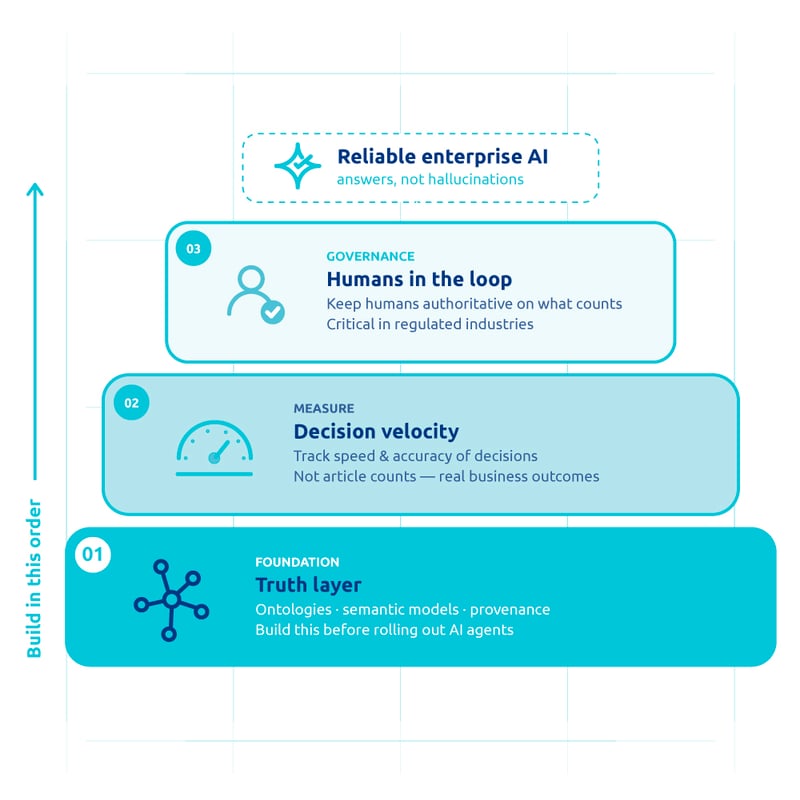
Three principles define modern KM strategy. The first is to build the truth layer before the agent layer, meaning investment in ontologies, semantic models and provenance before rolling out AI agents that depend on them.
This is the same logic that sits behind the semantic layer for AI readiness and behind the broader case for FAIR data principles in responsible AI.
The second is to measure KM by decision velocity and answer accuracy, not by how many articles sit in the knowledge base. The third is to keep humans in the loop on what counts as authoritative knowledge, especially in regulated industries where a wrong answer carries real cost.
Governance, provenance and human oversight
Strategy at this scale also has to be paired with serious data governance. Without governed inputs, the connected layer inherits whatever inconsistencies and gaps already live in the source systems, and the AI built on top of it does the same.
The practitioner community has been ahead of vendors on this shift, with Knowledge Summit Dublin's 2026 theme of Humans in the Loop capturing the change cleanly.
A common view among experienced practitioners is straightforward: explainable, ontology-backed knowledge is what makes enterprise AI usable, and any KM investment that skips the foundation layer risks producing a content store rather than a working knowledge platform.
Enterprise knowledge management examples
Generic knowledge management examples like onboarding and customer support miss what makes enterprise KM hard. The work looks different in each regulated industry because the knowledge looks different.
Below are three settings where enterprise data management programs grounded in real domain language have delivered the clearest return on investment for connected KM.
Life sciences and pharma R&D
Life sciences organizations sit on research notes, clinical trial data, regulatory submissions and decades of compound data scattered across systems. The knowledge is high-value but locked in formats and languages that traditional KM platforms cannot connect.
Strong KM produces faster trial design, audit-ready evidence for regulators and shorter cycles from research to submission. Datavid's work with Syngenta cut research time from weeks to hours across 16 million files of accumulated knowledge, by combining ontologies, semantic indexing and connected retrieval into a single platform.
The same approach extends to policy and regulatory knowledge, where the cost of a wrong interpretation can be a failed audit. Datavid's policy assistance work with Roche gave compliance teams a knowledge-graph-backed way to query policy obligations across jurisdictions, with provenance attached to every answer that comes back.
Banking and regulated finance
In banking, the knowledge is policy documents, compliance interpretations, transaction patterns and risk models that change frequently. New analysts onboarded onto a complex desk can take months to absorb it.
Connected KM gives compliance teams consistent regulatory responses, reduces investigation effort during AML reviews and shortens audit cycles.
Datavid's regulatory trade data hub work with ABN AMRO is one example of how knowledge graphs and provenance change what a bank can answer about its own activity, and how quickly it can answer when regulators ask.
Scientific publishing and standards bodies
Publishers and standards bodies hold editorial archives, peer-review correspondence, taxonomies and authority files that need to be searchable for authors, researchers and AI agents alike. The knowledge is dense, technical and often historical.
Strong KM turns these archives into queryable knowledge platforms that support both human and machine consumers. Datavid's work with the American Chemical Society on its content lake gave ACS a single authoritative repository for content spanning generations of production processes and editorial systems.
In the standards space, Datavid's BSI Compliance Navigator engagement shows how the same KM patterns apply when the knowledge being managed is the standards themselves, indexed and surfaced through search experiences that compliance teams actually use.
Where knowledge management is heading
Three observations about where knowledge management is going matter for any CDO planning the next two years.
KM and AI infrastructure are converging
The first is that the line between knowledge management and AI infrastructure is dissolving. GraphRAG, semantic layers and KM platforms are converging into the same stack, which is the broader story behind knowledge graphs and AI integration.
A decision about a KM platform in 2026 is also a decision about what AI agents will be able to do on top of it.
Provenance and explainability are becoming non-negotiable
The second is that provenance and explainability are becoming non-negotiable, especially in regulated industries. A KM platform that cannot show where an answer came from is a liability when auditors arrive.
That is why traceability now sits at the center of modern KM design rather than at the edges. The teams winning this kind of work tend to be the ones with deep multi-model and semantic experience rather than generic systems integrators.
Practitioner-led communities are shaping the field
The third is that the real working models for knowledge management are coming from practitioner-led communities rather than vendor roadmaps. Knowledge Summit Dublin, knowledge graph user groups and ontology working groups are where the field is being shaped this year.
Knowledge management is still a people discipline
One thing is not changing. Knowledge management is still a people discipline first. Tools amplify what good practitioners build, they do not replace the work.
Building knowledge that works for your people
Strong knowledge management is what makes enterprise AI worth deploying, not the other way around.
For data leaders, the right move in 2026 is to invest in the connected layer that turns documents into knowledge, to govern the inputs that feed it and to keep humans firmly in the loop on what counts as authoritative. The data foundation has to come first; the agents come second.
That foundation rarely comes from a single platform purchase. It takes semantic modeling, data engineering and ontology design working together, with the kind of regulated-industry experience that lets a connected layer be built alongside the team that will use it.
Datavid helps organizations connect fragmented knowledge through semantic modelling, data engineering, knowledge graphs, and governed AI retrieval. The starting point is understanding where knowledge is being lost, duplicated, or made difficult to use.
Assess your enterprise knowledge management maturity and identify a focused first use case!

%20Why%20AI%20agents%20dont%20just%20need%20data.png)
