
11 minute read
Quick answer: A semantic layer is an abstraction that sits between your raw data sources and the tools that consume them (dashboards, analytics platforms, AI systems), translating technical data structures into shared business concepts, governed definitions, and traceable relationships. It helps every team, tool, and AI agent in your organization work from the same governed definitions.
For CDOs managing data across multiple business units, platforms, and regulatory requirements, the semantic layer solves a problem you already know well: different teams define the same metric differently, AI systems produce outputs no one can explain, and regulatory audits expose inconsistencies that erode trust.
A semantic layer makes meaning explicit, governed, and reusable, so your data infrastructure delivers consistent results regardless of who or what is querying it.
For Datavid, the semantic layer is not just a BI abstraction. It is a governed, graph-based meaning layer that connects data, documents, metadata, business rules, and domain knowledge across systems.
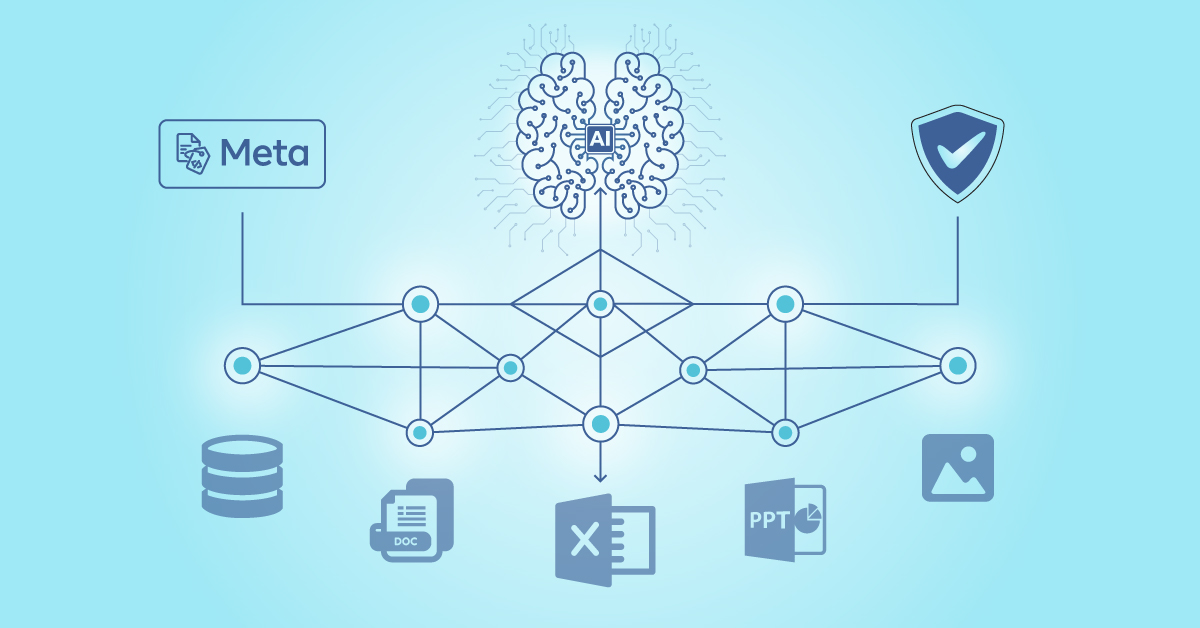
That distinction is important. A BI semantic model defines metrics for a single reporting tool. A graph-based meaning layer defines concepts, relationships, and governance rules that serve your entire data ecosystem, from dashboards and analytics through semantic search, GraphRAG, and autonomous AI agents.
When implemented with knowledge graphs and ontologies, this meaning layer becomes a reusable foundation that persists across tool changes and scales across business domains.
At a glance
- A semantic layer translates raw data structures into business-aligned concepts and governed definitions. In practical terms: it is the layer that gives your data consistent, shared meaning.
- Enterprise semantic layers differ from BI semantic layers in scope, governance, and durability. While BI models serve a single tool, an enterprise semantic layer serves your entire data ecosystem, including AI, governance, and cross-domain analytics.
- For CDOs, a semantic layer directly reduces the time teams spend reconciling conflicting metrics, lowers compliance risk by making data lineage traceable, and makes AI outputs explainable.
- Regulated industries (life sciences, financial services, publishing) see the strongest returns because consistent definitions and traceable relationships are regulatory requirements, not optional improvements.
- Datavid designs semantic layers grounded in knowledge graphs and ontologies, giving organizations a durable, tool-agnostic foundation that extends from analytics into AI search and agentic workflows.
What is a semantic layer in data architecture
In every enterprise data stack, there is a gap between how data is stored and how the business thinks about it. A database column labeled cust_id means nothing to a product manager.
A SQL calculation buried in a reporting script does not help a compliance officer trace how "Net Revenue" was defined. A semantic layer in data architecture closes that gap by providing a shared, governed translation between technical data structures and business concepts.
The semantic layer sits between raw data sources (data warehouses, lakes, APIs, document stores) and the tools that consume data (BI dashboards, analytics platforms, AI search systems, LLMs). It defines what terms like "Customer," "Active Subscription," or "Qualified Lead" mean across your organization, standardizes how metrics are calculated, and attaches governance rules (ownership, access controls, lineage) directly to those definitions.
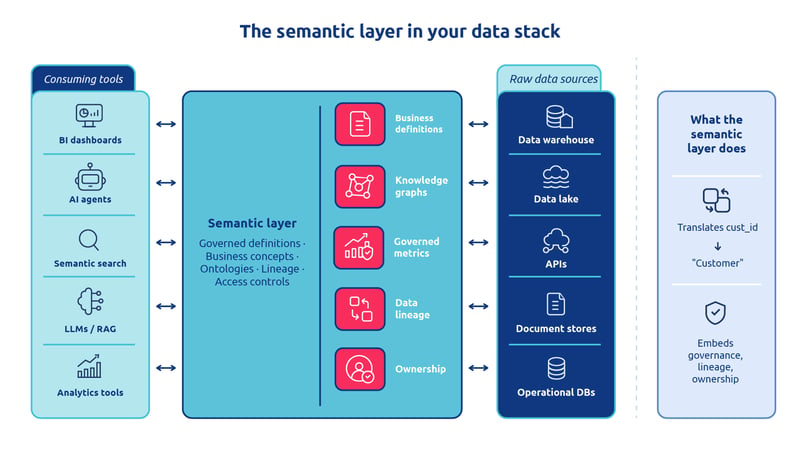
Without a semantic layer, the symptoms are familiar to any CDO: metrics defined differently in different reports, business users who do not trust analytics outputs, regulatory reporting that requires manual reconciliation, and AI systems that produce results no one can trace back to source data. These are not minor inconveniences.
They cost your organization time on every reporting cycle, create compliance exposure during audits, and undermine confidence in AI initiatives that leadership is counting on.
A well-designed semantic layer helps reduce these problems by making meaning a managed asset rather than something embedded in individual tools and scripts.
Enterprise semantic layer vs. BI semantic layer
Most data leaders first encounter the concept of a semantic layer through BI tools like Power BI, Tableau, or Looker. These platforms include built-in semantic models that define metrics, dimensions, and relationships for reporting. They are useful within their scope, but that scope is limited.
The distinction matters because CDOs who treat a BI semantic model as sufficient will run into the same inconsistency problems the moment data needs to flow across tools, teams, or AI systems. A BI semantic model was designed to serve a single reporting tool.
It was not designed to ground AI agents in governed domain knowledge, support cross-system lineage for regulatory audits, or provide the structured relationships that GraphRAG needs to retrieve accurate, explainable results.
Treating a BI modelling layer as your enterprise semantic layer is one of the most common mistakes organizations make when preparing for AI, because it leaves every system outside that BI tool without governed meaning.
|
Dimension |
BI semantic layer |
Enterprise semantic layer |
|
Scope |
Single reporting tool |
Entire data ecosystem (analytics, governance, AI, search) |
|
Technology |
Proprietary, vendor-locked |
Open standards (ontologies, knowledge graphs, taxonomies) |
|
Governance |
Managed by individual teams |
Governed collaboratively with clear ownership and lifecycle management |
|
Longevity |
Changes when tools change |
Persists as a stable foundation even as technologies evolve |
|
AI readiness |
Limited to dashboard queries |
Supports AI search, LLMs, agentic workflows, and GraphRAG |
An enterprise semantic layer built on open standards like ontologies and knowledge graphs is more durable and flexible than any vendor-locked BI model. It serves analytics, governance, AI, and search from a single governed foundation.
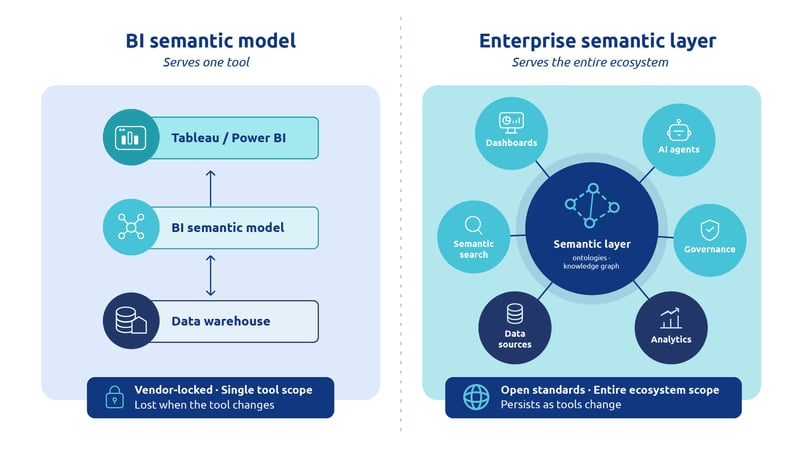
This is the approach Datavid takes: building semantic layers as graph-based meaning layers on ontology-driven structures and knowledge graphs that persist across tool changes and scale across business domains.
The result is a governed foundation that supports not just dashboards, but semantic search, explainable AI, autonomous agents, and regulatory traceability from a single source of defined meaning.
Why semantic layers matter for AI and analytics
The surge in enterprise interest around semantic layers is driven by AI. As organizations move from experimental LLM projects to production AI systems, the need for consistent, governed context becomes impossible to ignore. For CDOs, a semantic layer is the infrastructure that determines whether your AI investments produce trustworthy results or expensive noise.
Grounding AI in governed definitions
AI systems, including LLMs, generate outputs based on the context they receive. When that context is inconsistent (different definitions of "customer" across systems, conflicting metric calculations, ungoverned relationships between entities), AI outputs become unreliable and unexplainable.
A semantic layer addresses this by grounding AI in governed definitions and verified relationships. Every concept the AI reasons over comes from a single, governed source. This reduces hallucination risk and gives your compliance teams a traceable path from AI output back to source data.
This is where the difference between a BI semantic model and a graph-based meaning layer becomes most visible. A BI model can define "revenue" for a dashboard.
A graph-based meaning layer can define "revenue," connect it to the products, customers, regulatory classifications, and business rules that give it meaning, and make those connections available to every AI agent, search system, and analytics tool in your organization. That is the level of governed context production AI systems require.
Semantic layers for enterprise AI search
Semantic layers enable enterprise search systems to return results based on meaning and relationships, not just keyword matching. When a researcher asks for "all clinical trials related to Compound X in Phase II," a semantic layer connects those concepts through an ontology rather than relying on exact text matches across siloed documents.
As AI agents become more autonomous in enterprise environments, this shared semantic foundation becomes the guardrail that keeps them aligned with your domain knowledge and governance policies.
Datavid's AI services are designed around this principle: connecting LLMs and AI agents to structured knowledge graphs so that every AI-powered search result or recommendation is grounded in governed enterprise data.
Consistent analytics across tools and teams
Even outside of AI, a semantic layer ensures that every analytics tool and every team produces comparable results. Whether a data analyst builds a dashboard in Tableau, a data scientist runs a query in Python, or an AI agent answers a natural language question, the same definitions and access controls apply.
For CDOs managing analytics across multiple business units, this consistency eliminates the reconciliation work that currently absorbs significant analyst hours every reporting cycle.
Semantic layer benefits for regulated industries
The value of a semantic layer scales with the complexity and regulatory pressure your organization faces. Industries where Datavid has the deepest experience (life sciences, financial services, publishing) are also the industries where inconsistent definitions and untraceable data carry the highest cost.
Life sciences
Pharmaceutical and biotech organizations manage research data, clinical trial records, regulatory submissions, and post-market surveillance information across dozens of systems.
A semantic layer unifies these data sources under shared concepts (compounds, indications, patient populations, regulatory endpoints), making it possible to trace a single data point from a clinical trial through a regulatory submission and into safety monitoring.
Datavid's biobank metadata knowledge graph work shows how ontology-driven foundations can help standardize complex research workflows and support more consistent AI-assisted analysis across fragmented environments.
For CDOs in life sciences, this traceability is not optional. Regulatory bodies expect it, and the cost of demonstrating it manually grows with every new submission.
Organizations building toward AI-ready data foundations in life sciences gain the most from semantic layers because the same governed definitions that satisfy regulators also power AI-driven research tools.
Financial services
Banks and financial institutions deal with overlapping definitions of customers, products, risk metrics, and transactions across trading, compliance, and reporting systems. A semantic layer provides consistent definitions that reduce the reconciliation effort required for regulatory reporting and improve confidence in the numbers that reach the regulator's desk.
Datavid's work on a regulatory trade data hub shows how semantic enrichment, traceability, and audit-ready architecture can support complex compliance reporting in financial services.
It also supports AI-driven compliance monitoring by giving fraud detection and risk models governed context to reason over, which is increasingly important as regulators expect explainable AI in financial decision-making.
Publishing
Publishers and standards organizations manage large content archives where relationships between topics, authors, citations, rights, and taxonomies carry significant business value. A semantic layer enriches these archives with structured metadata and linked relationships, enabling smarter content discovery, automated rights management, and connected catalog experiences.
Datavid's work with CAS shows how connected scientific content and structured data foundations can support faster product development and richer discovery experiences.
For CDOs at publishing organizations, this translates to faster time-to-market for new content products and reduced manual effort in managing content relationships at scale.
In all three industries, treating meaning as managed infrastructure rather than something embedded in individual tools reduces compliance risk, accelerates time to insight, and creates a foundation that supports both human analytics and AI applications.
How to build an enterprise semantic layer
Building an enterprise semantic layer works best as an incremental capability rather than a single, organization-wide project. CDOs who approach it domain by domain see measurable value faster and reduce implementation risk. Here is a practical path forward.
1. Start with high-value business domains
Pick a domain where inconsistent definitions are already causing visible pain: conflicting revenue metrics, audit preparation that takes weeks, or an AI pilot that cannot produce explainable results. Starting here gives you a clear before-and-after that justifies expanding to other domains.
2. Define core concepts with business and technical stakeholders
The semantic layer works because it bridges the gap between how the business thinks and how data is structured. That bridge requires both sides at the table. Involve business SMEs, data engineers, and data governance leads to define the core concepts, relationships, and metrics that matter most.
3. Establish governance and stewardship roles
Definitions without ownership drift over time. Assign stewards responsible for maintaining and evolving the semantic layer as business requirements change. This is especially important in regulated industries where definitions have compliance implications.
4. Integrate with existing metadata and governance tools
A semantic layer does not replace your data catalog, governance platform, or data warehouse. It sits alongside them, enriching existing metadata with business meaning and ontology-driven relationships. Organizations on platforms like Databricks, Snowflake, or Microsoft Fabric can layer semantics on top of their current infrastructure.
5. Iterate and scale
Prove value in one domain, then expand. Each new domain builds on the ontologies and patterns established in previous ones, which is why the second domain is faster than the first and the tenth is faster still.
Organizations working with complex data across regulated industries often benefit from experienced partners who can accelerate ontology design and knowledge graph implementation. Datavid's approach is designed around this incremental model: start with a pilot, demonstrate measurable impact, then scale with confidence.
Semantic layer vs knowledge graph
These two concepts are closely related, and the terms are sometimes used interchangeably, but they serve different purposes in your data architecture.
Semantic layer
A semantic layer is the broader abstraction. It defines what your business terms mean, how metrics are calculated, who owns each definition, and what governance rules apply. It is the shared language your entire organization uses to talk about data consistently.
Knowledge graph
A knowledge graph is one of the most effective ways to implement that semantic layer. It represents entities (customers, compounds, transactions, documents) and the relationships between them in a connected, machine-readable structure.
That structure is what allows AI systems to reason across domains, trace lineage through connected data, and retrieve context that vector search alone would miss.
The real difference
The practical difference comes down to this: you can build a basic semantic layer using a BI tool's metric definitions and a data catalog. But if your organization needs AI search, GraphRAG, cross-domain reasoning, or regulatory traceability, a knowledge graph gives the semantic layer the connective structure it needs to support those use cases.
For regulated industries, where traceability and explainability are requirements rather than preferences, knowledge graphs are the implementation that makes a semantic layer production-ready for AI.
Datavid's approach combines both: defining the semantic layer through ontology management and domain modelling, then implementing it as a knowledge graph that serves analytics, search, AI agents, and governance from a single governed source. You can read more about how these foundations connect in our semantic layer whitepaper.
Semantic layer readiness checklist
Before you invest in building a semantic layer, it helps to understand where your organization stands. This checklist covers the areas that most directly affect whether a semantic layer will deliver value quickly or stall in implementation.
- Data definitions and consistency: Do your teams use the same definitions for key business terms (revenue, customer, product, risk) across departments and tools? If the same metric produces different numbers depending on who runs the report, a semantic layer addresses that gap directly.
- Metadata and cataloging: Is your metadata structured and accessible, or scattered across spreadsheets, wikis, and tribal knowledge? A semantic layer builds on top of your metadata. The more organized your starting point, the faster you see results.
- Governance and ownership: Are there clear owners for your most important data assets? Definitions without stewardship drift over time. If data governance roles and processes are not yet established, plan to put them in place alongside your semantic layer.
- AI readiness: Are you planning or already running AI initiatives (search, copilots, agents, RAG)? If so, those AI systems need governed context to produce trustworthy outputs. A semantic layer is what provides that context. Organizations that have already assessed their AI-ready data foundations will have a clearer picture of where semantic gaps exist.
- Cross-system data flows: Does your data need to move across multiple platforms (data warehouses, document stores, APIs, BI tools, AI systems)? The more systems that consume your data, the greater the benefit of a shared meaning layer that keeps every consumer aligned.
If you answered "no" to more than two of these, a semantic layer will likely address pain you are already feeling. The key is to start with the domain where the gap is most visible and work outward from there. Datavid's semantic AI readiness approach is built around this incremental model.
Build a semantic foundation for enterprise AI search
A semantic layer built on ontologies and knowledge graphs gives your organization a shared language for data that supports trusted analytics, governance, and AI-powered search. For CDOs, it is the infrastructure investment that ties together every other initiative on your data strategy roadmap, from regulatory compliance to AI-driven decision-making.