
10 minute read
Quick answer:
AI-ready data is data prepared for a defined AI use case, with the required quality, governance, context, accessibility, and traceability. For knowledge-intensive enterprise AI, this often includes semantic enrichment across structured and unstructured sources.
For chief data officers (CDOs), the gap between AI ambition and data reality has become the defining challenge of 2026. The path forward exists, but it runs through the data foundation rather than the model layer.
AI-ready data is enterprise data prepared for use by AI systems, which means unified, governed, semantically structured and traceable. This guide gives data leaders a practical six-stage approach to AI data readiness, designed for both structured and unstructured sources, and grounded in what actually works inside regulated industries.
At a glance
- AI-ready data is enterprise data that AI systems can use to produce reliable, explainable outputs at scale.
- Achieving AI data readiness takes more than a clean warehouse; it takes a semantic foundation that connects structured and unstructured sources.
- The six-stage approach moves from assessment through unification, governance, enrichment, operationalization and ongoing monitoring.
- Stages 2 and 4 (semantic unification and enrichment) are where most enterprise programs underinvest.
- AI-ready data infrastructure must capture provenance and lineage so every AI output can be traced back to source data.
- A reusable semantic foundation compounds returns across every new AI use case, instead of being rebuilt for each one.
What makes data AI-ready
AI-ready data is enterprise data prepared to power AI workloads with reliability, traceability and meaning intact. It goes well beyond clean and accessible. Five characteristics define it in practice:
- Unified across structured and unstructured sources, with a single connected view of business meaning
- Governed with role-based access, lineage tracking and audit-ready policies
- Semantically structured so AI systems can reason over meaning rather than match text
- Enriched with metadata, taxonomies, relationships and annotations that make context machine-readable
- Traceable where source data, transformations, retrieval context, and ownership can be inspected and audited.
AI-readiness is also use-case dependent. Training data for predictive models needs different preparation than retrieval context for LLMs. A pricing model needs feature-engineered tabular data, while a regulatory copilot needs entity-linked policy documents with lineage attached.
Both demand more than a traditional analytics data warehouse provides. A clean dimension table feeds a dashboard well. It does not give a generative model the meaning, relationships and provenance needed to produce trustworthy answers.
The 6-stage framework for AI-ready data
The six-stage approach below is sequenced but flexible. Most enterprises run several stages in parallel after the initial assessment, with the unstructured side of the work usually requiring more effort in stages 2 and 4.
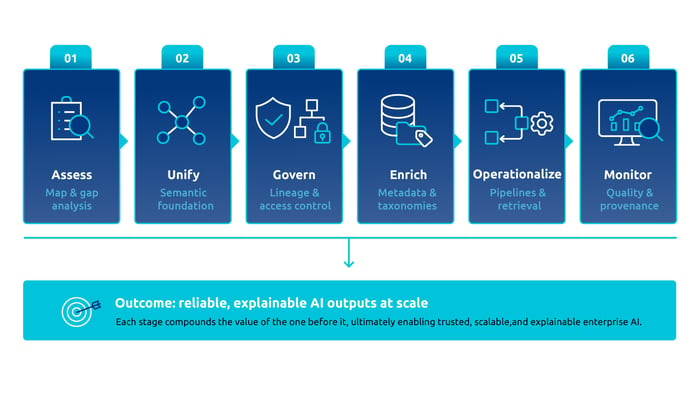
Each stage produces a specific capability that compounds the value of the stages before it, and applies to both structured and unstructured data.
|
Stage |
What it does |
Capability delivered |
|
1. Assess |
Map data sources against target AI use cases |
Gap analysis and scoped readiness plan |
|
2. Unify |
Connect data through a semantic foundation |
Connected view of business meaning |
|
3. Govern |
Apply access control, lineage and policy alignment |
Audit-ready, defensible AI outputs |
|
4. Enrich |
Add metadata, taxonomies, relationships and annotations |
Machine-readable domain knowledge |
|
5. Operationalize |
Build pipelines and retrieval architectures |
Production-ready AI workloads |
|
6. Monitor |
Track quality, provenance and downstream AI output |
Compound returns across new use cases |
Stage 1: Assess your current data landscape
Assessment sets the baseline. Without it, every downstream stage is guesswork, and budget conversations with the CFO get harder by the week. For CDOs scoping an AI data readiness program, this stage produces one deliverable: a gap analysis that maps current data sources to the AI use cases the business actually wants to support.
Cataloging has to cover both sides of the data estate. Structured sources include databases, data warehouses, CRMs and operational systems. Unstructured sources include everything from PDFs and contracts to research notes, internal wikis and chat logs. Most enterprises lose value on the unstructured side, where the majority of operational knowledge tends to sit.
The defining question for this stage: what AI use cases are you preparing for, and what data does each one actually need? A clinical research assistant has different requirements than a regulatory copilot. A pricing model needs different inputs than a customer-service agent.
Datavid’s work with Smith + Nephew shows how reviewing an existing platform against the intended analytical use case can reveal where architecture, processing, and technology choices need to change before the solution can scale.
Stage 2: Unify data with a semantic foundation
Traditional data integration brings sources into one place. A data lake holds your PDFs alongside your tables. A data warehouse harmonizes operational records. Useful work, but not enough on its own.
Once the data sits together, the relationships between concepts still remain implicit. A drug name in a clinical document still has no defined relationship to the same drug name in a regulatory filing. A customer in a CRM still has no formal link to the same customer in a master agreement.
That is the gap a semantic foundation closes. A semantic layer plus a knowledge graphs approach turns fragmented enterprise data into a connected view of business meaning. Entities become nodes. Relationships become edges. Both human users and AI systems can then query meaning rather than text alone.
For LLM-based AI, this matters more than it does for traditional analytics. Retrieval-augmented generation works well only when the retrieval step returns context the model can actually reason over. Vector search alone surfaces similar text.
A knowledge graph surfaces connected concepts, with their relationships and provenance attached. The same logic applies to predictive models that depend on multi-source feature engineering.
Datavid's work with Syngenta on the Synapse platform shows what this looks like at scale. The team unified 16 million files across decades of agrochemical research through ontology-driven indexing, helping researchers retrieve relevant information in minutes rather than weeks. The same pattern of harmonizing structured systems and unstructured archives through a meaning layer recurs across regulated industries.
Unification does not necessarily require physically centralising every source. It can also mean creating a governed, connected layer across existing systems. For more background, see our piece on semantic layer for AI readiness.
Stage 3: Govern, secure, and document lineage
Governance, security, and ownership run across all six stages. Stage 3 formalizes those controls, but governance requirements should be identified during assessment and applied throughout unification, enrichment, operationalization, and monitoring.
Strong data governance at this stage is what makes AI outputs defensible when auditors arrive. The work breaks down into three operational areas: access control, lineage tracking and policy alignment. Datavid’s work extending ABN AMRO’s trade data hub shows how lineage and traceability built into the data foundation can support reliable responses to regulatory scrutiny.
Set access control and role-based permissions
Role-based access has to apply across both the data foundation and any AI agents that consume it. Sensitive data should be visible only to authorized people and systems, with permissions inherited consistently from the semantic layer down through retrieval pipelines.
This matters even more when the same underlying data feeds multiple AI use cases, because permissions set once need to hold across every downstream agent.
Track data lineage and provenance
Lineage and provenance are non-negotiable for AI workloads. Every AI output should be traceable back to the source documents and records that grounded it. Without this trail, explainability becomes guesswork and audit responses turn into firefighting exercises.
Datavid's regulatory trade data hub work with ABN AMRO is one example of how lineage built into the data foundation changes what a bank can answer when a regulator asks where a number came from.
Align with regulatory and policy requirements
Policy alignment is sector-specific. Life sciences organisations may need to account for GxP requirements, relevant ICH guidance, data-protection obligations, and the phased requirements of the EU AI Act, depending on the system and use case.
Banking use cases may be subject to requirements relating to market reporting, anti-money laundering, operational risk, data protection, and model governance. Healthcare carries HIPAA and patient-safety constraints.
The common pattern is that data governance for AI cannot be retrofitted at deployment. It has to be designed into the data foundation from stage 2 onward, so AI workloads inherit governance rather than work around it.
Stage 4: Enrich data with metadata, taxonomies, and relationships
Enrichment is where AI-ready data goes beyond clean rows and becomes meaning-rich. For LLMs and retrieval systems, "AI-ready" means structured context the model can traverse, not just text chunks in a vector store. The work breaks into four operations that, together, turn fragmented sources into machine-readable domain knowledge.
Add descriptive and operational metadata
Descriptive metadata covers what the data is, who created it, when and why. Operational metadata covers how it has been processed and where it currently sits. Both are required so AI systems can weight, filter and trust the data they are working with. A clinical study report flagged with study phase, sponsor and version date can be retrieved with confidence; an unflagged PDF in a shared drive cannot.
Apply taxonomies and controlled vocabularies
Taxonomies and controlled vocabularies make domain language machine-readable. A standard list of disease names, regulatory codes or compliance categories lets AI systems reason across sources that use slightly different wording.
This is where ontology management earns its keep, because controlled vocabularies need ongoing curation by people who understand the domain. Skipping this step is one of the most common reasons retrieval-augmented systems return inconsistent results across what should be equivalent queries.
Capture entity relationships
Capturing relationships between entities is where the knowledge graph approach becomes especially valuable. A regulation references a clause. A clause governs a process. A process operates on a product.
Encoding these relationships at the data layer is what lets AI systems trace multi-step questions to defensible answers. Datavid's biobank unification work is one example of how connecting clinical entities across silos turns disconnected records into a queryable knowledge layer that supports both research and compliance.
Label and annotate unstructured content
Named entity recognition, classification and human-in-the-loop annotation turn documents into structured knowledge. High-stakes domains such as life sciences, banking and legal need expert validation in the loop, because the cost of labeling errors compounds across every AI use case downstream.
For organizations operationalizing enrichment for LLM-based AI, GraphRAG services bring graph-structured context into the retrieval step, lifting answer accuracy on enterprise-specific questions well above what vector-only systems deliver.
Stage 5: Build pipelines for AI workloads
By stage 5, the foundation work is done. Pipelines connect that foundation to actual AI use cases. For CDOs deciding how to operationalize, the decisions break into three areas: ingestion patterns, retrieval architecture and serving cadence. Strong data engineering services work makes these pipelines composable and reusable, so every new AI use case inherits earlier investment rather than starting from zero.
Choose your ingestion and transformation pattern
ETL fits when transformations are stable and batch latency is acceptable. ELT fits when downstream consumers vary and storage is cheap. Streaming fits when AI workloads need fresh signals, like fraud detection or live research alerts. Large enterprises may use a combination of ETL, ELT, and streaming depending on source type, latency, and workload requirements.
Design retrieval architectures for AI workloads
Hybrid retrieval (vector + graph + keyword) outperforms vector-only approaches for enterprise context. Vector search catches semantic similarity. Graph traversal catches multi-hop relationships across documents.
Keyword search catches exact regulatory terms and identifiers. Combining them is how AI systems answer questions like "show me every clinical trial affected by this 2024 EMA guidance" with the precision a regulator expects.
Serve data in real time or in batch
Real-time serving fits agentic workloads and operational AI. Batch serving fits analytical workloads and overnight model training. Hybrid setups support both, with cached retrieval layers in front of slower analytical stores.
Datavid’s ACS content lake work shows how composable pipelines can unify structured and unstructured scientific content in a reusable foundation for multiple downstream products and services.
Stage 6: Monitor, validate, and scale
AI initiatives fail when data quality drifts after deployment. This stage closes the loop. Observability covers the full pipeline, from source ingestion to AI output, so the team can answer two questions at any time: is the data still trustworthy, and which source documents grounded which AI answers? Provenance in action.
Validation has to be ongoing, not project-based. Source systems change. Schemas drift. Ontologies evolve. The strongest AI-ready data infrastructure builds feedback loops where downstream AI errors surface upstream data issues, with human reviewers in the loop on what gets corrected and how.
Scale is the payoff. When the semantic foundation, governance and enrichment are in place, every new AI use case compounds the earlier investment. A compliance copilot reuses the same ontologies as a research assistant.
Datavid’s Roche policy assistance work shows how a semantic knowledge foundation can support self-service policy access and create a reusable basis for future AI-powered compliance use cases.
For teams running their own audit, the AI-ready enterprise data checklist is a useful companion resource.
Common pitfalls that derail AI-ready data initiatives
Five patterns derail more AI data readiness programs than any others. Senior data buyers who recognize them early avoid the most expensive course corrections later.
- Treating cleanup as a one-time project. Data quality drifts. Pipelines bring in new sources. Teams that build automated quality checks and ongoing remediation get compounding returns; teams that ship a one-off scrub watch it decay within six months.
- Skipping the semantic layer to move faster. Vector search alone feels like a shortcut. It works for demos and breaks for enterprise queries that require multi-hop reasoning or precise terminology. The shortcut becomes a rebuild.
- Applying generic governance instead of AI-specific lineage. Standard data loss prevention and access controls do not capture which document grounded which AI output. AI-specific lineage has to be designed into the data foundation, not bolted on at the agent layer.
- Underestimating unstructured data effort. PDFs, contracts and research notes hold most of the business knowledge and need the most preparation. Programs that scope from structured-only assumptions consistently blow through their unstructured budget.
- Scoping for a single use case instead of a reusable foundation. Building only for one AI agent leaves a stack that does not compose. The same investment, scoped for reuse, supports five agents at marginal cost.
Move from data readiness to AI value
AI-ready data is structural, not hygienic. A clean warehouse is not enough; the work runs through semantic unification, governance, enrichment and operational pipelines, with monitoring keeping the foundation honest over time. Data leaders who get this right turn AI from a one-off pilot into a compounding capability across the organization.
The boutique partners moving fastest on this work tend to be the ones with multi-model expertise across graph, document and tabular data, plus regulated-industry experience that lets them build the foundation alongside your team.
That is the kind of work Datavid does for life sciences, banking, publishing and standards organizations, building enterprise data management programs from the foundation up while integrating with the platforms, workflows, and governance structures already in place.
 to map your current AI data readiness and identify where the next investment compounds the most across your AI roadmap.