
8 minute read
.png)
Quick answer:
GraphRAG for AI-powered products helps teams move beyond simple Q&A features by grounding AI in connected, governed data. In life sciences, this means research users can ask questions across fragmented biobank environments and receive consistent, reusable workflows instead of one-off answers that depend on manual scripting, duplicated logic, or disconnected metadata.
A research AI assistant can look impressive in a controlled demo.
It can answer a question, summarize a document, or retrieve a relevant passage from a known dataset. But the real product test starts later, when users ask similar questions across different datasets, secure environments, metadata models, or analytical workflows.
That is where many AI features begin to break.
The answer might be useful once, but not repeatable. The workflow might work in one environment, but not another. The model might retrieve relevant content but fail to understand how that content maps to the data structure, cohort logic, or metadata definitions behind the user’s request.
For Product Managers building AI-powered research tools, the question is not only: can the AI answer?
The better question is: can the feature behave reliably across real scientific workflows?
That is where GraphRAG becomes important. By combining knowledge graphs with retrieval-augmented generation, GraphRAG helps product teams build AI features that understand connected entities, governed metadata, and reusable workflows, not just similar text.
Datavid’s biobank work shows how GraphRAG can help product teams turn fragmented research data into reusable AI-powered workflows: how a global pharmaceutical organization used an ontology-driven metadata foundation and RAG workflow automation to make cross-biobank research more consistent, reusable, and ready to scale.
At a glance
- AI research assistants fail when they cannot translate user intent into repeatable workflows.
- Standard RAG can retrieve relevant content, but it does not automatically solve inconsistent metadata, fragmented environments, or reusable workflow generation.
- GraphRAG connects natural-language questions to governed entities, metadata, relationships, and executable workflows helping teams create more consistent feature behavior across datasets and systems.
- For Product Managers, this means lower productionization risk, improved feature consistency, clearer roadmap scalability, and stronger user trust in AI-powered research workflows. For users, this means faster workflow execution, fewer manual handoffs, and more reliable outputs across biobank environments.
- A strong first GraphRAG pilot should focus on one high-value workflow, two or three critical data sources, and measurable outcomes such as reduced workflow rebuild effort, faster validation cycles, or increased workflow reuse.
Watch: GraphRAG vs traditional RAG in 90 seconds
Before we look at the biobank example, this short video explains the core product problem: why standard RAG often gives shallow, inconsistent answers, and how GraphRAG improves traceability, multi-hop reasoning, and user trust.
The product problem: fragmented research environments create unreliable AI experiences
Life sciences research rarely happens in one clean, unified environment.
Researchers often work across multiple systems, datasets, tools, and access-controlled environments. In biobank research, this complexity becomes even more visible. Population-level biobanks help research teams understand disease pathways, validate hypotheses, and accelerate drug discovery. But each biobank can operate with its own metadata model, scripting requirements, platform constraints, and security rules.
From a data architecture perspective, this is fragmentation.
From a product perspective, it is a user experience problem.
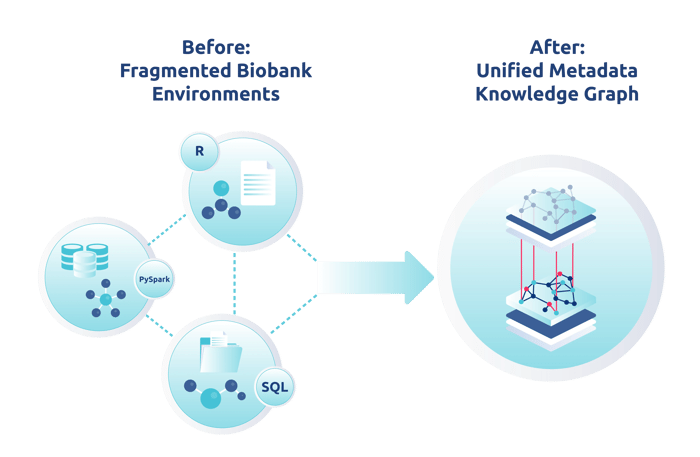 If researchers need to relearn tools across environments, rebuild analytical workflows, manually adapt scripts, and repeat validation logic, the AI feature does not feel intelligent. It feels incomplete.
In Datavid’s biobank case study, the customer’s R&D teams relied on population-level biobanks, but each environment had different metadata models, tools, and scripting requirements. This forced researchers to rebuild workflows, relearn technologies, and repeatedly validate logic, slowing scientific progress and increasing operational overhead.
For a Product Manager, this creates several feature risks:
- users receive inconsistent outputs across environments, reducing trust in the feature
- workflows are repeatedly rebuilt instead of reused, increasing onboarding effort and slowing feature scalability
- automation becomes difficult to scale because workflows cannot be reused consistently across environments
- validation effort becomes repetitive, increasing delivery cycles and reducing workflow consistency across environments
- adoption suffers because the product does not remove enough friction
The issue is not that users lack data. It is that the product cannot consistently turn that data into a reliable workflow.
Why standard RAG is not enough for this kind of product
Standard RAG is useful when the problem is finding and summarizing relevant content. It can help an AI assistant retrieve documents, passages, or knowledge snippets that appear semantically close to a user’s question.
But in life sciences product workflows, the hard part is often not retrieval alone.
A user might ask a natural-language research question, but the feature needs to understand how that question maps to:
- cohort definitions
- metadata fields
- source systems
- controlled vocabularies
- analytical logic
- security constraints
- validation steps
- reusable workflows
Standard RAG may retrieve relevant text, but it does not automatically understand how different metadata structures relate to each other. It does not automatically generate a governed workflow that can run across multiple biobank environments. It does not automatically make outputs reusable, validated, or consistent.
For PMs, this is the key distinction.
The problem is not only answer quality. It is feature behavior.
A standard RAG assistant might provide a helpful answer. A GraphRAG-enabled product can understand how the user’s question connects to defined entities, metadata relationships, and executable workflows.
That changes the product from a passive assistant into a workflow-enabling feature.
To see how Datavid supports GraphRAG strategy, architecture, and implementation

What GraphRAG changes: from Q&A to workflow automation
In the biobank PoV, Datavid delivered an ontology-driven metadata platform powered by Datavid Rover’s semantic layer and RAG architecture. The goal was to standardize how research questions are asked, interpreted, and executed across multiple biobank environments.
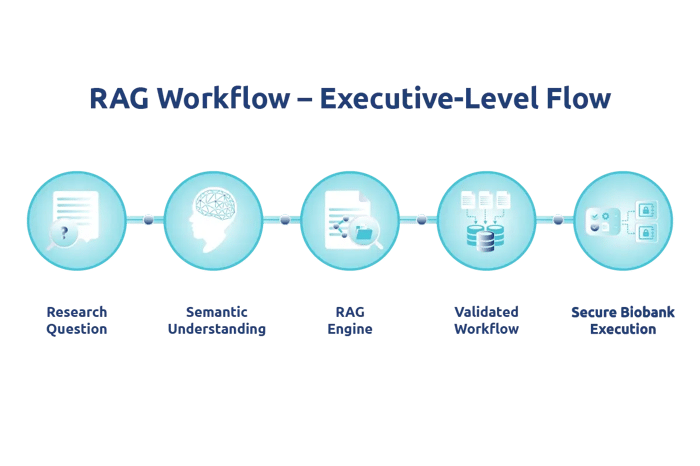 The product lesson is not only that the architecture worked. It is that each architectural capability translated into a clearer user and PM impact.
Governed metadata knowledge graph
The platform unified data definitions across two biobanks using internal models and the OMOP 5.4 standard.
For users, this created a more consistent way to understand research concepts across environments. They no longer had to work around different metadata structures every time they moved between biobanks.
For PMs, this improves feature consistency and reduces environment-specific rework during onboarding and validation. The AI product is less likely to behave differently depending on the dataset, source system, or user context.
RAG-driven workflow automation
The solution translated natural-language research questions into validated analytical workflows.
For users, this reduced the need to manually write, adapt, and debug scripts for every analysis. They could move from question to workflow faster.
For PMs, this moves the feature beyond Q&A. It creates clearer user value because the product does not just retrieve information, it helps users complete a task.
Agentic LLM orchestration
Specialized agents supported query interpretation, script creation, validation, and guardrails.
For users, this meant more reliable outputs because the system was not simply generating freely. It followed a controlled process with validation steps built in.
For PMs, this improves trust and lowers the risk of failure in production. It also makes the feature easier to defend with technical, data, and governance stakeholders.
Secure and scalable architecture
The solution supported ingestion, enrichment, and analysis across protected biobank environments while maintaining security controls.
For users, this created a safer way to work across sensitive research environments without losing access to useful cross-biobank insights.
For PMs, this improves production readiness by reducing manual adaptation effort as additional biobanks are onboarded. The product is designed around real enterprise constraints from the start, including security, access control, scalability, and future onboarding of additional biobanks.
Together, these capabilities showed that cross-biobank research could be standardized, automated, and scaled without compromising security or governance. The PoV also validated a repeatable model for onboarding additional biobanks and supporting future R&D initiatives.
Product lessons from the biobank example
The full case study is useful proof of delivery, but for Product Managers the more important question is: what does this teach us about building GraphRAG-powered features?
There are 5 practical lessons.
1. Start with one workflow, not a whole platform
The biobank PoV was delivered in eight weeks and focused on proving a specific model across two environments.
That matters because GraphRAG projects can easily become too broad. A PM may want to solve search, analytics, workflow generation, discovery, and governance all at once. But the fastest way to prove value is to choose one high-value workflow and show that the product can improve it.
A good first pilot should answer:
- which user workflow are we improving?
- which two or three data sources matter most?
- what output should the user trust?
- what metric will prove the feature is better?
The goal is not to prove that GraphRAG works in general. It is to prove that GraphRAG improves a workflow users care about.
2. Metadata quality is product quality
In AI product development, metadata can look like a backend concern. But in research workflows, metadata directly shapes the user experience.
If two biobanks define concepts differently, the AI feature may interpret the same user question differently. If metadata is incomplete, the feature may retrieve the wrong context. If relationships are not modeled, the system may return plausible but shallow answers.
Ontology alignment is therefore not just a data task. It is a product quality task.
For PMs, this means metadata readiness should be part of feature discovery. Before scoping a GraphRAG feature, ask whether the underlying concepts are defined consistently enough for the AI to behave reliably.
3. Reusability is the real product win
A one-off AI answer is useful. A reusable workflow is more valuable.
The biobank PoV created reusable workflows and replaced manual, ad-hoc coding with governed, repeatable analytical steps.
That is the kind of outcome PMs should care about. Reusability reduces friction for users, but it also improves roadmap efficiency. Once a pattern works for one environment, it can be extended to others with less reinvention.
This is where GraphRAG can become a product accelerator. The graph, metadata model, and workflow logic become reusable product infrastructure, not just implementation detail.
4. Guardrails need to be designed into the workflow
For life sciences users, reliability is not optional.
An AI feature that generates a script, suggests a workflow, or summarizes a research path needs validation. It needs guardrails. It needs a way to show how an output was produced and whether it can be trusted.
Agentic orchestration helps by breaking the workflow into controlled steps: interpreting the query, generating logic, validating the output, and applying guardrails before the result reaches the user.
For PMs, this reduces production risk. It also supports a better user experience because trust is built into the workflow, not added as a disclaimer at the end.
5. Production readiness starts in the pilot
A GraphRAG pilot should not be a disconnected demo.
It should prove the foundations needed for production: secure access, workflow repeatability, metadata alignment, validation, and scalability. The biobank PoV demonstrated a repeatable model for onboarding additional biobanks and supporting future R&D initiatives.
That is the right mindset for PMs. A pilot should not only show what is possible. It should de-risk what comes next.
What PMs should evaluate before building a GraphRAG feature
GraphRAG is not the right answer for every AI product feature. It is most valuable when the product needs to reason across connected entities, fragmented systems, governed data, or repeatable workflows.
Before scoping a feature, PMs should ask:
- What user workflow are we trying to improve?
- Does the feature need to work across multiple systems or data environments?
- Are users asking questions that depend on connected entities, not just documents?
- Is metadata inconsistency affecting answer quality or workflow reliability?
- Does the feature need to produce repeatable outputs, not just plausible answers?
- What validation or governance guardrails are needed before users can trust it?
- Can the first pilot be scoped to one workflow and two or three high-value data sources?
- What measurable outcome will define success?
The strongest GraphRAG pilots have a clear product shape. They do not start with “build a knowledge graph.” They start with a user problem where connected knowledge, governed retrieval, and repeatable workflow automation can create visible value.
GraphRAG as a feature foundation, not just a data architecture
For AI Product Managers in life sciences, GraphRAG matters because it helps turn complex, fragmented research environments into product features users can rely on.
The biobank example shows the difference clearly. The biobank example showed how governed metadata and workflow-aware retrieval can reduce repeated scripting, improve workflow consistency across environments, and create reusable foundations for onboarding additional research systems over time.
That is the real opportunity for GraphRAG for AI-powered products.
It helps teams move from impressive demos to features that can support real users, real workflows, and real enterprise constraints.
Datavid helps life sciences teams design GraphRAG pilots that move from promising demos to reusable, production-ready AI features.
For more examples of where GraphRAG fits in AI-powered products, download the GraphRAG for AI-powered products guide.
The strongest GraphRAG initiatives are not measured by how well they answer a question once, but by how consistently they support repeatable research workflows across environments over time.
Have questions about running a GraphRAG pilot?
Read the GraphRAG Pilot FAQs for AI Product Teams to understand scope, timelines, success metrics, and what a pilot should prove before you commit further roadmap effort.