
6 minute read
.png)
Traditional RAG systems promise reliable AI assistants, but production reality tells a different story. When real users arrive with complex, multi-part questions and expectations of continuity, the cracks begin to show. This blog breaks down exactly why RAG fails at scale and how GraphRAG offers a more structurally sound alternative.
Watch: RAG vs GraphRAG in 90 seconds
See how GraphRAG helps product teams move beyond isolated retrieval towards more connected, traceable AI responses.
RAG works until real users show up
Most AI assistants today are built using Retrieval-Augmented Generation (RAG). In controlled environments, this approach works well. The system retrieves relevant content, generates coherent responses, and performs reliably against expected queries.
This is why many product teams feel confident after early demos or pilot releases.
However, production environments introduce a very different reality. Users do not interact with systems in predictable ways. They ask follow-up questions, combine multiple intents, and expect continuity across interactions. Over time, the same system that appeared reliable begins to show inconsistencies.
Answers feel incomplete. Similar queries produce different responses. Context does not carry forward as expected.
These are not isolated issues; they are systemic.
GraphRAG is not a standalone solution to these challenges. Its effectiveness depends on the strength of the underlying data foundation and how it is combined with other system components, such as user-intent classification and output guardrails.
When applied within a well-structured system, GraphRAG helps improve how context is assembled, enabling more complete and context-aware responses.
And from a product perspective, they quickly translate into lost user trust, lower adoption, and increasing effort to maintain the experience.
The gap between demo behavior and product reality
In demos, queries are curated. In production, they are exploratory.
Users refine their questions, revisit topics, and expect the system to maintain context across multiple interactions. RAG systems, as typically implemented, treat each query independently. This creates a mismatch between how users expect the system to behave and how it actually operates.
From a product perspective, this is where trust begins to erode.
What this looks like inside your product
The limitations of RAG are not abstract. They surface as very specific product issues.
Inconsistent answers across similar queries
Users often receive different answers to slightly varied versions of the same question. Even when the underlying data is the same, the system may retrieve different contexts and produce different outputs.
This inconsistency reduces confidence quickly.
Follow-ups that lose context
A user asks a question and then follows up, expecting continuity. The system fails to carry forward relevant context, forcing users to restate information or accept incomplete responses.
Shallow answers to complex questions
When a query requires connecting multiple pieces of information, the system tends to provide partial or surface-level answers. It retrieves what is closest, not what is complete.
Limited visibility into failures
When responses are incorrect, it is difficult to determine why. Was the issue retrieval, prompt design, or data quality? Without clear traceability, debugging becomes time-consuming and uncertain.
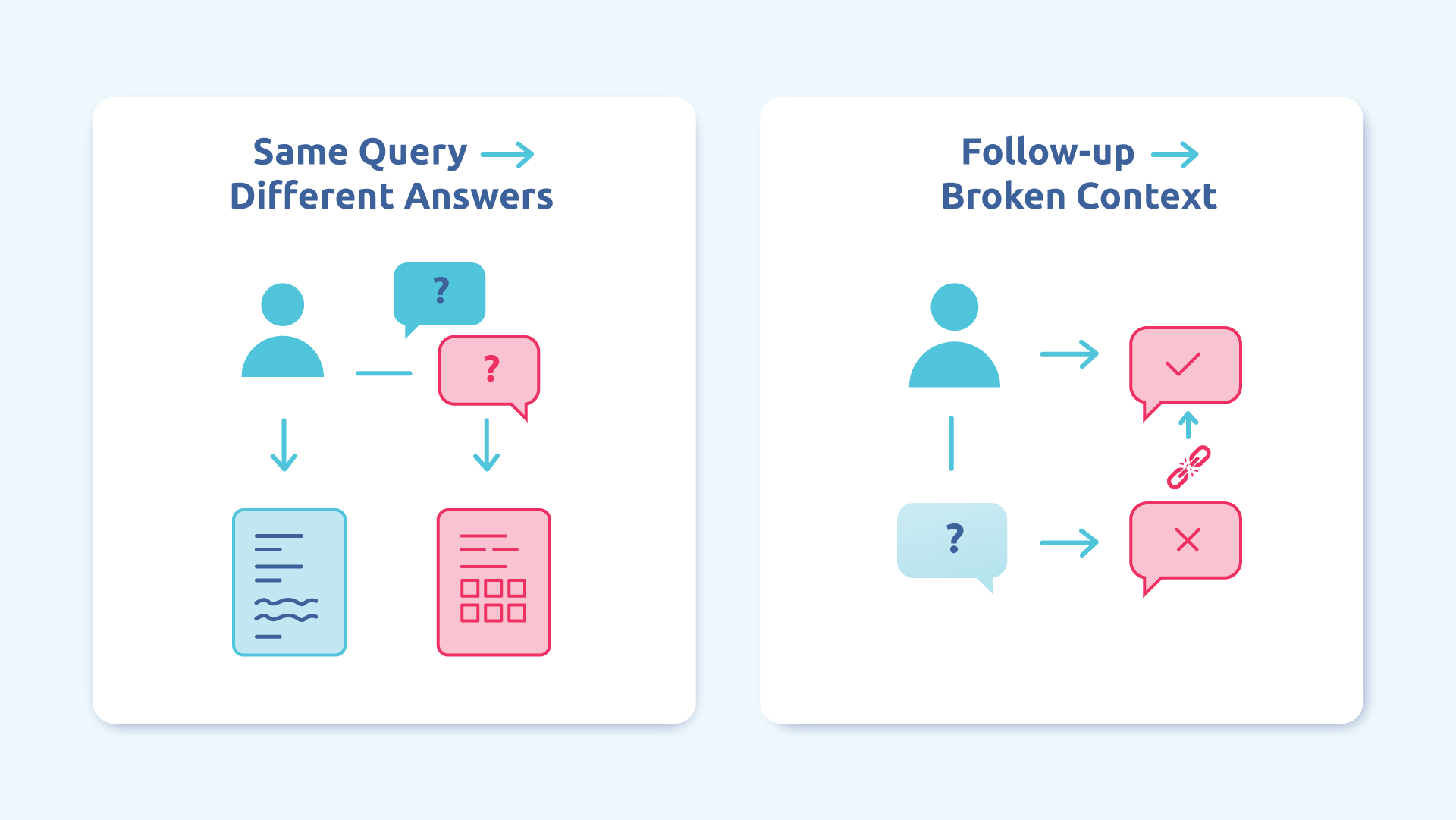
These issues tend to appear gradually, often becoming visible only after the system is exposed to real user behavior.
Users begin to notice that similar questions return different answers. Follow-up queries fail to build on previous context, forcing them to repeat information. As query complexity increases, responses become more surface-level, missing important connections across data.
From a product perspective, over time, these issues impact core product metrics: user trust declines, feature usage becomes inconsistent, and teams spend more time managing edge cases than improving the product.
Why RAG breaks under real-world usage
These behaviors are symptoms of deeper structural limitations.
1. Retrieval is limited to an isolated context
RAG retrieves one or two relevant chunks of data. While sufficient for simple queries, this approach fails when answers depend on linking multiple sources.
2. Data is fragmented during processing
To enable efficient retrieval, content is broken into smaller segments. In doing so, relationships between ideas are often lost. The system retrieves fragments, not full meaning.
3. Similarity does not reflect intent
Vector search identifies similar content, but similarity does not always align with what the user is actually asking. This results in responses that are related but incomplete.
4. There is no structured reasoning layer
RAG retrieves information but does not connect it. There is no built-in way to understand how different pieces of data relate to each other.
This is why follow-ups and multi-step queries tend to fail.
The underlying issue is how context is represented
The core limitation is not retrieval itself, but the way context is assembled.
AI systems operate on fragments of information, while real user questions depend on how those fragments connect. When that connection is missing, the system cannot maintain continuity or provide complete answers.
These limitations are not caused by a single factor. They emerge from the interaction among retrieval, data structure, and system design.
Addressing them typically requires improvements across multiple layers, including
- how data is organized,
- how user intent is interpreted, and
- how responses are controlled.
What GraphRAG changes
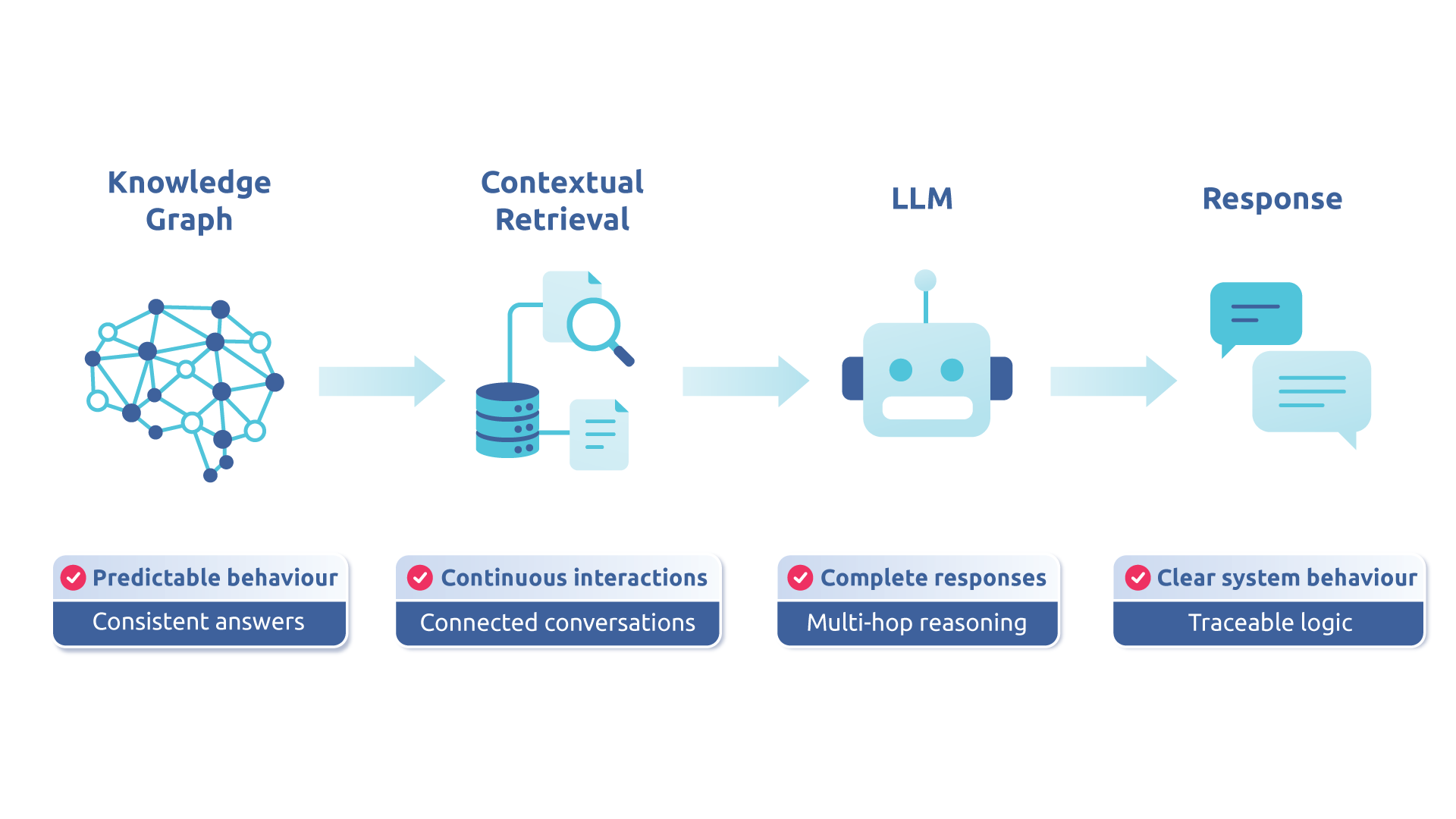
GraphRAG introduces a structured layer on top of retrieval by connecting related pieces of information.
Rather than acting as a standalone solution, it works alongside techniques such as semantic retrieval, user-intent classification, and output guardrails to improve how context is assembled during response generation.
It complements traditional vector search by going beyond similarity and surfacing information that is contextually connected, helping produce more complete and relevant answers as data grows more complex.
1. Reducing variability in responses across similar queries
By leveraging relationships between data, GraphRAG reduces inconsistencies in how similar questions are answered. The degree of consistency still depends on data quality and how retrieval and intent handling are implemented.
2. Supporting more coherent follow-up interactions
GraphRAG helps reconnect related information across queries, making it easier to maintain context. When combined with session memory and intent tracking, this improves conversational continuity.
3. Enabling more complete responses to complex queries
By linking multiple pieces of information, GraphRAG helps systems go beyond surface-level retrieval and assemble richer answers, especially in scenarios where relationships across data are important.
4. Contributing to clearer system behavior
While debugging depends largely on system design and observability practices, structured data makes it easier to trace how information is connected and retrieved, enabling better issue diagnosis.
What this means for product teams
For product teams, these improvements translate directly into user experience outcomes.
More consistent answers increase trust, better follow-up handling improves usability, and more complete responses reduce repeated queries and drop-offs.
For product managers, this shift directly impacts product quality and delivery.
Instead of continuously patching edge cases, teams can address the root cause of inconsistency at the data and context level.
This leads to:
- more predictable feature behavior in production
- reduced effort spent on debugging and edge-case handling
- faster iteration cycles on AI features
- clearer path from MVP to production readiness
Where this is already delivering value
Organizations adopting structured, connected data approaches are seeing measurable improvements.
In large-scale content environments, unstructured data has been transformed into connected systems that enable deeper discovery and more reliable answers.
If your AI feels unreliable, this is likely why
Many product teams reach a point where improving the AI model or refining prompts no longer delivers meaningful gains. The system continues to produce inconsistent answers, struggles with follow-up queries, and requires ongoing manual intervention to maintain quality.
At this stage, the issue often appears to be a tuning or data-coverage issue. More documents are added, prompts are adjusted, and edge cases are handled individually. However, these efforts tend to produce diminishing returns.
The underlying problem is rarely the AI model itself.
It is more often rooted in how context is retrieved and connected. When the system relies on fragmented information, it cannot maintain continuity across interactions or assemble complete answers to complex queries.
This is why the same question may produce different responses depending on how it is phrased. Follow-ups fail to build previous context, and the AI system reacts to isolated inputs rather than operating with a coherent understanding of the underlying data.
Until this structural limitation is addressed, improvements will remain incremental and difficult to sustain.
Addressing these challenges typically requires a combination of improvements in refining prompts, or adding more data alone is rarely sufficient.
Progress comes from aligning three key elements: how data is structured, how intent is interpreted, and how responses are controlled.
GraphRAG improves one critical layer, how context is connected, which is most effective when combined with these broader system elements.
Moving from RAG to production-grade AI
RAG is an important step, but it is not the final architecture for production systems.
GraphRAG builds on RAG by introducing structure, relationships, and connected context. As part of a broader system design that includes strong data foundations, clear intent understanding, and guardrails, it helps AI systems behave more reliably in real-world use.
No single approach fully resolves production challenges. Reliability emerges from how these components work together.
At Datavid, we’ve been applying this approach across content-heavy and enterprise environments where context, consistency, and explainability are critical, especially in domains where accuracy and traceability directly impact decision-making.
For teams looking to move beyond early-stage AI and build features that hold up in production, this shift becomes essential.
Ready to see GraphRAG in product context?
Download the use-case guide to explore how GraphRAG can support more reliable, traceable AI-powered product features.
Or explore how GraphRAG can stabilize and scale AI features in production.