
10 minute read
Quick answer: AI-ready data is enterprise information that has been structured, governed, and semantically enriched so AI systems can consume, learn from, and reason over it at scale.
Your organization probably isn't short on data. It's short on data that AI can actually use. For CDOs, and data leaders evaluating AI initiatives, this is the central tension: most enterprise pipelines were designed to feed reports and dashboards, which means they store information in formats optimized for human consumption.
AI workloads need something different: granular, contextualized, and semantically enriched data with clear lineage and governance baked in.
At Datavid, we see AI readiness as a foundation problem first: the barrier to production AI is not model access, but whether the data foundation is structured, governed, contextualized, and traceable enough for AI systems to use safely.
This article discusses what AI-ready data actually looks like, why the gap exists, and how to close it.
At a glance
- AI-ready data goes beyond clean spreadsheets. It requires semantic context, governance, and infrastructure designed for machine-scale consumption, not just human reporting.
- Most enterprises struggle with AI readiness because their data is fragmented across silos, lacks metadata context, and was never built with AI workloads in mind.
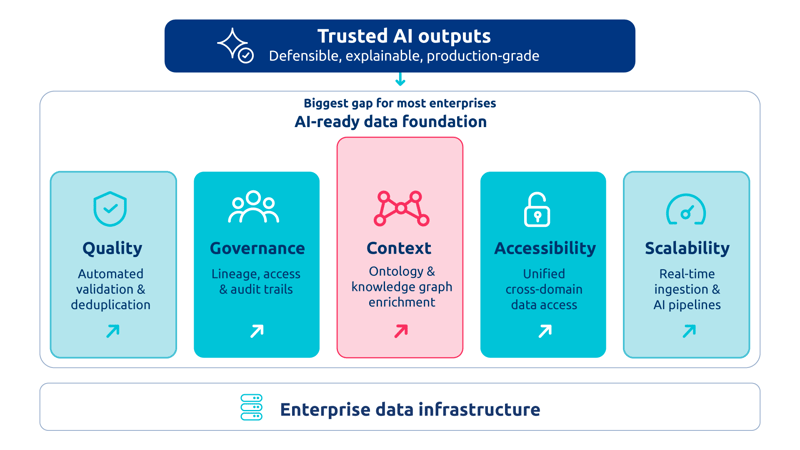
- Five pillars define AI-ready data: quality, governance, context, accessibility, and scalability. Weakness in any one of them can derail an AI initiative.
- Knowledge graphs and ontology-driven enrichment solve the context gap that traditional data pipelines leave open, giving AI models structured relationships to reason over.
- Getting started doesn't require a full platform overhaul. A focused audit, a clear ontology strategy, and a well-scoped pilot can move your organization from experimental to production-grade AI.
What is AI-ready data?
AI-ready data is information that is accurate, well-governed, semantically enriched, and structured so AI models can generate grounded outputs from it at scale. That is what separates it from the data most organizations already have. A BI tool needs aggregated, human-readable summaries.
An AI model, whether it's powering retrieval-augmented generation, fine-tuning, or agentic workflows, needs granular, contextual, and machine-interpretable data with rich metadata that describes what each field means, how it relates to other data, and where it came from.
The table below outlines the core characteristics that define AI-ready data and what they look like in practice.
|
Characteristic |
What it means for AI readiness |
|
Complete |
No critical gaps, missing fields, or orphaned records that could skew model outputs |
|
Consistent |
Standardized formats, naming conventions, and taxonomies across all sources |
|
Contextualized |
Metadata, semantic relationships, and ontology-driven enrichment that tell an AI system what the data means, not just what it contains |
|
Governed |
Clear ownership, lineage tracking, access controls, and audit trails that meet regulatory standards |
|
Accessible |
Unified, cross-domain access that breaks down silos so AI systems can work with the full scope of enterprise information |
|
Scalable |
Infrastructure capable of handling real-time ingestion, automated processing, and growing AI workloads |
The role of metadata and semantic context is particularly important here. Without structured relationships between data points, AI systems have limited context for interpreting how information connects. This is where approaches like knowledge graphs and ontology design become valuable, because they give AI the structured context it needs to move beyond simple keyword retrieval toward genuine reasoning.
For CDOs, this is the difference between AI projects that deliver defensible business outcomes and ones that produce outputs no one trusts enough to act on.
Why most enterprises aren't ready for AI
If your organization has invested in data infrastructure over the past decade, you likely have solid pipelines feeding BI tools, reporting platforms, and operational dashboards. That work isn't wasted, but it wasn't designed for AI workloads.
The barriers to AI readiness tend to compound with each other, which is why so many pilots never reach production. For CDOs these aren't abstract technical problems. They're the reasons AI initiatives burn budget without delivering the returns the board expects.
Data silos and fragmentation
Enterprise data is typically spread across dozens of systems, departments, and formats. Pipelines were built to serve specific teams or reporting use cases, not to provide a unified view that an AI model can traverse.
When data sits in disconnected silos, it's nearly impossible to train models that account for cross-functional context.
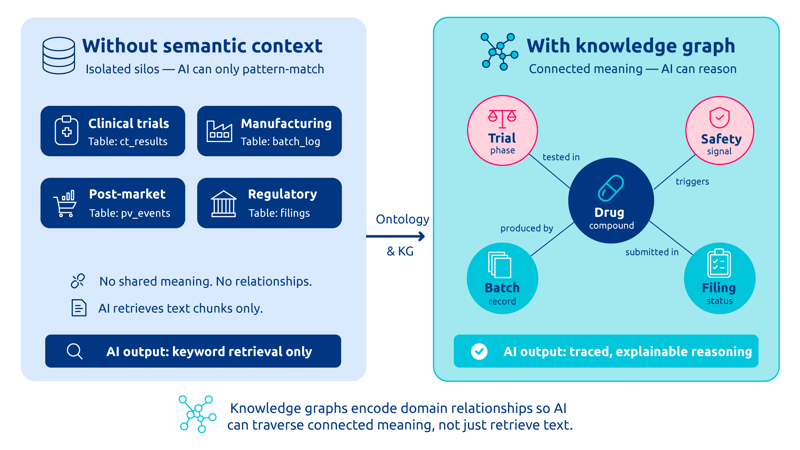
A pharma company trying to build an AI-powered regulatory assistant, for example, needs data from clinical trials, manufacturing records, and post-market surveillance in a single, connected view. That rarely exists out of the box.
The cost to the CDO is duplicated effort across teams, slower time-to-insight, and AI pilots that can't scale beyond the single department that curated their data.
Governance and compliance gaps
Fragmentation also makes governance harder to manage. If you can't trace where data originated, who modified it, and how it flows through your systems, you can't meet the lineage and auditability requirements that regulators in life sciences, financial services, and publishing increasingly demand.
Missing access controls and incomplete audit trails create risk that scales alongside your AI ambitions. For data leaders reporting to the board, this translates to regulatory exposure and an inability to demonstrate that AI outputs are compliant and trustworthy.
The context gap
Raw data without semantic enrichment or metadata context is like a filing cabinet full of unlabeled folders.
Traditional pipelines store data but don't encode what it means or how different data points relate to each other. This is where most enterprises hit a wall, and it's also where knowledge graph and ontology-driven approaches provide the greatest lift.
They add the structured relationships and domain-specific context that AI models need to reason accurately.
The pilot-to-production stall
Hand-curated data works fine for a proof of concept. Scaling that to production AI requires automated validation, continuous ingestion, and governance that doesn't slow down when the data volume grows.
Without those capabilities, AI initiatives remain stuck in the lab. This is often where data leaders face a build-vs-buy decision: do you invest in building ontology, governance, and pipeline capabilities internally, or do you bring in specialized consultancy expertise to accelerate the path from pilot to production?
The five pillars of AI-ready data
Building an AI-ready data foundation comes down to five capabilities that need to work together. Weakness in any single pillar can undermine the others, so it's worth treating these as a connected system rather than an isolated checklist.
For CDOs building the business case for AI investment, these pillars map directly to the outcomes leadership cares about: reduced risk, faster time-to-value, and AI initiatives that scale beyond a single pilot.
1. Quality
AI models amplify data flaws. If your training data contains duplicates, outdated records, or biased samples, your model outputs will reflect those problems at scale. Quality controls for AI-ready data need to be automated and continuous, not a one-time cleanup effort.
That means automated validation rules, regular deduplication, and bias checks built into your data engineering pipelines rather than applied retroactively. The ROI here is direct: fewer failed model deployments, less time spent retraining, and outputs that stakeholders across the organization can trust.
2. Governance
Clear ownership, access controls, lineage tracking, and compliance readiness form the trust layer that makes AI outputs defensible. This pillar is especially important in regulated industries where you need to prove which data trained a model and demonstrate that it complied with privacy and regulatory requirements.
A well-designed data governance framework should feel like a guardrail, not a bottleneck.
3. Context
This is the pillar where most organizations have the largest gap, and where Datavid's semantic data platform and expertise in semantic enrichment and knowledge graphs make the biggest difference.
Context means metadata, semantic relationships, and ontology-driven enrichment that give AI models the structured context to reason across connected knowledge rather than just retrieve text chunks.
Without it, your AI is pattern-matching on isolated data points. With it, your AI can traverse relationships and deliver answers that account for domain-specific meaning. For example, semantic knowledge foundations can help teams turn complex internal policy content into trusted, self-service knowledge access.
4. Accessibility
AI systems can't act on data they can't reach. Unified, cross-domain access is what allows models to work with the full scope of your enterprise data rather than a narrow slice from one department or system. This goes beyond simply connecting data sources.
It requires a consistent access layer that normalizes formats, resolves schema conflicts, and makes data available through APIs or pipelines that AI workloads can consume.
For the CDO, this eliminates the redundant data preparation work that currently eats up engineering hours across every team trying to run their own AI experiments.
For document-heavy organizations, AI readiness often starts with modernizing fragmented content environments so knowledge can be governed, retrieved, and reused consistently.
5. Scalability
The infrastructure that supports your dashboards probably won't handle the volume, velocity, and processing demands of production AI. AI-ready scalability means real-time ingestion, automated processing pipelines, and architecture that can grow from a pilot serving one team to a production system serving the entire organization.
Building for scale from the start avoids the costly re-architecture that trips up organizations trying to move from experimentation to enterprise deployment.
When these five pillars work together, they create a data foundation where AI services can deliver reliable, explainable, and production-grade results.
AI-ready data vs. traditional data
The shift from traditional data management to AI-ready data isn't just about doing more of the same. It's a fundamentally different approach to how data is structured, governed, and interpreted. This comparison captures the key differences:
|
Dimension |
Traditional data |
AI-ready data |
|
Structure |
Optimized for human-readable reports and dashboards |
Optimized for machine consumption, training, and inference |
|
Governance |
Manual, periodic audits focused on compliance |
Automated, continuous governance with lineage tracking and access controls built into pipelines |
|
Context and metadata |
Limited metadata, primarily for cataloging |
Rich semantic enrichment, ontology-driven relationships, and domain-specific context |
|
Pipeline design |
Batch-oriented ETL for BI and reporting |
Real-time ingestion, automated validation, and AI-optimized processing |
|
Quality assurance |
Periodic manual checks and one-off cleanups |
Continuous automated validation, deduplication, and bias detection |
|
Scalability |
Designed for human-scale query volumes |
Built for high-volume, high-velocity machine workloads from pilot to production |
The shift doesn't mean throwing out your existing infrastructure. It means layering on the governance, semantic context, and pipeline capabilities that AI demands. Datavid's data engineering services and enterprise data management capabilities are built around helping organizations make exactly this transition without replacing the platforms they already rely on.
How to make your enterprise data AI-ready
Moving from traditional data infrastructure to an AI-ready foundation doesn't require a single massive overhaul. For CDOs, the more effective approach is a sequence of focused steps that build organizational confidence and deliver measurable results along the way.
Whether your team handles this internally or works with a specialized partner, the sequence stays the same.
The difference is speed: organizations with deep in-house ontology and semantic expertise can often move faster on steps two and three, while those without it benefit from external knowledge graph and data architecture specialists who have done this across regulated industries.
1. Audit your current data landscape
Outcome: A clear map of data sources, silos, quality gaps, governance risks, and priority AI use cases.
Start with a clear picture of where things stand. Inventory your data sources, identify silos, assess quality, and map existing governance gaps. The goal isn't a perfect catalog on day one. It's enough visibility to know where the biggest obstacles are and which use cases have the most to gain from AI-ready data.
For CDOs, this audit also becomes the foundation for a credible business case: you can quantify the gap, estimate the cost of inaction, and show leadership exactly where investment will generate returns.
2. Define an ontology and metadata strategy
Outcome: A shared semantic model that gives AI systems the context to interpret enterprise knowledge accurately.
This is where most organizations skip ahead too quickly and pay for it later. Establishing a semantic framework that models your domain-specific concepts, relationships, and taxonomies is what gives AI models the context to reason accurately. In life sciences, that might mean mapping relationships between compounds, trials, and research biobank data.
In publishing, it could mean connecting authors, topics, citations, and editorial workflows. Knowledge graph expertise is what turns raw metadata into a reasoning layer that AI can actually use.
3. Automate quality and governance controls
Outcome: Repeatable validation, lineage, and access controls that scale beyond manual review.
Manual data checks don't scale. Moving to automated validation, lineage tracking, and access management means your data governance keeps pace with your AI ambitions instead of slowing them down. Automated controls also build stakeholder confidence in AI outputs, which matters when you're trying to move AI from a data science experiment to an enterprise-wide tool.
4. Build scalable, AI-optimized pipelines
Outcome: Flexible, production-ready data pipelines that support real-time AI workloads across structured and unstructured data.
Design your ingestion and processing pipelines for AI workloads, not just reporting and BI. That means supporting real-time data flows, handling unstructured content like documents and images, and building in the flexibility to serve multiple AI use cases from a single pipeline architecture.
An AI-ready lakehouse approach can provide the flexibility to support both analytical and AI workloads from the same foundation.
5. Start with a pilot, then scale
Outcome: A validated AI use case with measurable ROI that builds momentum for broader enterprise adoption.
Test your AI-readiness approach on a focused use case before expanding. Pick a domain with clear business value, a manageable data scope, and measurable outcomes. Validate the approach end to end, from data ingestion through model output, then use what you learn to refine your strategy as you scale across the organization.
For CDOs, a successful pilot with documented ROI is the fastest way to secure budget and executive support for enterprise-wide AI data transformation.
AI-ready data checklist
Before scaling AI, use this checklist to assess whether your data foundation is ready:
- Lineage: Can you trace critical data back to its source?
- Metadata consistency: Do you have consistent metadata across systems?
- Semantic structure: Are key domain concepts connected through a shared ontology or semantic layer?
- Governed access: Can AI systems access governed data across business units?
- Automated controls: Are quality, validation, and access controls automated?
- Reusability: Can the same data foundation support more than one AI use case?
If you answered "no" to more than two of these, your data foundation likely needs work before AI initiatives can move from pilot to production.
Build an AI-ready data foundation with Datavid
AI readiness is a data foundation problem, not a model problem. For CDOs and data leaders evaluating where their organization stands, Datavid brings the semantic enrichment, knowledge graph expertise, and data engineering depth to close the gap between where your data is today and where it needs to be for production AI, in weeks rather than years.
Datavid helps enterprises assess whether their data foundation is ready for production AI, from metadata and lineage to semantic enrichment, governance, and scalable pipelines.