
7 minute read
Quick answer:
AI knowledge management helps CDOs decide which enterprise knowledge tasks to automate, which to keep human-led, and which need human oversight. Done well, it turns fragmented knowledge into governed, trusted inputs that improve AI accuracy, transparency, and decision-making at scale.
Most guidance on AI knowledge management starts from the same assumption: automate everything you can, as quickly as possible. That approach falls apart the moment it meets a regulated enterprise.
As a Chief Data Officer working in life sciences, banking, or publishing, you already know the harder question is not how much to automate. It is how to sort the work so that scale never comes at the cost of trust.
This blog gives you a practical way to make that decision, and to build the governed knowledge layer that holds it up.
At a glance
- For CDOs, the challenge is not how much to automate, but which knowledge workflows should be automated, expert-led, or governed through oversight.
- AI knowledge management transforms siloed enterprise knowledge into structured, retrievable assets that AI systems can use reliably and at scale.
- Human in the loop AI helps ensure high-stakes answers remain accurate, validated, and traceable back to their source.
- The business problem it solves is institutional knowledge disappearing, work being repeated, and AI producing answers no one can trust.
- Organizations that get it right see faster decision-making, higher answer accuracy, greater knowledge reuse, and improved AI adoption.
- A governed knowledge layer of knowledge graphs and semantic models is the foundation that makes enterprise AI trustworthy.
AI knowledge management is about sorting work, not just automating it
Before you can decide what to build, you need a clearer definition than the market usually offers. AI knowledge management means applying AI to capture, organize, retrieve, and synthesize organizational knowledge, across reports, emails, policies, and databases. The promise is real. The way most vendors frame it is not.
The dominant narrative says more automation equals more value. Enterprise data leaders are discovering that the opposite can be true. Scale without governance produces outputs that sound authoritative but are inaccurate, which is exactly the failure regulated environments cannot absorb.
An AI assistant that summarizes the wrong clinical guidance or cites a superseded policy does not save time. It creates liability.
So the question shifts. The connection between knowledge management and AI is not "how much can we automate?" but "which of these tasks benefits from AI scale, which depends on human judgment, and which sits in between." Sorting work in this way is the foundation of trusted, scalable AI.
What to automate, what to keep human, and what needs both
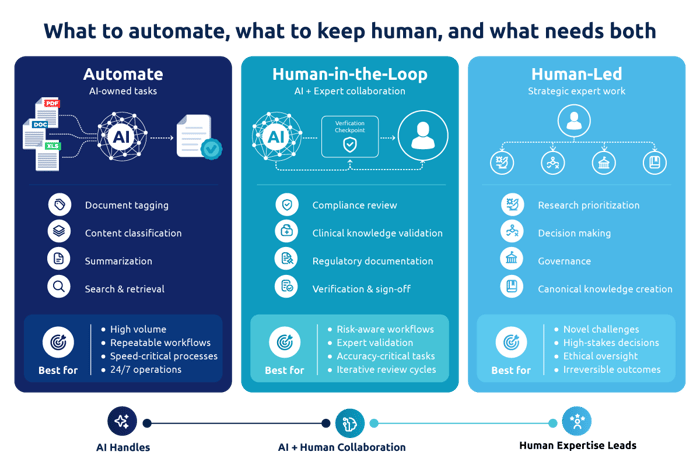
A practical framework is to sort knowledge workflows into three categories: tasks to automate, tasks to keep expert-led and tasks that require humans in the loop.
The right category depends on five factors: the stakes if the output is wrong, the ambiguity of the input, the judgment required, the regulatory exposure, and how often the task repeats. High frequency and low stakes pull toward automation. High stakes and high judgment pull toward people.
Tasks AI handles better than people
AI delivers the best when applied to repetitive, pattern-driven work. Tagging and classifying documents, surfacing related content, summarizing long reports, and translating between formats are all tasks AI does faster and more consistently than a team working by hand.
The return here is time recovered, not headcount removed. Your experts spend less time searching for information and more time applying their expertise where it creates the greatest business value.
The scale of that return is easy to underestimate. Datavid built a semantic data platform for Syngenta that indexed more than 16 million files across dozens of siloed sources, cutting research time from weeks to minutes. That is the business problem this bucket solves: knowledge that exists but cannot be found, so people repeat work and decisions stall.
Tasks that should stay human
Not all knowledge work benefits from automation. Activities that depend on judgment, context, experience, or strategic decision-making should remain with people. Setting research priorities, interpreting an ambiguous customer signal, and deciding what becomes canonical knowledge all carry consequences that a model cannot weigh.
Any task where the wrong answer carries reputational, regulatory, or strategic cost should stay human. Automating these does not reduce friction. It transfers risk to a system that cannot be held accountable for it.
Tasks for human in the loop AI
Between those two sits the most valuable category for regulated enterprises. Human in the loop AI covers high-stakes work AI can accelerate but should not own outright. Regulatory document review, clinical knowledge synthesis, and compliance Q&A all fit here.
This approach is equally valuable for retrieval workflows where accuracy, traceability, and speed all matter. The model does the heavy lifting. A person verifies before anything is published or acted on.
Why is governed knowledge the foundation of trusted AI
Here is the part most guidance skips. Every approach above assumes the knowledge underneath is in good shape. In most enterprises it is not. The blocker that stalls KM-AI pilots is almost always the same: the underlying knowledge is unstructured, ungoverned, and scattered across systems, so AI outputs cannot be trusted no matter how good the model is.
This is why automation without governance is dangerous rather than just disappointing. AI can generate answers that look authoritative, but are outdated and tough to verify.
For regulated industries such as life sciences, pharma, banking, and publishing, that is a non-starter. The cost of a wrong answer is measured in audits, recalls, and reputation.
A governed knowledge layer with knowledge graphs changes the inputs. Knowledge graphs, ontologies, and a semantic layer turn "AI on top of documents" into AI on top of organizational knowledge that is structured, relationship-aware, and traceable to its source.
That shift is what makes the semantic layer for AI readiness more than a buzzword. It also makes human in the loop workflows feasible, because a reviewer can see what the AI retrieved, where it came from, and whether it actually applies. Without that, review is guesswork.
This is the work Datavid does before any AI sits on top. When the American Chemical Society had decades of content with no single authoritative repository,
Datavid built a content lake that consolidated and normalized it into one governed source. The return was lower storage and processing costs alongside faster, more reliable search across structured and unstructured content. That governed base is what an AI knowledge management system needs underneath it to produce answers a CDO can stand behind.
Human in the loop AI patterns that fit enterprise KM
Human in the loop is not one design. It is a small set of recurring patterns, each with a clear role for the person and a clear role for the model. Most enterprise knowledge workflows fall into three common models.
Retrieval with human review
The model surfaces candidate answers and source citations from a governed knowledge base. A subject matter expert validates the answer before it is published or acted on.
This pattern fits compliance, regulatory, and clinical contexts, where being roughly right is not good enough and every claim needs a verifiable source behind it. GraphRAG services for traceable retrieval strengthens this approach by grounding each answer in the graph rather than in the model's training data.
Agentic workflows with checkpoints
Multi-step AI agents handle search, synthesis, and drafting, then pause at defined checkpoints for human approval before moving on. Research synthesis, policy drafting, and contract review all fit this shape.
The human is not reviewing every token. They are signing off at critical decision points where governance, accuracy, or business risk must be assessed.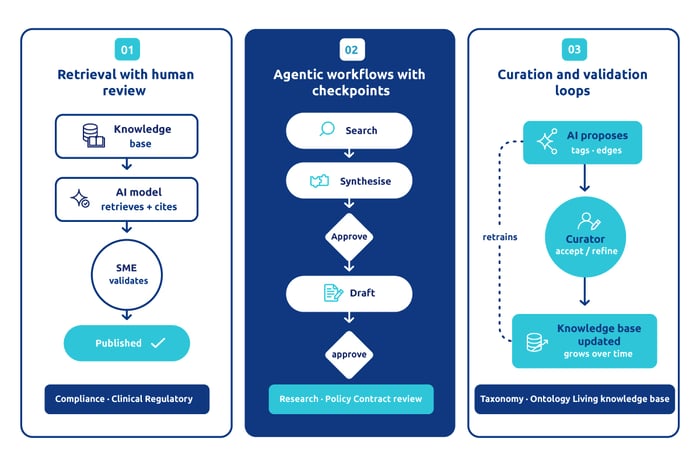
Curation and validation loops
AI proposes new content, tags, or knowledge graph relationships. Human curators accept, reject, or refine them, and those decisions train the system over time. This pattern keeps a knowledge base current and lets an ontology grow without a full manual rebuild. It is how knowledge infrastructure stays alive instead of decaying the moment it ships.
How to roll out a sort-first approach to AI knowledge management
Start with an audit, not an architecture diagram. Map the knowledge tasks your teams do today, score each one by stakes and judgment required, and categorize them as automated, expert-led, or human-in-the-loop. This tells you where AI pays off quickly and where it would quietly introduce risk, before you have spent anything on tooling.
Address the knowledge layer next. Identify where governed knowledge already exists and where it has to be built before any high-stakes workflow can go live. Then pilot human in the loop on one narrow, high-value use case, such as regulatory Q&A or clinical literature review, and measure both accuracy and time recovered. One number without the other tells you nothing useful.
Treat governance, escalation paths, and reviewer training as part of the rollout from day one rather than bolt-ons later. Pairing AI services that pair governance with delivery with this discipline is usually what separates a pilot that survives contact with production from one that stalls after the demo.
The payoff a CDO should track is concrete: faster decisions, fewer duplicated efforts, higher answer accuracy, and quicker onboarding as knowledge stops living only in people's heads.
Build AI knowledge management that keeps humans where they matter most
The value of AI in knowledge management comes from sorting work well, not from automating broadly. Governed knowledge enables AI to operate on trusted information, while human oversight provides the accountability needed for high-risk enterprise decisions.
Get those two rights and the business case follows: less knowledge lost when people leave, less work repeated, and AI answers your teams can act on without second-guessing.
Datavid builds the governed knowledge layer that makes this work, and has done it inside the regulated environments where the margin for error is smallest. If you are deciding what to automate and what to keep human in your own knowledge operations, that decision is far easier once you know the state of the knowledge underneath it.
Assess what to automate, what to keep human, and where your knowledge layer needs governance.