


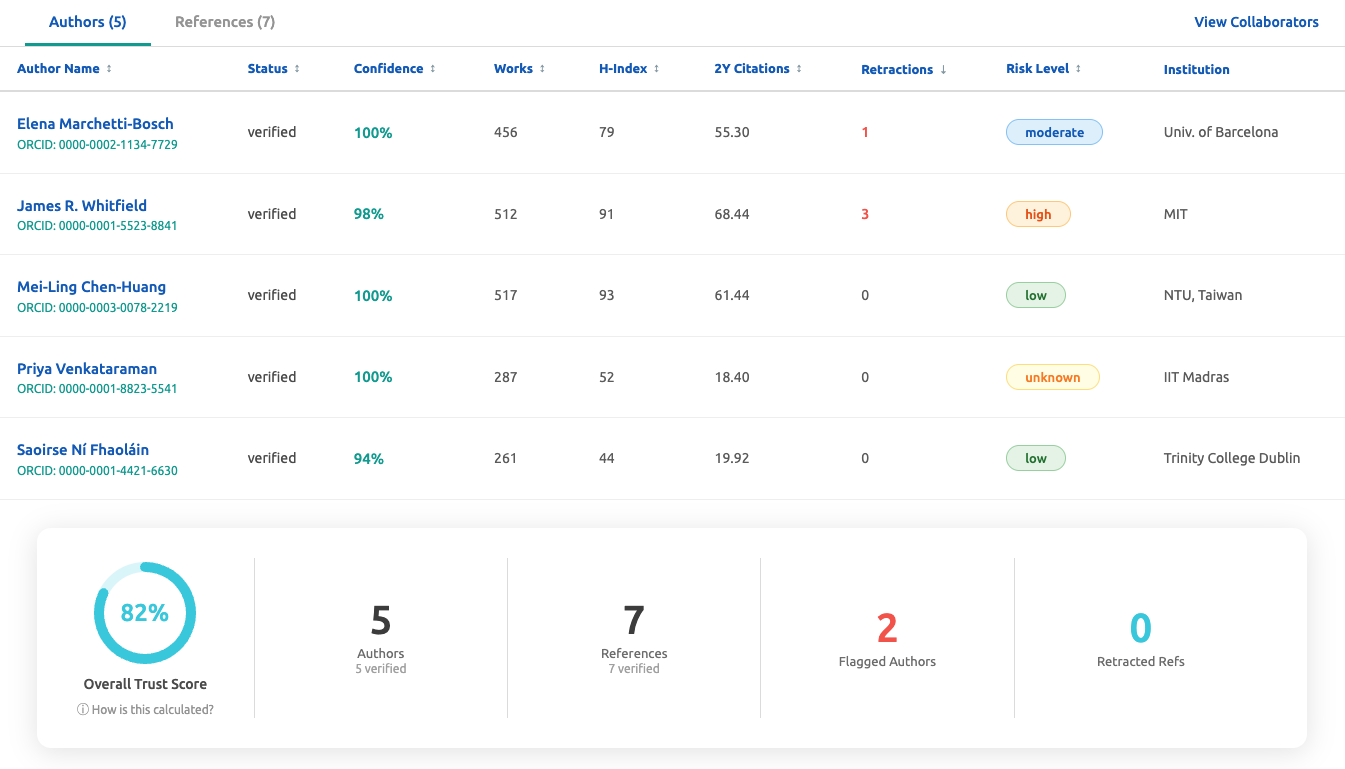

Trust Signals provides editors with evidence-based insights by analyzing 30+ trust markers to help you vet authors faster and more confidently.
Why it matters
Editors no longer need to rely on intuition or manual checks. Trust Signals transforms metadata into a transparent confidence score you can cite, share, and defend — helping you protect your journal’s reputation, prioritize editorial review, and streamline peer review.
How Trust Signals works
Using verifiable research metadata and adaptive scoring, we assess manuscripts across four dimensions to produce a single, explainable Trust Score
(0–100). Topic alignment and collaboration network analysis reveal patterns beyond the manuscript — so you can quickly identify what warrants closer review.
Author credibility & verification
Detects identity mismatches and authorship anomalies to spot paper-mill patterns.
Reference quality & integrity
Flags retracted or circular citations.
Institutional trust & affiliations
Verifies affiliations via ROR and OpenAlex.
Transparency & compliance
Checks funding, open access, and clinical trial disclosures.
Shape how integrity is assessed
Join a small group of publishers evaluating how transparent, evidence-based scoring supports editorial decision-making.
The goal:
Screen authors, manuscripts, and references with PID-backed integrity checks (e.g. ORCID, ROR, CROSSREF).
Catch problems before peer review - not after publication.