
6 minute read
.png)
Quick Answer
The biggest risk in enterprise AI today isn't a weak model; it's a decision no one can defend in an audit. As AI moves into business-critical workflows, the deciding factor is trusted knowledge, semantic context, governance, explainability, and human oversight.
Enterprise AI has entered a new phase. The race is no longer about who has access to the smartest model. It's about who can trust AI enough to use it in real business decisions.
Trusting AI systems to handle customer decisions, compliance filings, or revenue numbers without requiring a person to re-check every output by hand remains one of the biggest challenges for enterprises. This was the central theme of the Humans & AI panel at Knowledge Summit Dublin 2026, where industry leaders converged on one point: the next phase of enterprise AI will be decided by trust, not by which team has the smartest model.
AI is moving at an extraordinary speed. Enterprise trust must keep pace
AI innovation is accelerating faster than ever, but enterprise adoption is proving far more complex. While organizations are investing heavily in AI, many are still struggling to turn pilots into measurable business outcomes. The challenge is not keeping up with the pace of AI innovation—it's building the trust, governance, and organizational readiness needed to make AI work at scale.
- 80.3 percent of AI projects deliver no business value. RAND 2025, confirmed by Gartner in April 2026. Twice the failure rate of conventional software.
- Three patterns explain nearly every failure. Data quality, organizational maturity, and use-case drift. Not technology problems, leadership, and process gaps.
Why speed without trust does not scale
Foundation models are more capable, deployment is easier, and adoption is accelerating across customer support, enterprise search, regulatory analysis, and software development. The question for most organizations isn't whether to adopt AI; it's how fast they can do it without creating risk they can't explain later.
That's the tension every CXO is now managing: moving fast enough to stay competitive, but not so fast that governance, reliability, and accountability get left behind.
Ford's decision to bring experienced quality engineers back into the manufacturing process demonstrates that true excellence is built on quality, trust, and accountability. While AI accelerates inspection and detects patterns at scale, it cannot replace the judgment earned through years of engineering expertise. The strongest quality systems combine human insight with AI, ensuring every decision is trusted, every product meets the highest standards, and accountability remains at the heart of delivering safe, reliable outcomes.
Charles Poon, Ford's Vice President of Vehicle Hardware Engineering, summed it up: AI is a "fantastic tool," but only as good as the information used to train it.
Trust is not a single project. It is an operational capability that needs deliberate investment across five areas.
1. Strengthen AI governance
Define approved data sources, acceptable model usage, human review requirements, audit logging, and risk classifications by use case. This is what turns AI adoption from ad hoc to accountable.
2. Connect fragmented enterprise knowledge
Prioritize the knowledge behind your highest-stakes decisions: policies, regulatory documents, product and customer definitions, and business glossaries. Disconnected knowledge is the single biggest driver of inconsistent AI output.
3. Build explainability into every workflow
Every recommendation should trace back to its source, show the policy or rule that shaped it, and carry a confidence level. If your team can't explain an output in an audit, it isn't production-ready.
4. Human & Accountability
Define clear escalation paths for low-confidence responses, compliance-sensitive queries, and financial or legal recommendations before you need them, not after an incident.
5. Measure trust, not just accuracy
Track source traceability, review effort, audit success rate, and override frequency. These tell you far more about production readiness than model accuracy alone.
Read: How to make your enterprise data AI-ready — a practical framework
What does it mean to move at the speed of trust?
Moving at the speed of trust does not mean slowing innovation. It means ensuring that AI adoption is supported by the governance, transparency, and operational controls needed for confident decision-making at scale.
Think of enterprise AI readiness as a stack. Weakness in any single layer limits how far AI can go, no matter how strong the model on top of it is.
Each layer plays a critical role:
- Trusted data – Accurate, governed, and up-to-date information that provides a reliable foundation.
- Trusted knowledge – Connected business concepts, definitions, and domain expertise that give AI meaningful context.
- Trusted context – Relationships, policies, business rules, and organizational meaning that enable AI to interpret information correctly.
- Governance and control – Access controls, lineage, versioning, auditability, and policies that ensure AI operates within enterprise standards.
- Explainability – The ability to understand, justify, and trace AI outputs back to authoritative sources.
- Human oversight – Expert review and accountability for high-impact, compliance-sensitive, or ambiguous decisions.
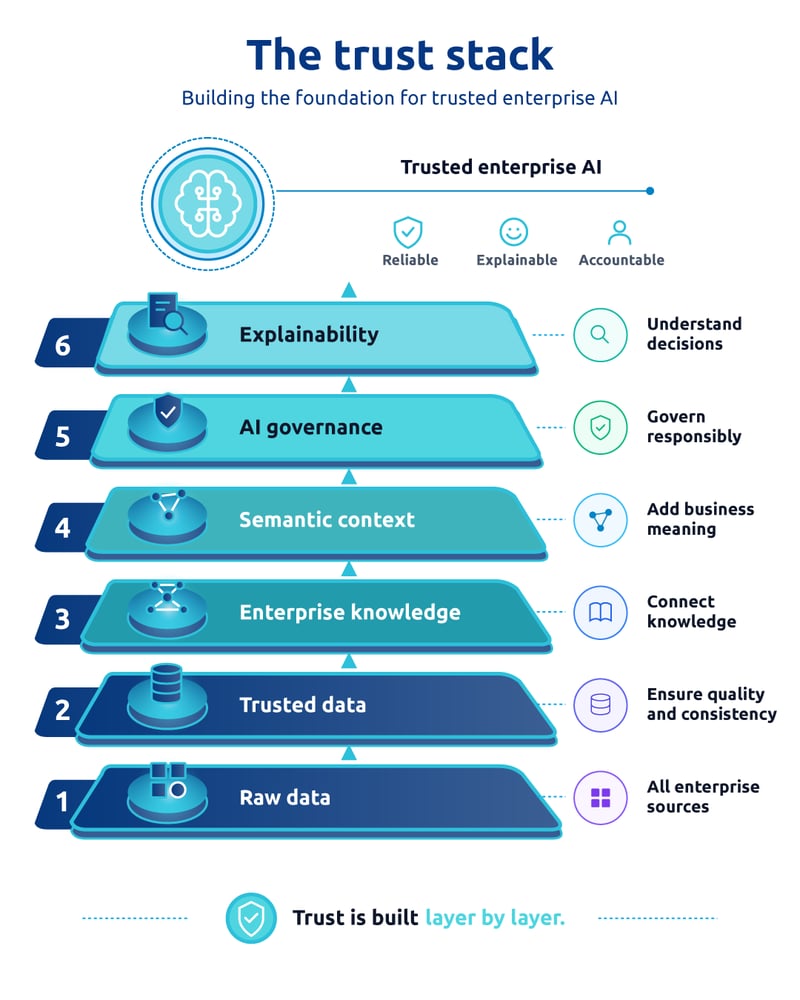
The strength of enterprise AI is only as strong as the integrity of every layer that supports it. A weakness in any one layer reduces confidence in decisions, increases operational risk, and limits production readiness, regardless of how capable the underlying model may be.
Why humans are still needed in AI
One of the strongest messages from the panel discussion was that enterprise AI does not remove the need for human expertise—it reinforces its importance.
AI can accelerate decisions, but accountability must remain with people. Human oversight is essential for:
- Enterprise accountability – ensuring clear ownership of AI-supported decisions.
- Escalation – reviewing high-impact or high-risk recommendations.
- Policy interpretation – applying business and regulatory requirements.
- Resolving ambiguity – making informed decisions when context is unclear.
- Preserving organizational memory – applying institutional knowledge and business expertise.
The most effective enterprise AI systems combine AI's speed with human judgment, governance, and accountability to deliver trusted, production-ready outcomes.
Why enterprise knowledge is the foundation of trusted AI
Many organizations have invested heavily in data platforms and AI technologies, but trust challenges often originate in the layer above the data: enterprise knowledge.
Enterprise knowledge rarely exists in one place. It is scattered across documents, SharePoint, collaboration platforms, business glossaries, policies, research repositories, structured databases, and other business systems. Without connecting these sources, AI can retrieve information, but it cannot understand the business context needed to deliver reliable, consistent, and trustworthy decisions.
A model that accesses disconnected content without understanding the relationships between business concepts, policies, and authoritative sources is operating with information—not enterprise knowledge.
At Datavid, we believe trusted enterprise AI is built on connected, governed, and semantically structured enterprise knowledge. By connecting structured and unstructured knowledge into a shared semantic foundation, organizations give AI the context it needs to produce explainable, auditable, and production-ready outcomes.
The role of semantic context
This is where semantic layers and knowledge graphs become strategically important.
A semantic layer provides AI with the business context it needs to interpret your enterprise information accurately. It helps AI understand what business terms mean, which systems are authoritative, how people, products, and concepts are related, which policies apply in different situations, how definitions vary across business units, and what information each user is authorized to access.
For example, the term “customer” may have different meanings in billing, support, and regulatory systems. A semantic model makes those distinctions explicit.
Datavid's experience across regulated and knowledge-intensive industries shows that semantic context is the missing layer between enterprise data and trusted AI. Trusted enterprise AI requires connected, governed, and semantically structured enterprise knowledge that gives AI the context to deliver explainable, auditable, and production-ready outcomes.
When organizations connect structured and unstructured knowledge through governed semantic models, they create a foundation that is more explainable, auditable, and resilient.
What enterprise leaders should do to build AI that can be trusted
Trust is not a single project. It is an operational capability that needs to deliberate investment.
Building trusted enterprise AI requires more than deploying powerful models. Organizations need strong governance, connected enterprise knowledge, explainable decision-making, human oversight for high-impact use cases, and metrics that measure trust alongside accuracy. Together, these capabilities create the foundation for AI systems that are reliable, transparent, and ready for production at enterprise scale.
Click to read: How to make your enterprise data AI-ready: a practical framework
Explore how Datavid helps organizations build trusted AI foundations
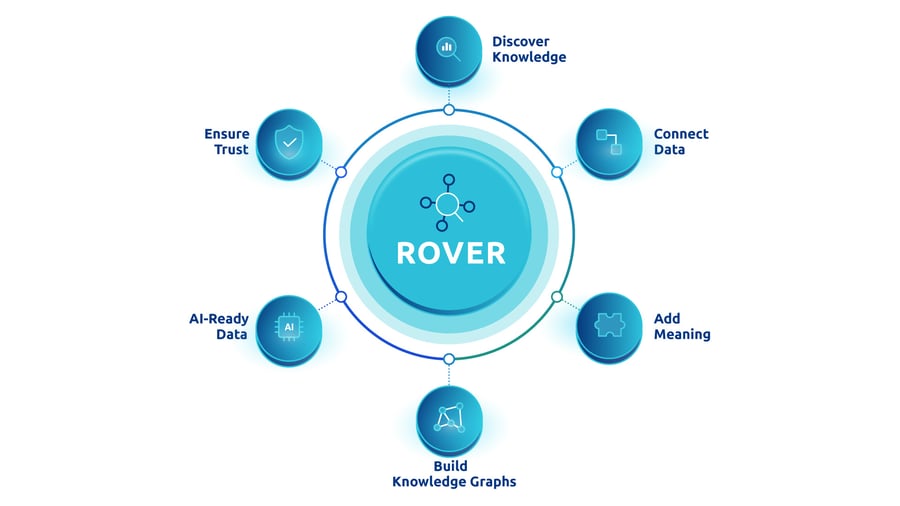
Enterprise AI becomes trustworthy when organizations have the right foundation beneath their models. Datavid Rover helps enterprises build that foundation by connecting structured and unstructured knowledge into a governed semantic layer that gives AI the context it needs to deliver accurate, explainable, and auditable outcomes.
Rather than relying on isolated documents or disconnected data sources, Rover creates a connected knowledge foundation where business concepts, policies, regulatory content, and enterprise definitions are linked through semantic relationships. This enables AI to understand not just information, but its business meaning and context.
With semantic layers, knowledge graphs, governance, and built-in traceability, Rover helps organizations move AI from experimentation to production. Every response is grounded in trusted enterprise knowledge, making AI more reliable for high-value use cases where transparency, accountability, and compliance matter.
Building trusted enterprise AI requires more than deploying powerful models. It requires connected enterprise knowledge, strong governance, explainability, human oversight, and measurable trust. Datavid Rover brings these capabilities together, helping organizations build AI systems that are reliable, transparent, and ready for production at enterprise scale.
Explore how Datavid helps enterprises build trusted knowledge foundations for explainable, governed, production-ready AI.