
5 minute read

Quick answer
AI is moving from answering questions to acting, such as updating records, triggering workflows, and routing cases. To do this reliably, it needs to understand what enterprise data means, how business entities relate to one another, and which rules apply. A semantic layer makes this meaning explicit and consistent across systems, giving AI applications a stronger foundation for decisions and automation.
For enterprises, the challenge is not just connecting more data or deploying more capable AI models. It is establishing shared business definitions that can be reused across applications.
By building this foundation once, organizations can reduce conflicting interpretations, avoid duplicated efforts across AI projects, and scale automation more effectively, while retaining appropriate human oversight. One infrastructure subsequently enabled rapid deployment of multiple use cases.
Having data is not the same as having shared meaning
Enterprises have invested heavily in data infrastructure, yet different systems can still interpret the same business information differently.
Consider a manufacturing company. For maintenance, an asset is a physical machine with an operating status and service history. For finance, it is a depreciating item with a book value. In the ERP system, it may be represented by a serialized part number.
Each record can be accurate within its own system, but the definitions are not necessarily interchangeable.
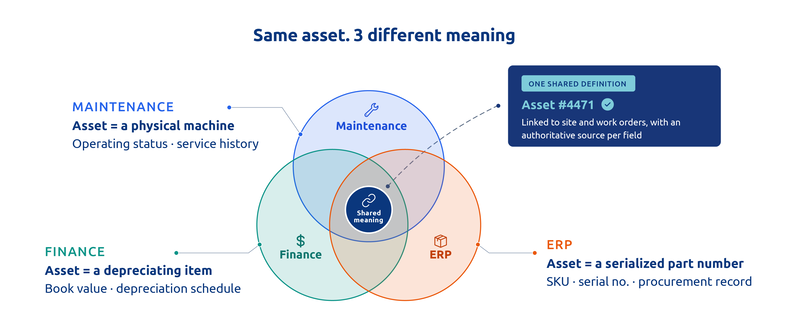
People bridge these differences through experience. They know which identifiers refer to the same equipment and how different records connect. AI applications cannot be assumed to make those connections correctly.
People also understand which data source is appropriate. One prototype chatbot for field engineers we reviewed was taking tolerance information from the marketing brochure rather than the technical data sheet.
The challenge is not simply whether data is available or structured. It is about whether the business's underlying meaning is sufficiently consistent to support a decision.
What changes when AI starts to act?
When AI generates an answer, a person can review it and correct misunderstandings. When an AI agent acts, that same misunderstanding can have operational consequences.
Consider logistics, where “delivered” might mean a shipment was scanned at a depot, received by the customer, or cleared for invoicing.
An agent that treats a depot scan as customer receipt could close a service case prematurely or trigger a payment before the required conditions are met. The workflow may be executed correctly, but the decision is based on the wrong interpretation.
This is not always a model-performance problem. Even a capable model can make an inappropriate recommendation when its business context is incomplete or ambiguous.
As discussed in Datavid’s article on enterprise AI decision-making, faster AI does not automatically translate into better business decisions. Shared meaning helps provide the context needed to interpret information and act with greater confidence.
What a semantic layer adds
Many data leaders know semantic layers as a way to standardize metrics and definitions for business intelligence. In enterprise AI, the concept extends to business entities, their relationships, applicable rules, and the origins of information.
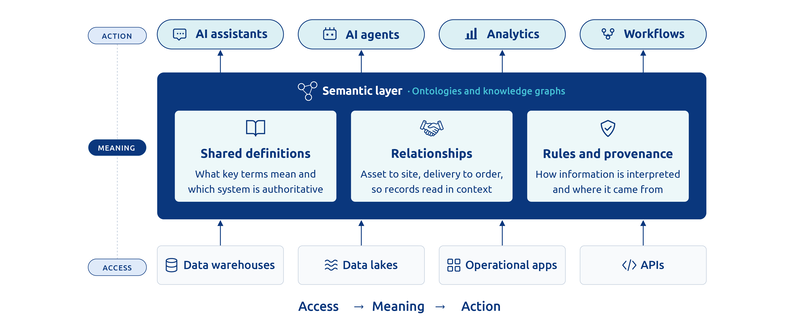
A semantic layer brings 3 elements together:
- Shared definitions: Establishing what key terms mean and which system is authoritative for each one.
- Relationships: Connecting entities, such as an asset to a site or a delivery to an order, so applications can interpret records in context.
- Rules and provenance: Clarifying how information should be interpreted and where it originated.
Ontologies and knowledge graphs are among the technologies used to represent these concepts and relationships in a structured, reusable form.
A semantic layer does not replace the systems that hold enterprise data. It adds a shared understanding of what those systems contain and how they work alongside existing warehouses, data lakes, operational applications, and APIs.
Build meanings once. Reuse it across AI initiatives.
Without a shared foundation, every AI project risks developing its own interpretation of the business. Teams duplicate mapping work, introduce competing definitions, and build logic that becomes difficult to maintain across applications.
A shared semantic foundation offers a different approach. Business definitions, relationships, and rules can be established once and reused across assistants, agents, analytics, and workflows.
Different applications can retain their own permissions and decision controls while drawing on a consistent understanding of the business.
For enterprise leaders, this makes semantic infrastructure more than a fix for an individual AI project. It can become a reusable infrastructure that supports AI adoption across the organization without requiring existing systems to be replaced.
What regulated industries already understand
Life sciences have long faced the challenge of making scientific information discoverable and meaningful across fragmented systems.
Datavid’s work with Syngenta illustrates the value of addressing this challenge. Syngenta’s crop protection R&D teams needed to access scientific knowledge spanning decades of research, multiple sources, and various formats.
Datavid developed Synapse, an AI-powered semantic search platform that uses semantic enrichment and knowledge graphs to connect information and improve discovery.
According to the published Syngenta Synapse case study, the solution made more than 16 million documents across 22 sources searchable. The case study also reports improvements in search performance and reductions in the time spent on data discovery.
The lesson extends beyond life sciences. The value comes not simply from making more data accessible, but from connecting information through shared concepts and relationships so it can be interpreted and reused.
Manufacturing, logistics, and other industries face similar challenges as AI moves closer to operational decisions. The terminology differs, but the need for consistent business meaning remains.
Where should enterprises start?
Building a semantic layer does not have to begin with a company-wide transformation. A focused workflow provides a practical starting point.
- Choose one high-value workflow. Start with a process in which an incorrect decision carries a measurable cost or risk.
- Identify 5 to 10 key business terms. Find where definitions differ across the systems involved.
- Establish authoritative sources and relationships. Document the relevant definitions, connections, and business rules.
- Measure the impact. Track errors, exceptions, manual rework, or decision time before expanding to other use cases.
Human accountability remains essential. A semantic layer supports better interpretation, but it does not replace appropriate approval processes, access controls, or risk-based oversight.
From data access to meaningful action
As enterprise AI moves from answering questions to executing workflows, access to information is no longer enough. Organizations need AI applications that can interpret business context and operate within business boundaries.
A semantic layer can help establish that understanding, reduce duplicated interpretation across projects, and provide a reusable foundation for automation.
The question is no longer simply whether AI can access the data. It is whether the enterprise has given AI enough shared meaning to understand what it is acting on.
Access → Meaning → Action.
Explore how Datavid can help you build the semantic foundation your AI and automation initiatives depend on.