
6 minute read
.png)
Quick answer
Publishers can add integrity screening without disrupting editorial workflows by using an approach that connects to existing submission data, uses trusted identifiers, provides explainable outputs, and supports editors inside the processes they already use. The goal is to surface manuscript risk signals earlier without creating another disconnected system to maintain.
Publishing technology teams are often asked to support new editorial tools that promise better screening, faster review, or improved research integrity.
The promise may be valuable, but even useful tools can create problems if they do not fit into existing submission workflows.
Editors may need to leave the system they currently use to visit other sites. Submission information may need to be checked manually. Results may sit on a separate dashboard. IT teams may need to support another integration, another login, another data flow, and another set of user questions.
For integrity screening to work at scale, it has to do more than identify risk signals. It has to fit in with the way publishing teams already work.
That is especially important for publishers trying to strengthen research integrity without slowing editorial teams down or increasing technical burden. A screening layer that is difficult to access, difficult to understand, or difficult to support can quickly become another operational problem.
The goal should not be another disconnected tool.
It should be a way to flag earlier manuscript risk signals inside the editorial workflow, with outputs that editors, research integrity teams, and publishing technology teams can trust.
Integrity screening is also a workflow challenge
Integrity screening is often discussed as an editorial or research integrity issue. That makes sense. Editorial and research integrity teams are the ones reviewing submissions, assessing concerns, and deciding whether a manuscript should move forward, be flagged as a potential concern or desk rejected.
But integrity screening is also a workflow challenge.
The signals that matter often depend on information already moving through the submission process: author details, references, funding information, affiliations, disclosures, identifiers, and manuscript-level data.
If those signals are difficult to access, difficult to connect, or difficult to surface at the right point, screening becomes harder to operationalise.
The challenge is not only whether integrity risks can be identified. It is whether those signals can be raised inside the workflow where editorial decisions are made.
For publishing technology teams, this matters because they are often responsible for making new tools work reliably across existing editorial systems. They need to think about how screening fits into current processes, how results are presented to users, how data is handled, and how much support the tool will require once it is live.
A screening approach that works well in isolation may still fail in practice if it does not fit the daily workflow of editors and research integrity teams.
Why disconnected tools create technical and editorial friction
A new tool can be helpful in theory and frustrating in practice.
If integrity screening sits outside the editorial workflow, it can create additional steps for the people it is meant to support. Editors may need to check another dashboard. Research integrity teams may need to compare outputs with separate notes or systems. Technology teams may need to manage another integration, another software platform and another set of user questions.
This is where disconnected tools create friction.
Separate tools can become cumbersome. They can create confusion, increase costs, and make it harder to trace how decisions were made. Manual checks or having to upload or export manuscripts can also introduce extra work and increase the risk of inconsistency.
If integrity screening creates another disconnected process, it risks becoming one more system that editors must check and one more tool for technology teams to support.
That can affect adoption.
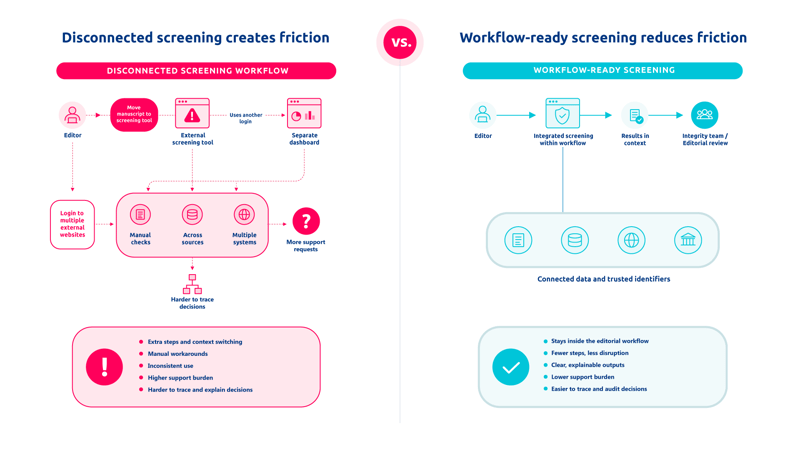 Editorial teams are unlikely to keep using a screening tool if it feels like extra admin. Research integrity teams are unlikely to trust outputs that are difficult to explain. Technology teams are unlikely to support another system long term if it creates avoidable complexity.
For integrity screening to succeed, it needs to reduce friction rather than add to it.
What publishing technology teams need from integrity screening
Publishing technology teams need more than a promising screening concept. They need an approach that can work reliably inside real editorial operations.
A workflow-ready approach to integrity screening should:
- Work with existing editorial and submission workflows
- Use structured submission data where available
- Support persistent identifiers such as ORCID, ROR, Crossref, and Crossmark
- Provide explainable outputs that editors and integrity teams can understand
- Reduce manual checks and workarounds
- Avoid unnecessary context switching
- Support data privacy and governance requirements
- Be reliable enough for operational use
- Reduce support burden rather than add to it
These requirements matter because publishing technology teams sit between editorial ambition and operational reality.
They need to support tools that help editors and research integrity teams do better work, but they also need to protect the stability of the wider publishing environment. A screening approach that depends on too many manual steps, unclear outputs, or unstable processes will be difficult to maintain.
The strongest approach is one that supports the existing workflow while making risk signals easier to find, understand, and act on.
Integrity screening needs the right data connections
Successful integrity screening relies on being able to connect the right submission information to the right trusted sources.
Author details, references, affiliations, funding information, disclosures, and identifiers all help build a clearer view of potential manuscript risk. These elements are often reviewed separately, but they become more useful when they can be connected and interpreted together.
Persistent identifiers play an important role here.
Identifiers such as ORCID, ROR, Crossref, and Crossmark can help link submission information to authoritative sources. This can support checks around authors, affiliations, references, corrections, retractions, and related publication information.
For publishing technology teams, the practical question is not whether accurate information matters. Of course it does.
The question is whether the screening approach can connect the right information at the right point in the workflow, without creating additional manual work for editorial teams.
When those connections are manual or fragmented, screening becomes harder to automate and harder to explain. When those connections are structured and reliable, screening can support clearer outputs, smoother workflows, and more consistent editorial review.
Integrity screening is only useful if it can connect the right submission data to the right trusted sources at the right point in the workflow.
Explainability matters for adoption and support
Explainability is often discussed from a research integrity perspective. Teams need to understand why a manuscript has been flagged before they can investigate, escalate, or clear it.
But explainability also matters for technology adoption.
If outputs are unclear, publishing technology teams will have to provide support to clear up any possible confusion. Editors may ask what a score means. Research integrity teams may need help interpreting why something was flagged. Product and systems teams may need to explain whether the result is reliable enough to use in the workflow.
A black-box output creates more questions than answers.
Explainability reduces friction because teams are more likely to trust and use screening outputs when they understand the reasoning behind them.
For editors, this means seeing why a submission may need closer attention. For research integrity teams, it means having a clearer evidence trail. For technology teams, it means fewer avoidable support issues and a stronger basis for adoption.
A screening approach that cannot explain its outputs may technically function, but it will be harder to embed in a real editorial workflow.
How Trust Signals supports workflow-ready integrity screening
Trust Signals is Datavid’s approach to structured, evidence-based manuscript screening.
It helps publishers connect manuscript risk signals that may otherwise remain scattered across manual checks, systems, and workflows. It analyzes submissions across multiple trust markers, including signals related to authors, references, affiliations, funding, disclosures, and manuscript-level attributes.
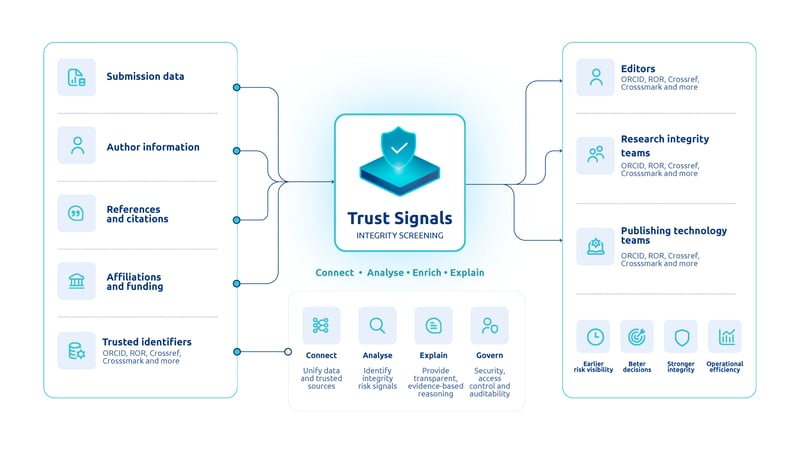 For publishing technology teams, the value is not only that risk signals can be identified earlier.
The value is that those signals can be made clearer, more structured, and easier to support across the editorial workflow.
Trust Signals is designed to provide explainable outputs, so editors and research integrity teams can understand what has been flagged and why. It supports editorial and research integrity decisions while keeping humans in control.
It also reflects a practical principle: integrity screening should not replace the systems publishers already rely on. It should support the workflows, data connections, and decision points that already exist.
The goal is not to add another tool to maintain. It is to make integrity signals easier to detect, understand, and act on within the editorial workflow.
What publishing technology teams should ask before adding integrity screening
For reviewing integrity screening options, the first question should not be whether the tool can identify risk.
It should be whether the tool can fit the workflow.
Useful questions to ask include:
- Does the screening approach fit our current editorial workflow?
- What submission data does it need?
- Can it use persistent identifiers such as ORCID, ROR, Crossref, and Crossmark?
- Does it provide explainable outputs?
- Will editors need to use another dashboard or manual process?
- How are results are presented to editorial and research integrity teams?
- How is data handled, and is it secure?
- What implementation support is needed?
- Will this reduce manual workarounds or create new ones?
- What would success look like in an early access pilot?
These questions can help technology teams evaluate whether integrity screening will support the publishing workflow or add another layer of complexity.
For publishers, successful adoption depends on more than the strength of the screening model. It depends on whether the screening process is usable, explainable, reliable, and aligned with how editorial decisions are determined.
Ready to explore workflow-ready integrity screening?
Trust Signals helps publishers surface and connect risk signals earlier without creating another disconnected tool for editors or IT teams to manage.

to help shape the next generation of workflow-ready integrity screening