
7 minute read
.png)
Quick Answer:
AI can produce an answer in seconds. That does not mean your organization can make a decision in seconds. In many enterprises, the bottleneck is increasingly moving. The problem is no longer simply getting an answer from AI. It is determining whether that answer is trustworthy enough to act on.
A business leader may receive an AI-generated recommendation almost instantly, but before acting, someone still needs to ask: Where did this information come from? Is it current? Does it apply to this situation? What evidence supports it? Which policy or jurisdiction matters? Who is accountable for the decision?
That gap matters because organizations do not create value by generating AI outputs. They create value when people can confidently turn those outputs into decisions and action.
In this context, decision velocity is the speed at which an organization moves from an AI-generated insight to a trusted business decision and action.
The goal is not simply to make AI faster. It is to become faster with AI while maintaining the confidence needed to act.
AI is getting faster. Enterprise decisions are not.
Consider a typical enterprise scenario. An AI assistant is asked about a customer, an operational issue, an investigation, or a business process. Within seconds, it produces a detailed answer.
Technically, the system has done its job.
But the business may still need time before it can act. The answer needs to be grounded in authoritative, up-to-date information, interpreted in the appropriate business context, and checked against relevant policies, permissions, and approval requirements.
The AI response took seconds. Establishing enough confidence to act could take hours or days. This is why improving decision velocity requires looking beyond model performance.
A faster model can reduce the time needed to generate an answer. It does not automatically reduce the time needed to trust that answer.
For enterprises, the more useful question is therefore not:
How quickly can AI answer?
It is:
How quickly can the enterprise trust the answer enough to act?
For Operations teams, AI is increasingly being used to improve efficiency, reduce costs, and speed up decisions. But if every output still requires significant manual validation, the bottleneck simply moves.
There is also a risk of context poisoning: when an AI-generated answer is recorded and used as context for future answers, an inaccurate or unverified response can influence what comes next. Trusted, authoritative context, therefore, matters not only for the decision at hand, but for the quality of future AI outputs.
What holds back decision velocity?
The factors slowing enterprise decisions are rarely just about AI.
They are often rooted in the information and processes surrounding it.
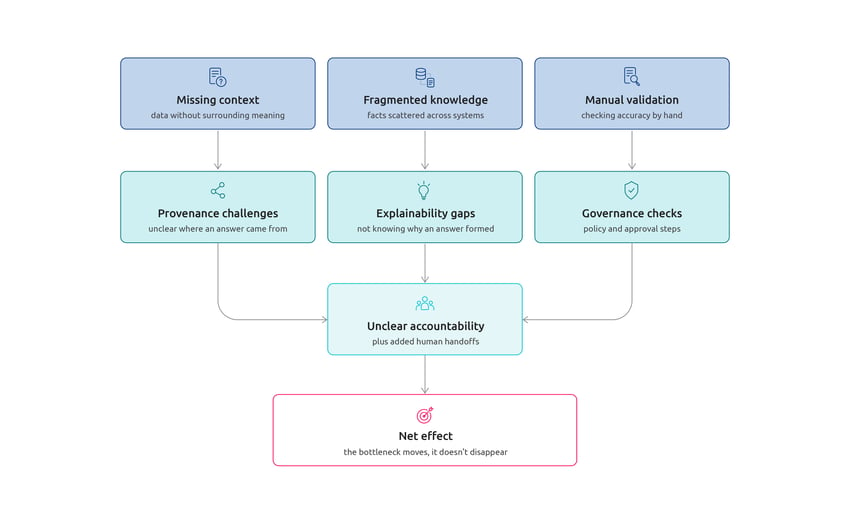
Missing context. An AI system may retrieve a relevant piece of information without understanding the broader business context around it.
Fragmented knowledge. Important facts may sit across documents, systems, databases, teams, and applications. People must reconstruct their relationships before they can be confident in an answer.
Manual validation. Employees may spend significant time verifying that AI output is accurate, up to date, complete, and appropriate for the situation.
Provenance challenges. If people cannot easily see where an answer came from, they have less basis for trusting it.
Explainability. For important decisions, knowing the answer is not enough. Teams may need to understand what information informed it, what evidence supports it, and how it relates to the business context.
Governance checks. Data access, policies, compliance requirements, and approval processes can all affect how quickly a decision can move forward.
Unclear accountability. When AI contributes to a decision, organizations still need to know who owns the outcome.
Human handoffs. Every additional person or team involved in checking, interpreting, approving, or transferring information can add time and friction.
Request overload
Operations teams are increasingly overwhelmed by the sheer volume of requests, making it harder to prioritize, investigate, and act quickly.
None of these checks is inherently bad. In many situations, they are necessary.
The problem is when people have to perform the same checks repeatedly because the information, context, evidence, and decision rules are difficult to access or connect.
Improving decision velocity is therefore less about removing controls and more about making trust easier to establish.
Make AI outputs easier to trust and act on
One important foundation for faster decisions is better access to the context surrounding an AI-generated answer.
Connected enterprise knowledge can help bring together the information, entities, relationships, and sources needed to properly understand a question.
Semantic context can play an important role here.
Semantic structures add explicit meaning and relationships to enterprise information, helping AI systems and users interpret information in context, trace relationships, and understand where an answer came from.
That matters when an employee needs to validate an AI output.
Rather than manually reconstructing the meaning behind an answer, they can work from connected information and clearer provenance. The result is not that every AI answer becomes automatically correct. It is that some of the work required to establish confidence becomes easier and more systematic.
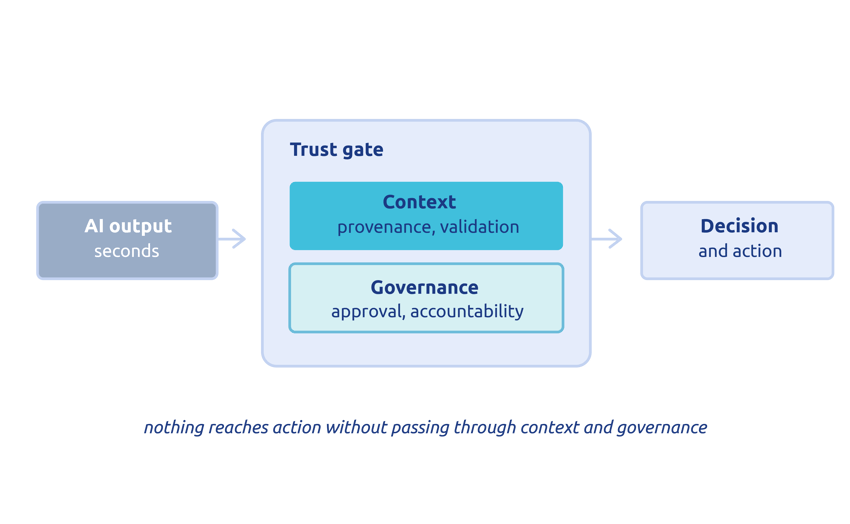
A useful way to think about this is:
AI output → Context → Trust → Decision → Action
The stronger the foundation between those stages, the less friction an organization has to overcome before acting.
A practical example: from fragmented knowledge to faster investigation
Consider a Life Sciences research organization working with large amounts of fragmented information.
Researchers may have relevant knowledge distributed across documents, datasets, entities, relationships, and different information sources. Finding the right information is one challenge. Understanding how pieces of information relate to one another and validating the resulting answer is another.
A connected knowledge foundation can bring those relationships into a more usable context.
Instead of spending weeks finding and reconstructing the information needed to answer a research question, teams can reduce that effort and reach useful answers in hours.
The important point is not that semantic context alone creates this improvement. The outcome depends on the broader foundation: connected data, appropriate context, usable information, governance, and decision-making processes.
But reducing the time spent on finding, interpreting, and validating context can narrow the gap between an insight and an action.
This is not the same as automating the decision itself. It removes one source of friction before the decision can be made.
And that is ultimately what matters for decision velocity.
Governance and human oversight should enable decisions, not delay them
Trust does not mean removing governance.
Effective governance can support faster decision-making by reducing uncertainty about what AI is allowed to do, what data it can use, and when human judgment is required.
The challenge is designing governance around the level of risk involved.
A low-risk operational task should not necessarily go through the same review process as a high-impact regulatory or financial decision.
Organizations can define clear boundaries for where AI can act, where it can recommend, and where a person must approve.
They can also establish rules around:
- Which data sources can be used
- How information should be validated
- What provenance needs to be retained
- Which decisions require approval
- Who is accountable for the outcome
- Where AI can operate autonomously
When these rules are clear and embedded into the workflow, governance becomes an enabler rather than another layer of uncertainty.
The opposite can also happen. If every AI output triggers the same manual checks and approval steps, governance can become a bottleneck.
The goal is not less governance.
Governance helps the right decisions move faster.
Human-in-the-loop does not mean human-in-everything
Human oversight remains essential where judgment, accountability, or risk demands it.
But putting a person at every step of every AI workflow does not necessarily lead to better decisions.
A better approach is to determine where human involvement adds the most value.
For example, AI may be able to act autonomously within clearly defined boundaries for low-risk, repeatable tasks. In other situations, it may generate a recommendation for a person to review before taking action. For high-risk or consequential decisions, human approval may remain essential.
The distinction is important.
Human-in-the-loop should mean that human judgment is applied where it matters, not that humans are required to manually validate everything an AI system produces.
An evidence-grounded investigation workspace illustrates this principle well.
Instead of simply giving an analyst an AI-generated conclusion, the system can first build a case plan based on the organization's own evidence. The analyst owns that plan. They can rewrite a step, reorder it, add something the system missed, or skip a step with a reason attached.
Nothing executes silently.
In this model, actions do not execute silently and everything is auditable.
The plan itself becomes part of the audit trail: what was considered, what the analyst decided, and what evidence supported the work.
The AI's role can remain deliberately constrained to the evidence retrieved from approved organizational sources, with outputs traceable back to that evidence.
That creates a different model of AI assistance.
The value is not just speed. It is speed with defensibility, consistency, and accountability.
General-purpose AI assistants are typically optimized to produce an answer. An evidence-grounded system can instead be designed to show what is known, what is not known, and where the supporting evidence came from.
That difference matters when the decision has consequences.
How leaders can increase decision velocity
Improving decision velocity starts with identifying where trust breaks down.
Leaders can begin by measuring what happens after an AI output is generated.
Useful measures include:
- Time between identifying an insight and taking action.
- Time from AI output to decision or action
- Number of validation steps required
- Number of human handoffs
- Time spent finding supporting context or provenance
- Percentage of outputs requiring additional verification
- Escalation or rework rates
These measures can reveal whether the real bottleneck is the model, the data, the workflow, governance, or some combination of them.
From there, organizations can focus on practical improvements:
Make context easier to access. Connect the information people repeatedly need to interpret AI outputs.
Make provenance visible. Give users a clear path from an answer back to the evidence supporting it.
Reduce repeated validation. Where the same checks happen repeatedly, build them into the workflow rather than relying on manual effort each time.
Embed governance earlier. Define rules and boundaries before AI reaches the decision stage.
Use risk-based human oversight. Reserve deeper human review for decisions where judgment and accountability genuinely require it.
Automate appropriate low-risk steps. Let AI handle repeatable work with clear boundaries, while keeping people responsible for decisions that require human judgment.
The objective is not to remove every step between AI output and business action.
It is to remove unnecessary friction from those steps.
Decision velocity is the business advantage
AI capability creates potential.
Decision velocity creates business value.
Organizations will not create enterprise AI value through model speed alone. The ability to turn AI-generated insights into trusted decisions and action depends on connected information, the right context, trusted data, effective governance, and clear accountability. When these foundations are in place, organizations can reduce the friction between an AI-generated answer and the decision that follows.
That requires more than AI capability.
It requires connected information, meaningful context, trusted data, clear provenance, appropriate governance, defined accountability, and human oversight where it matters.
The advantage comes from making those pieces work together.
Insight → Trust → Decision → Action.
The less unnecessary friction between those stages, the faster an organization can respond to opportunities, resolve problems, and act on what it knows.
So, the real question is not how quickly A
I can answer. It is how quickly the enterprise can trust the answer enough to act.
Explore how Datavid can help assess the data, context, and governance foundations behind your enterprise AI initiatives.