
8 minute read
See how a semantic model keeps terms consistent across systems, with 5 examples.
Quick answer
A semantic data model describes data by what it means in the real world. It captures the entities an organization tracks, the relationships between them, and the rules they follow. Because that meaning sits above tables and columns, people and software can interpret the data in the same way.
Without shared definitions, data may be read correctly by chance, or it may take on whatever meaning someone assigns to it. Neither is ideal in a business setting.
For data architects and analytics leads new to semantics, the decision is which use case to model first and who owns each term. A semantic model gives the chief data officer (CDO) they report to an agreed set of definitions for reports and AI to share.
Giving people and AI one agreed version of the business is the problem a semantic data model sets out to solve, a pattern Datavid (a C5i company) works on with data teams across regulated industries. Datavid’s Semantic5i platform (formerly Datavid Rover) supports that work by organizing content from different sources around a shared ontology.
At a glance
- Conceptual, logical, and physical models describe how data is organized, while a semantic model records what each term stands for.
- Power BI semantic models and semantic layers both rely on a semantic model underneath, though each does a different job.
- AI assistants tend to answer more consistently when they read from a governed semantic model.
- A first model often works best around 1 use case, with named owners who keep it current.
What’s obvious to me isn’t obvious to you, and data is no different.
What is a semantic data model?
The simplest definition of a semantic data model is a description of your data in business terms. It names what the company cares about, how those things relate, and what must be true of them.
Take Maria studies at Harvard. Maria and Harvard are entities, and “studies at” is the named relationship between them.
Entities and attributes
Entities are the things a company talks about, such as a customer, a product or a patient. Attributes add detail, like a patient’s date of birth, and each should match across systems.
Named relationships
Relationships carry meaning of their own, such as “holds an account with” or “is prescribed.” A relational table usually hides that link in a foreign key, so readers may have to guess.
Rules and constraints
Rules state what has to be true, for example, that every invoice belongs to exactly 1 customer. With the rules written into the model, the software has a standard against which to test new data.
How is a semantic data model different from relational, conceptual and logical models?
People compare a semantic model with a data model because each answers a different question. A semantic model is built upon concepts and meanings, unlike the traditional data model, which is based on tables, columns, and rows. It usually sits atop conceptual, logical, and physical models, keeping them in place.
|
Model |
Who uses it |
What it captures |
|---|---|---|
|
Conceptual data model |
Business stakeholders |
Core entities and how they link, such as “customer places order” |
|
Logical data model |
Data modelers |
Attributes, keys and relationships, such as an order’s customer ID |
|
Physical (relational) data model |
Database engineers |
Tables, columns and indexes, such as an ORDERS table |
|
Semantic data model |
People, applications and AI |
Meaning and rules across systems, such as “active customer” defined once |
Semantic data model, semantic layer and Power BI semantic model
Ask “what is a semantic model?” and the answer depends on who’s asking. In Power BI, the term names a reporting dataset, while data teams may mean a semantic layer or the model of meaning itself. The semantic layer vs data model question gets simpler once you see how the 3 connect.
|
Term |
What it is |
Main job |
|---|---|---|
|
Power BI semantic model |
A dataset of tables, measures, and relationships |
Gives reports a single governed set of figures |
|
Semantic layer |
A layer between data sources and the tools that query them |
Serves governed definitions to business intelligence (BI) and AI tools |
|
Semantic data model |
The agreed meaning of entities, relationships, and rules |
Supplies the common language the other 2 rely on |
A semantic layer is only as reliable as the model it draws on, so the model usually comes first.
Why semantic data models matter
Semantic modeling matters when you want to capture more meaning out of your data. It defines data by its meaning in the real world and brings relationships to the surface. It also gives people and systems a shared language, so finance and sales are more likely to agree on what “customer” means.
AI raises the stakes. A large language model (LLM) or AI agent needs those shared definitions too, or it may pick the wrong one and answer with confidence. An AI semantic layer serves them to the model as it reads the data. Choose the knowledge layer first, then the model.
How are semantic models built?
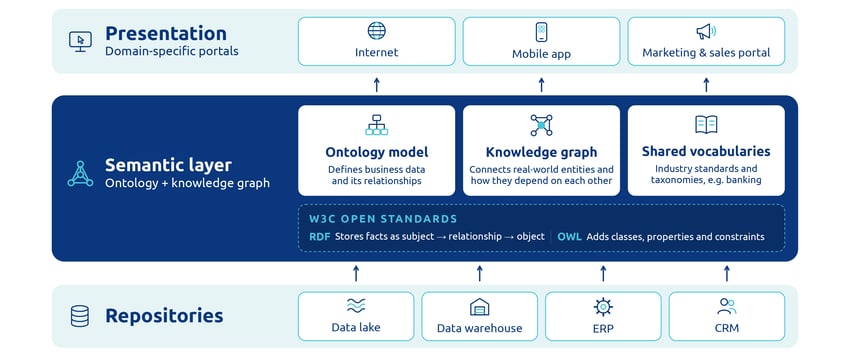
An ontology model identifies and describes business data, establishing existing relationships among the data. A knowledge graph visually represents real-world entities and their interdependencies.
Both are often written in open standards from the World Wide Web Consortium (W3C). The Resource Description Framework (RDF) stores facts as subject, relationship, and object statements. The Web Ontology Language (OWL) adds classes, properties, and constraints on top.
Industries such as banking publish shared vocabularies in these formats. If you’re weighing a simple vocabulary against a full model, settle the ontology versus taxonomy choice early.
5 semantic data model examples
A useful semantic data model example starts with a familiar problem: a product, patient, or account described differently in each system. Banking and healthcare show industry vocabularies solving it at scale, and AI assistants reveal why it now matters beyond reporting. The last 2 are projects delivered by Datavid.
1. Banking with a shared customer and transaction vocabulary
Banks acquire customer data from an increasingly wide number of sources (e.g. online purchases, credit apps, social media). Because many banks organize their systems around products, that data often sits in silos.
How semantics gets applied in banks
A well-designed semantic data model for financial institutions introduces a common business language understandable by people and machines across the bank.
The model uses knowledge graphs that map business objects and their underlying relationships, using information stored in databases and in text documents as well.
Subject matter experts (SMEs) from across the organization collaborate to create knowledge graphs, and to do so, they don’t have to start from the beginning.
They use the Financial Industry Business Ontology (FIBO) to define business terms, processes, and transactions in the financial industry and map relationships. FIBO is an OWL ontology hosted by the Enterprise Data Management (EDM) Council and standardized by the Object Management Group (OMG).
Semantics in regulatory reporting
That vocabulary can also support regulatory reporting, since figures described in FIBO terms trace back to a single agreed source. At ABN AMRO, Datavid extended the bank’s existing Progress MarkLogic platform to handle daily Markets in Financial Instruments Directive II (MiFID II) reporting.
2. Healthcare records that agree on each condition
Conventional technology can struggle to manage the huge variety of disparate healthcare data.
An example is Electronic Health Records, which are created from various sources. Here, a medical condition can be described in different ways.
Take a ‘heart attack ’, which is ‘myocardial infarction’ in medical terminology. If a cardiology system records the first term and a billing system records the second, the patient may appear to have 2 separate conditions.
People often use ‘cardiac arrest’ interchangeably with ‘heart attack’, but they are 2 different emergencies. This could lead to an incorrect diagnosis, resulting in the wrong treatment and endangering the patient’s life.
Semantics brings strong interoperability to healthcare data
To achieve strong interoperability, semantics create a common vocabulary that assigns a common meaning to each health condition. A condition recorded as “heart attack” in System 1 and “myocardial infarction” in System 2 can then be matched correctly.
Many health systems do this with Systematized Nomenclature of Medicine Clinical Terms (SNOMED CT). Maintained by SNOMED International, it holds more than 350,000 clinical concepts with defined links between them.
3. AI assistants that answer from agreed definitions
Ask an AI assistant how many active customers you have, and it has to decide what “active” means. Sales may count open contracts, while finance counts customers billed in the last 90 days.
A governed semantic model provides the LLM or agent with the agreed-upon definition. That grounding, which depends on AI-ready data, is one of the more reliable ways to cut wrong answers alongside testing and human review. A related approach, GraphRAG, uses retrieval-augmented generation (RAG) that pulls its facts from a knowledge graph.
4. Standards search that matches what people mean
Organizations use Compliance Navigator from the British Standards Institution (BSI) to align their requirements with the applicable standards. Its keyword search relied on exact matches, so a vague query such as “cardiac catheter” often came back empty.
Datavid built an ontology-based knowledge graph linked to BSI’s standards database. That query now returns standards for catheters and implantable devices, and fewer users abandon their search. The 6-week build is a useful example of a semantic model for document-heavy teams.
5. Scientific search built on medical and chemical vocabularies
A global scientific society and publisher needed search that could keep pace with its research content. Datavid built a cognitive search platform that tags concepts in each document and maps them to Medical Subject Headings (MeSH), PubChem, and the society’s own taxonomies. Researchers now find relevant information in seconds.
How to build a semantic data model in 4 steps
Semantic data modeling works best in small steps that each end with a result stakeholders review. A data architect can run them with 1 domain team before the model grows. That keeps progress visible to the CDO and gives the next project a tested model to build on, which limits rework later.
1. Choose the business use case
Start with a single use case that has a low barrier to entry and clearly defined outcomes.
The business use case can help focus the views of both IT and the business. With both sides involved from the start, the model is more likely to get used.
2. Model the entities, relationships, and rules with domain experts
Start from an industry vocabulary such as FIBO or SNOMED CT where one exists, then add your own terms. Agree each definition with the people who use it daily. With ontology management in place, the model stays versioned and searchable as it grows.
3. Map your existing data to the model
Your data architecture might comprise various databases and data warehouses. Thankfully, semantic modeling usually doesn’t require existing data assets to be modified.
Keeping the model and its mappings in open W3C formats keeps them usable in other tools. The model can outlive the tools.
4. Govern and maintain the model
The model stays useful while it matches how the company works, which takes 3 habits:
- Assign a named owner to each domain who approves changes.
- Version the model so that applications know which release they are reading.
- Review it when products or regulations change.
Start your semantic data model with 1 use case
Before you make a choice in favor of semantic data models, you need to look carefully at the business outcome you wish to achieve.
For a CDO, the practical move is 1 governed use case with a clear owner that can deliver a working result in 6 to 8 weeks. The Datavid Rover (now Semantic5i) semantic data platform can shorten that work. It’s an accelerator a delivery team uses to extract and map concepts across your sources while the model takes shape.
Not sure if your data is AI-ready? Start by identifying your opportunities