
7 minute read
Quick answer: Vertical AI is not a model you buy or train. It is a capable LLM grounded in your organization's entities, terminology, policies, and controls through an ontology, a knowledge graph, and a semantic layer, with GraphRAG as the retrieval architecture that puts that foundation to work. In regulated enterprises, that foundation often separates AI that clears an audit from AI that stalls after a promising pilot.
If you are weighing where to put your next AI investment, you have likely seen the pattern that makes the decision hard. A pilot performs beautifully in a demo, then loses credibility the moment it meets production data, regulatory scrutiny, or a question requiring two facts held in different systems.
Most CDOs have ruled out doing nothing and are choosing between two costly paths. Train your own domain model, and you take on cost, time, and a talent market that barely exists. Clean up your data quality, and you get tidier inputs carrying no structural meaning.
Neither explains why the budget stops renewing. This piece lays out the foundation both paths skip, so you can judge what to build before committing to a model.
At a glance
- Generic AI tends to plateau after the pilot, because a general-purpose LLM carries little representation of the entities or governance rules that define your business. Fine-tuning and document-level RAG both help, but neither adds that governed representation.
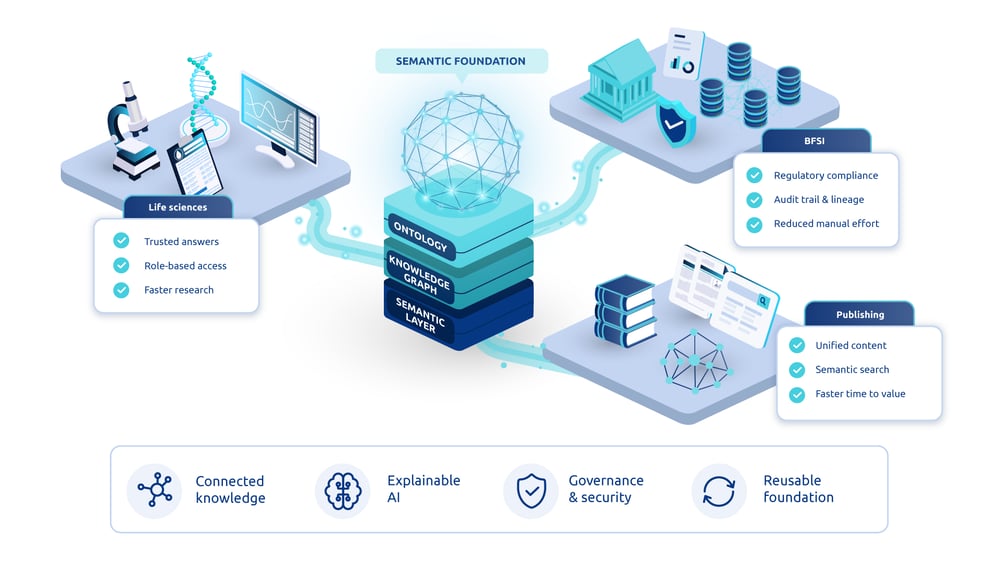
- Three layers help a capable model behave like a domain expert: an ontology defines meaning, a knowledge graph connects entities, and a semantic layer keeps the foundation governable and reusable.
- GraphRAG operates that foundation in production, combining graph, vector, and keyword retrieval to support claim-level citation and explainable AI.
- The ROI case rests on reuse, fewer rebuilt integrations, and outputs that stand up to regulatory review.
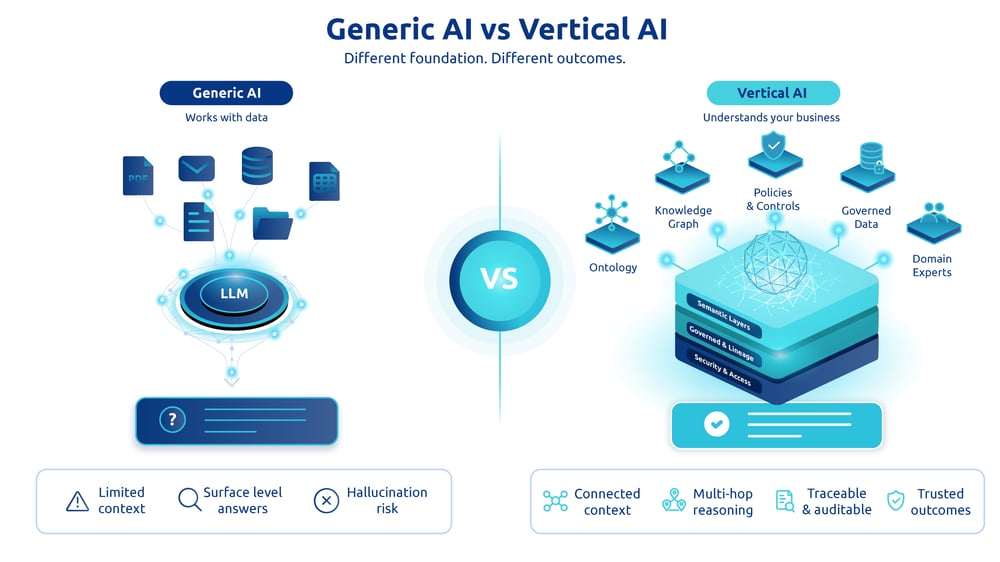
Vertical AI vs generic AI
The two approaches diverge on what decides whether a pilot reaches production.
|
Criterion |
Generic AI |
Vertical AI |
|
Knowledge source |
Public training data |
Your governed enterprise knowledge |
|
Understands your entities |
Little to none |
Modeled in an ontology |
|
Reasoning across records |
Text similarity only |
Multi-hop across defined relationships |
|
Citation |
Document level at best |
Claim level, to source records |
|
Audit readiness |
Retrofitted after the fact |
Property of the architecture |
|
Cost per new use case |
Rebuilt each time |
Falls as the foundation is reused |
What vertical AI means inside a regulated enterprise
The term has three meanings, and conflating them leads CDOs to make the wrong buying decision. It can mean industry SaaS with AI features attached, or custom-trained industry models like the BloombergGPT archetype, or a capable general model grounded in one organization's knowledge.
For most Chief Data Officers in life sciences, banking, or publishing, only the third is realistically buildable.
"Domain-specific" here rarely means "specific to my industry." Industry-specific AI trained on public text does not know that your organization treats "study" and "investigation" as distinct entities with different approval paths.
The useful definition is narrower: AI grounded in your terminology, entities, policies, and controls. That shifts the buying decision from model selection toward foundation design, a very different budget conversation.
In regulated environments, vertical AI has to clear an operational bar that generic AI struggles with:
- Explainability: a reviewer can see why the system produced an answer, not just that it did.
- Provenance: every claim traces back to a specific source record.
- Governance: access control, lineage, and audit trails apply as to any regulated system.
Fall short and the pilot stalls before production. That is the risk a buying decision must price in, before a model is selected.
Why generic enterprise AI plateaus after the pilot
The plateau is rarely a model quality problem. A general-purpose LLM pattern-matches language about your industry while carrying little representation of the entities and governance rules that define your business. It knows what a clinical trial is, but not what your trials are or which obligations attach to them.
Two common fixes fall short. Fine-tuning adapts a model's language but adds little understanding of how enterprise entities relate, and standard RAG improves factual accuracy while vector similarity alone still cannot reason across connected entities. That is a foundation problem, not a model problem.
The question for any evaluation is whether the approach gives the model a governed representation of your entities, not just more parameters.
The foundation that makes domain-specific AI work
A domain-specific system has to answer three questions a model cannot answer alone: what does this term mean here, how do these entities connect, and how does it stay governable as use cases multiply. A solution that cannot demonstrate all three rarely scales beyond the pilot.
1. Ontologies: giving your AI a shared definition of the domain
An ontology is a formal model of the concepts, entities, and relationships that matter in your business: compounds and protocols in pharma, or counterparties and obligations in banking.
Without one, a model has little basis for knowing that "trial," "study," and "investigation" mean the same thing in your organization, or when they deliberately do not. That is where AI-ready data quietly fails: clean data, undefined meaning. Treating ontology management as an ongoing discipline keeps meaning stable as the business changes.
2. Knowledge graphs: connecting entities so the AI can reason, not just retrieve
A knowledge graph turns the ontology into live, queryable structure across your enterprise data, which is what supports multi-hop reasoning. The AI follows a chain of defined relationships, from compound to trial to regulator to obligation, rather than guessing at connections.
It also lets outputs cite specific claims to specific source records, much of the difference between an answer you can defend and one you can only hope is right. Knowledge graph solutions built on a governed ontology make that trail practical.
AbbVie's TCPR2 platform shows the return. Research data was transformed into RDF triples, letting scientists run property-specific queries across complex structures, and the reusable search components were later applied to other projects.
3. Semantic layer: making the foundation scale across use cases
The semantic layer is the governed, reusable interface between your enterprise data and every downstream AI application, so each use case is not a fresh integration project.
This is where the ROI compounds, and it is the number worth taking to a CFO. Without it, each use case rebuilds the same plumbing and carries its own governance review. With it, the foundation is paid for once and drawn on repeatedly, so cost per use case falls as the portfolio grows. That curve is the core of the build-versus-buy argument.
It is also where governance, access control, and audit trails live. Building a semantic layer for AI readiness is what sits under GraphRAG and agentic AI deployments.
How GraphRAG turns semantic foundations into vertical AI
GraphRAG is how the foundation operates in production, sitting between the two expensive paths most enterprises consider. It combines graph traversal with vector similarity and keyword retrieval, so the model is more likely to receive the right evidence rather than the closest text.
That combination can change what the model is able to do:
- Multi-hop reasoning across governed enterprise data, following defined relationships rather than inferring them.
- Claim-level citation, where an assertion points to the source record it came from.
- Traceable outputs, so a reviewer, auditor, or regulator can follow the reasoning path.
GraphRAG services can provide that operational layer inside regulated enterprises, without the cost and scarce talent a proprietary model demands. Where accelerators and existing semantic assets are available, a focused prototype reaches users faster, and a pilot that shows value early is more likely to keep its budget.
GraphRAG is not a guarantee of accuracy. It depends on the ontology beneath it and the review around it. What it changes is whether a wrong answer can be caught and corrected.
What semantic foundations look like in life sciences, BFSI, and publishing
The pattern holds across regulated sectors. These are not examples of replacing generic models with sector-specific ones, but of the governed knowledge infrastructure that lets AI operate in domain-specific enterprise environments.
Life sciences: grounded assistants for policy, research, and clinical data
Roche's compliance advisors were fielding roughly 10,000 policy inquiries a year with delays often exceeding 24 hours, and an earlier attempt to centralize that knowledge had stalled for two-and-a-half years.
A semantic knowledge base delivered in six weeks unified the policy content, extracted entities, and built a knowledge graph with role-based access. Employees got real-time answers and compliance teams could update content without waiting on IT. The Roche policy assistance engagement also left a reusable foundation for AI-powered compliance workflows.
BFSI: audit-ready data foundations for regulatory and trade data
The banking lesson is not about a "finance LLM." It is about grounding data in the obligations, entities, and controls that regulators actually audit, so any AI built on top can be trusted.
ABN AMRO's regulatory trade data hub extended the bank's TradeStore with semantic enrichment using metadata and RDF triples, plus granular capture of every action from ingestion through reporting. The outcome was daily MiFID II compliance, straight-through processing, and end-to-end audit trails.
Provenance and explainable AI carry real weight here, and a semantic layer is one of the more reliable ways to support them, because the audit trail becomes a property of the architecture rather than a report generated afterward. The return is manual effort removed and exposure reduced.
Publishing and standards: turning content archives into governed assets
Publishers and standards bodies do not need a vertical model. They need archives modeled as connected, governed knowledge that AI can reason across.
The American Chemical Society consolidated decades of fragmented content into a cloud-native content lake with semantic enrichment. As the case study describes, that unified content was made ready for AI, text, and data mining. Processing ran 50% faster, storage costs dropped 30%, and preparation of 2,400+ posters and nearly 890 books fell from hours to minutes. The case study names Chief Data Officers as the beneficiaries, numbers a CDO can defend in a budget review.
BSI's compliance navigator shows the same principle where the governed knowledge is the standards themselves, surfaced through semantic search.
Where to start before you invest in a domain-specific model
The sequence matters more than the tooling. Three steps a senior data leader can act on without a procurement cycle.
Audit your semantic readiness. Ask what entities, relationships, and rules a domain-specific system would need, then how much already exists in governed form. The gap is usually meaning rather than volume, and sound data governance is often where that material lives.
Scope one use case around the foundation, not the model. Pick something high-value and high-friction, such as a policy assistant or regulatory response engine, then define the ontology and graph it needs. The model becomes an implementation detail.
Decide the delivery model honestly. Building a governed semantic foundation in-house tends to be a multi-quarter program requiring ontology, graph, and data architecture skills that are scarce and expensive. A specialist can compress that into weeks, shifting the payback period.
Building the foundation for trustworthy vertical AI
For a data leader deciding where to commit budget, the pattern points one way: durable value in enterprise AI rarely comes from the most impressive model. It comes from AI that can explain itself, cite its sources, and hold up when a regulator or scientist asks how it reached its conclusion.
That makes grounded AI a foundation decision before a model decision. Build the ontology, connect the graph, govern the semantic layer, and a capable model starts behaving much more like a domain expert. The return arrives as reuse, faster delivery, and outputs that stand up to review, which is what the right AI services partner should help you build.