

9 minute read
Quick answer
GxP validation documents that a system used in regulated life sciences does what it is intended to do, reliably and traceably, under regulations such as GMP, GCP, and GLP. Generative and agentic AI require a different approach from fixed algorithms, focusing on the data retrieved, rules followed, and records left. Validate this foundation within a defined context of use, and much of the evidence auditors need can be produced as the system runs.
GenAI assistants and agents are arriving in clinical, regulatory, and quality workflows faster than the validation playbook for fixed software can keep pace with. Regulators are still finalizing how to treat them, and a use case that can't be validated is unlikely to reach a GxP workflow.
That tends to make the validation strategy a gating decision for AI, and much of it falls to the CDO, who is accountable for the data these systems run on. In pharma, the governed data foundation under clinical and research AI is increasingly where that evidence comes from.
At a glance
- GxP validation asks the same question of AI as of any system: is it fit for intended use, and can you show it?
- Classical machine learning can be validated as a closed model, while generative and agentic systems tend to require validation of the data around them.
- GAMP 5, FDA guidance and CSA are broadly aligned on risk-based assurance.
- Six controls cover much of what an inspector asks about an AI system, and each depends on governed data.
- Building that foundation first can make validation evidence a by-product of running the system.
What GxP validation means, and what changes for AI
What is GxP validation in practice? It's documented evidence that a computerized system used in GMP, GCP, or GLP work is fit for its intended use. The classic GxP validation process runs from requirements and risk assessment through IQ, OQ, and PQ to periodic review, usually following GAMP 5.
Three kinds of AI an inspector may meet
|
AI type |
How it behaves |
What validation tends to focus on |
|
Classical, locked machine learning |
Same input, same output |
Model, training data, retraining trigger |
|
Generative models |
A new answer each time |
Context of use, retrieval, output checks, review |
|
Agents acting across systems |
Decides its next step at runtime |
Each action, its permissions, its record |
The ISPE AI Maturity Model frames this as a rise in autonomy.
What this means for the CDO
For generative models and agents, validation increasingly needs to cover the data, retrieval, rules, and permissions around the model. That puts a CDO near the center of GxP life sciences validation, and it's why life sciences data programs increasingly treat provenance and access rules as validation assets.
The standards that govern AI validation in GxP
No single standard covers GenAI in GxP yet, and the existing ones broadly agree on a risk-based, context-of-use approach. Anchoring on the GxP regulations your inspectors cite most, and mapping the others to a single control set, gives a CDO a single evidence list.
GxP regulations and guidance mapped to AI evidence
|
Standard or guidance |
Status |
What it covers |
Evidence expected for AI |
|
GAMP 5 and the ISPE GAMP Guide: Artificial Intelligence |
Published |
Risk-based lifecycle, fit-for-purpose data |
Lifecycle activity and data quality matched to risk |
|
Draft |
Risk-based credibility assessment |
A documented context of use and credibility evidence |
|
|
Final |
Risk-based assurance over scripted testing |
Assurance effort matched to risk |
|
|
EU GMP Annex 11 and draft Annex 22 |
Annex 22 in draft |
Computerized systems and AI in GMP |
Deterministic models in critical uses, GenAI kept out |
|
21 CFR Part 11 and ALCOA+ |
In force |
Electronic records, signatures, data integrity |
AI outputs that become records meet ALCOA+ |
|
EU AI Act |
In force, phased |
Obligations by risk tier |
Risk management, logging and oversight |
What the table means in practice
The draft Annex 22 position is a key reason GenAI in GMP tends to sit behind retrieval, rules, and human review rather than acting as the system of record, while the FDA credibility assessment offers a template for a context of use. For GxP compliance, modeling the knowledge foundation once turns each new guidance into a mapping exercise rather than a rebuild, where data governance services pay back.
Why GenAI and agents strain the classic GxP validation process
Classic computer system validation assumes deterministic behavior: defined inputs produce predictable, repeatable outputs, so a system can be tested against requirements, locked, and kept under change control. Generative models are probabilistic, so the same prompt can produce different but equally plausible answers, and an agent decides its next step at runtime. What you tested is rarely quite what runs in production.
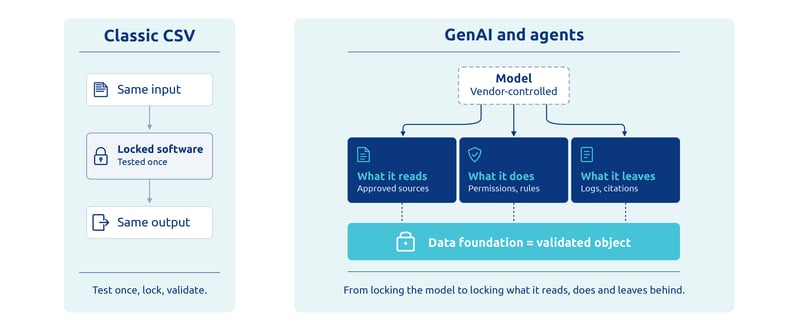
Three breaks in the classic approach
- The model is a changing component: It's supplier-controlled, so a vendor update can become an uncontrolled change.
- The output is new text: It isn't a record that's traceable to a field, so the AI model's validation can't rely on field-level checks alone.
- The action spans systems: An agent's step crosses separately validated systems, with no validated record of the chain.
The reframe
Since the model can't be locked in the classic sense, the workable move is to lock what it may read, do, and leave behind. The data foundation then becomes a central part of what gets validated, and the semantic layer is where many of those rules live. A semantic layer explainer covers the concept, and knowledge graph solutions help enforce the rules at query time.
Six controls for validating agentic and GenAI systems in GxP
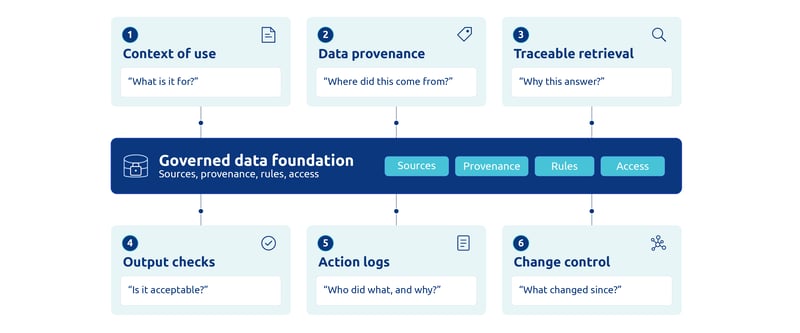
Six controls cover much of what an inspector asks about a GenAI or agentic system. Validation here increasingly needs to address not only the model but also the data, retrieval, rules, permissions, and controls around it, so each control pairs the inspector's question with the evidence to produce.
That is where the CDO's role matters: data quality, provenance, lineage, access, and governance underpin the evidence needed for AI assurance, translating a validation plan into fundable data requirements.
A defined context of use with the sources it may read
- The inspector asks: What is this system for, and what does it read?
Context of use is the FDA's starting point and a step many GenAI pilots skip. Define the task, users, and approved sources, then limit the model to those sources to validate it as a bounded system. In the Roche Policy Assistance work, dispersed policy content was consolidated into a semantic knowledge base on Rover within six weeks, with role-based access.
Fit-for-purpose data with provenance at ingestion
- The inspector asks: Where did this data come from, and is it current?
The GAMP AI guide's fit-for-purpose data principle and ALCOA+ both land here: each source needs origin, version, and status attached before a model reads it. At Roche Helios, study forms were mapped to a common semantic model, with ontology-based checks and business-rule validation in the pipeline.
Trial data processing became 5x faster, manual errors fell by 80%, and operational costs dropped 40%, with on-demand audit readiness for FDA and EMA. Checks at ingestion can produce evidence before an inspector asks, which is how clinical trial data programs pay back.
Retrieval that returns evidence with each answer
- The inspector asks: Why did the system give this answer?
A vector search returning similar passages struggles to answer that. Retrieval grounded in a knowledge graph returns identified entities and sources, so each answer carries evidence and review cycles tend to shorten. GraphRAG services deliver that pattern, and AI enterprise search covers how.
Output checks against rules the business owns
- The inspector asks: How do you know the answer is acceptable?
Define forbidden content and required elements as rules, such as off-label claims or mandatory citations, and check outputs against them automatically with reviewer sampling. EY's AI-tests-AI idea is one way to scale this. Sustained ontology management keeps those rules current and business-owned, so reviewers sample rather than read each output.
Action logs and permissions for each agent step
- The inspector asks: What did the agent do, with whose authority?
Each step benefits from a record of the user it acted for, the data it read, the rule applied, and the result. Human review is risk-based: routine steps run, consequential ones wait for sign-off. The Unifying Biobank work delivered a governed metadata knowledge graph and an RAG-driven workflow with agentic LLM orchestration across two biobanks in eight weeks, under strict security controls. This piece on knowledge graphs for AI agents covers the operating model.
Change control that covers the model, the data, and the ontology
- The inspector asks: What changed since you validated it?
Vendor model updates, new sources, and definition changes each typically require a release process. Versioned ontologies allow a definition change to ship as a release, with affected entities flagged, so a change rarely requires full revalidation. They also underpin AI decision traceability when a reviewer asks which version produced an answer.
From CSV to CSA: a risk-based GxP validation process for AI
Computer software assurance moves effort from exhaustive scripted testing to assurance proportional to risk, which suits a system that changes. CSA validation of an AI use case can follow five steps, and for a CDO the sequence doubles as a plan for the data work beneath it.
Five steps from context of use to monitoring
- Define and classify: Define the context of use and classify its GxP impact so effort matches risk.
- Model and govern the sources: Model the entities, rules and access policies for the sources the system reads, with provenance attached by data pipelines at ingestion.
- Stand-up traceable retrieval: Build retrieval that returns sources for each answer, plus the output rules.
- Test by risk: Test representative, rare, and failure cases, scripted where risk is high and unscripted where it's low, recording the evidence.
- Monitor under change control: Watch outputs, drift, and vendor model changes, treating each as a controlled release.
As one example of how governed semantic data, access control and knowledge management can support this operating model, a semantic data platform such as Rover carries reusable components for the sources, rules and provenance these steps rely on, so a first governed use case tends to reach a working result in 6 to 8 weeks. Forward-deployed engineering and governed AI services tend to shorten the pilot-to-production timeline.
GxP validation checklist for GenAI and agentic systems
The checklist pairs each check with the evidence that satisfies it, two per control, with the evidence after the colon. It suits a validation planning meeting and works as a first screen for the AI validation pharma teams are asked to plan, showing a CDO which gaps sit in the data.
Twelve checks and the evidence behind them
- The context of use is documented: a signed statement of the task, users, and sources.
- The model reads only approved sources: access rules are enforced at retrieval, with logs.
- Sources carry origin, version, and status: provenance metadata attached at ingestion.
- Data is fit for purpose: ingestion checks on AI-ready data.
- Each answer cites its sources: citations that resolve to identified entities.
- Retrieval is traceable: query logs of the entities and sources returned.
- Output rules are defined and owned: a rule set with business owners and versions.
- Outputs are checked and sampled: automated check results plus reviewer samples.
- Each agent step is logged: records of user, data, rule, and result.
- Consequential steps wait for sign-off: review thresholds with approval records.
- Model, data and ontology changes are controlled: release records with affected entities flagged.
- Vendor model updates are assessed: impact assessment and re-test records.
If the evidence is aspirational for more than two of these, the foundation is usually where to start.
AI adoption in GxP is more than a model validation problem
For a regulated enterprise, adopting GenAI and agents in GxP workflows isn't only a model validation problem. It's a context, data, governance, traceability, and change control problem, and those are the areas an inspector tends to ask about first.
A generative model is hard to lock, and in most cases you don't need to. Address what it reads, does, and leaves behind; add the risk-based oversight that enterprise AI decisions depend on; and ensure much of the evidence can be produced as the system runs.
Understand what it takes to validate your first GenAI or agentic AI use case for regulated life sciences. Assess your data foundations, provenance, and control gaps before moving into a GxP workflow.