
7 minute read
Quick answer:
AI-ready data is data that an AI system can find, trust, and reason over without a human stitching in the missing details each time. In practice, that resolves to the FAIR data principles, findable, accessible, interoperable, and reusable, plus an AI-specific layer of provenance, labeling, and semantics on top. Built in at pipeline design rather than retrofitted, it is what separates AI features that reach production from pilots that stall in review.
Most enterprise AI programs do not stall on model choice. They stall because the data underneath cannot be found, cannot be trusted, or cannot be reasoned over without an expert in the room, and stronger models rarely fix a foundation that was never built for machines to read.
For a chief data officer, that gap has a specific cost. Every stalled pilot is budget spent without a feature shipped, and every retrofit competes with the roadmap for the same engineers.
This piece defines AI-ready data concretely for an enterprise buyer, shows why FAIR is the foundation that the question resolves to, and covers the AI-specific layer that sits on top. The goal is a shared definition you can hold a program to, not another explainer.
At a glance
- AI-ready data is data that an AI system can find, trust, and reason over on its own, and the FAIR data principles are the practical standard that delivers it.
- Readiness is less a platform you buy than a property you build into data at design time, which tends to keep it off the roadmap as later rework.
- FAIR gives AI the four properties it depends on, and an AI-specific layer of provenance, labeling, and semantics turns FAIR-compliant data into training- and grounding-ready data.
- Retrofitting readiness after the fact tends to cost more than building it in, and some datasets fall out of reach entirely once consent or source knowledge is lost.
- Regulated enterprises tend to gain the most, because explainability, audit readiness, and compliance lean heavily on data that an AI can trace rather than guess.
- A governed semantic layer is the mechanism that makes data reusable across features rather than being rebuilt for each feature.
What AI-ready data means
AI-ready data is data that an AI system can act on without requiring a person to supply what is missing. That breaks into four concrete properties, and a fifth set of needs specific to AI.
A model needs data that is easy to locate, clearly defined, interoperable across systems, and accurate and up to date. When any of those fail, the risk of unsupported or poorly grounded outputs increases.
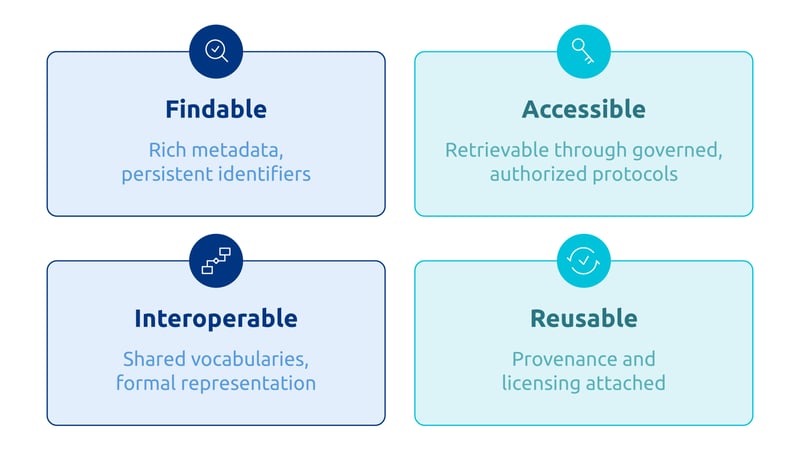
The four properties map directly onto readiness:
- Findable: rich metadata and persistent identifiers, so a system can locate the right dataset rather than the nearest match.
- Accessible: retrievable through governed, authorized protocols, so access is controlled without being blocked.
- Interoperable: shared vocabularies and formal representation, so data from different systems means the same thing.
- Reusable: provenance and licensing attached, so the same dataset serves many features instead of being re-prepared each time.
For a data leader, the payoff of defining readiness this way is that "data readiness for AI" stops being a vague aspiration and becomes a checklist a program can be measured against. In enterprise terms, AI-ready data is data that satisfies these properties before a model ever touches it.
Why FAIR is the foundation for AI-ready data
The four properties above are the FAIR data principles, and that is not a coincidence. FAIR was defined to make data usable by machines at scale, which is the same problem enterprise AI now faces outside the research settings where FAIR began.
That origin matters commercially. FAIR is the pragmatic middle ground between a platform pitch that promises readiness as a product feature and academic papers that treat it as a research ideal. It gives a CDO a recognized standard to fund against rather than a vendor's proprietary definition.
The definitions themselves are well covered elsewhere, so the useful move here is to point rather than repeat. For the business case for building FAIR early rather than late, the cost of delaying FAIR data principles sets out why the price rises the longer readiness is deferred, and AI-readable data covers what a machine-consumable structure looks like in practice.
The reader's benefit is standing. Adopting a standard the whole industry recognizes means a readiness program can be staffed, audited, and defended during a budget review, rather than relitigated every time priorities shift.
Beyond FAIR: the AI-specific readiness layer
FAIR gets data to the point where a machine can find and trust it. AI adds requirements on top, and this is the layer most platform pages skip.
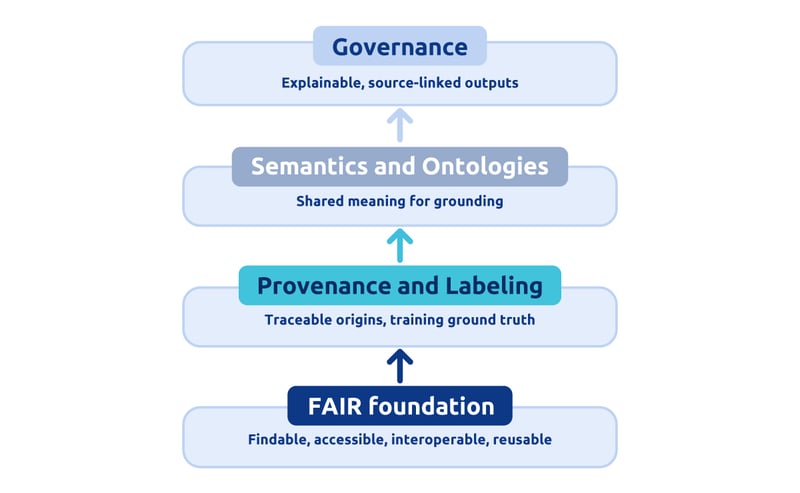
Three additions turn FAIR-compliant data into genuinely AI-ready data. The table below shows what each layer contributes and the reader benefit it unlocks.
|
Layer |
What it adds |
Benefit to the enterprise |
|
FAIR foundation |
Findable, accessible, interoperable, reusable data |
Data a machine can locate and trust |
|
Provenance and labeling |
Traceable origins and training ground truth |
Faster audit sign-off, defensible models |
|
Semantics and ontologies |
Shared meaning for grounding |
Consistent answer features can rely on |
|
Governance |
Reviewable, source-linked outputs |
AI that is easier to approve, monitor, and scale |
Taken together, these are what move data from FAIR-compliant to genuinely AI-ready.
Provenance and labeling for training
A model trained on data of unknown origin is a compliance liability waiting to surface. Provenance records where each record came from and how it was transformed, and labeling gives supervised systems the ground truth they learn from.
For a regulated enterprise, this often determines whether a model can be defended to an auditor. The benefit is direct: traceable training data means faster sign-off and fewer features held in review.
Semantic enrichment and ontologies for grounding
Retrieval and reasoning need more than keyword matching. A model has to know that two differently named fields refer to the same real-world thing, which is what ontologies encode. Grounding a model in a knowledge graph built on knowledge graph solutions is what lets it reason over connected data rather than pattern-match text.
The payoff shows up as answer consistency. When the same question tends to return the same grounded answer, a feature becomes something a product team can rely on rather than a caveat.
Governance for explainability
Explainability is not only a model property; it also depends on the data and context behind an AI system's outputs. If the data carries provenance and semantic structure, an AI system can show which sources produced an answer. Built through AI services designed around governed data, that traceability is what turns a black-box output into an auditable one.
For a CDAO, this is the layer that converts AI from a risk the board worries about into a capability the board can approve.
Making enterprise data AI-ready in practice
The single most consequential choice is when readiness gets built. Retrofitted, it is a project with its own budget that pulls engineers off features. Built into pipeline design, it is a marginal cost absorbed into work already happening.
That design-time approach is data engineering work more than governance paperwork. The mechanism is a governed semantic layer that sits over source systems, holding the metadata, vocabularies, and provenance that make data findable, interoperable, and reusable by default.
Two principles keep it practical for an enterprise:
- Build readiness into the pipeline where data is created, so each new source arrives AI-ready rather than joining a backlog of remediation.
- Model the narrow slice a real use case needs first, prove it, then extend, so the first feature ships without waiting for an enterprise-wide program.
The ROI is compounding. The first use case incurs the setup cost, and every subsequent feature reuses the same governed foundation rather than rebuilding it from scratch. That is what turns readiness from a recurring tax into a one-time investment that pays down over the roadmap.
Why regulated enterprises trust Datavid for AI-ready data
The pattern above is only useful if it survives contact with a real regulated environment, with real volume, real audit requirements, and real legacy systems. That is where delivered evidence matters more than method.
The Roche Helios platform is a concrete example. Fragmented clinical trial data were mapped to a common semantic model with FAIR principles embedded at the pipeline level, resulting in 80% fewer manual errors, 5x faster trial data processing, 40% lower operational costs, and on-demand FDA and EMA audit readiness.
Read those numbers as a CDO would. Fewer manual errors is lower operational risk, faster processing is shorter time to insight, lower cost is budget freed for the next initiative, and on-demand audit readiness is a compliance burden turned into a standing capability.
A second example shows the same foundation serving a different problem. The ACS content lake unified decades of scientific content, spanning 2,400 posters and 890 books, into a single governed repository, delivering 50% faster processing and a 30% reduction in storage costs. For a data leader, that is duplication removed and the same content made reusable across every downstream AI and search feature, rather than being re-prepared each time.
The wider point is that FAIR-by-design delivery, semantic and knowledge-graph capability, and a regulated-industry track record are what move AI-ready data from a whiteboard definition to a production foundation. Accelerators can considerably compress the build when the domain and the range of the source systems are clearly defined.
Assess your data's AI readiness
Most AI features on your roadmap inherit the readiness of the underlying data. The features that ship, get reused, and pass audit are the ones built on a foundation that an AI can find, trust, and reason over; the ones that stall are usually waiting on data that was never made ready.
The next step is to find out where your data actually sits against that standard, before the next planning cycle, rather than after it.