Industry
Life Sciences
Challenge
A global pharmaceutical organization faced fragmented biobank environments, inconsistent metadata, and limited automation, slowing cross-biobank research and increasing operational overhead.
Solution and Results
A global pharmaceutical organization partnered with Datavid to deliver an ontology-driven metadata platform that standardizes how research questions are interpreted and executed across biobank environments. By unifying metadata and automating research workflows through a governed semantic and RAG-driven approach, the solution reduced duplication, improved consistency, and enabled reusable, cross-biobank analysis. The platform established a secure, scalable foundation for AI-assisted research without compromising governance.
Technology used
AWS, python, ReactJS, Datavid Rover, neo4j, OpenSearch, Spark, R

About the customer
A global pharmaceutical company focused on advancing research and innovation across complex scientific and data-intensive environments.Setting the Scene
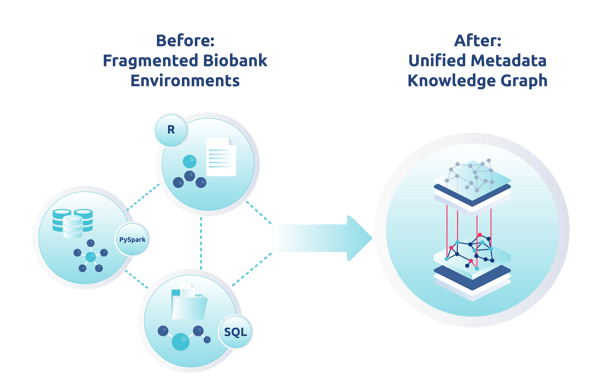
The customer’s R&D teams depend heavily on population-level biobanks to understand disease pathways and validate hypotheses to accelerate drug discovery. Each biobank operates in isolated, secure environments with different metadata models, tools, and scripting requirements.
This forced researchers to rebuild workflows, relearn technologies, and repeatedly validate logic, slowing scientific progress and increasing operational and governance overhead.
The customer sought a solution to eliminate duplication of effort, standardize how research questions are executed across biobanks, and create a governed foundation for AI-assisted scientific workflows. They partnered with Datavid to deliver an 8-week Proof of Value demonstrating how an ontology-driven metadata foundation and agentic RAG workflows could standardize cross-biobank research without compromising security.
WHY THIS MATTERS FOR CDOs
This initiative directly supports the CDO mandate to make enterprise data governed, interoperable, and AI-ready. By harmonizing metadata and automating script generation, the PoV demonstrated reduced operational friction, improved data traceability, and enabled faster access to trusted insights in secure, siloed environments while maximizing the value of existing data investments.
The Challenges
As the customer’s teams navigated different biobank platforms, models, and constraints, several critical challenges emerged that needed to be resolved before scalable cross-biobank research could become a reality:
- Technological fragmentation
Each biobank required different development approaches and platforms, increasing training and onboarding effort and slowing time-to-insight across research teams.
- Isolated development
Biobanks operate in highly secure, restricted environments that prevented reuse of shared logic and standardized tools. This forced researchers to manually debug and redeploy code for every environment.
- Cross-biobank inefficiency
Solutions had to be rebuilt for each biobank, reducing efficiency and complicating validation across cohorts.
- No automation possible
Scripts had to be executed manually due to security rules, slowing analysis and creating unnecessary operational overhead.
Is your organization ready to make its
data interoperable, AI-ready, and reusable at scale?
Datavid enables CDOs to establish metadata-driven foundations that accelerate
insight generation and reduce operational overhead.
The Solution
The customer envisioned an ontology-driven metadata platform, powered by the Datavid Rover semantic layer and RAG architecture, to standardize how research questions are asked, interpreted, and executed across multiple biobank environments.
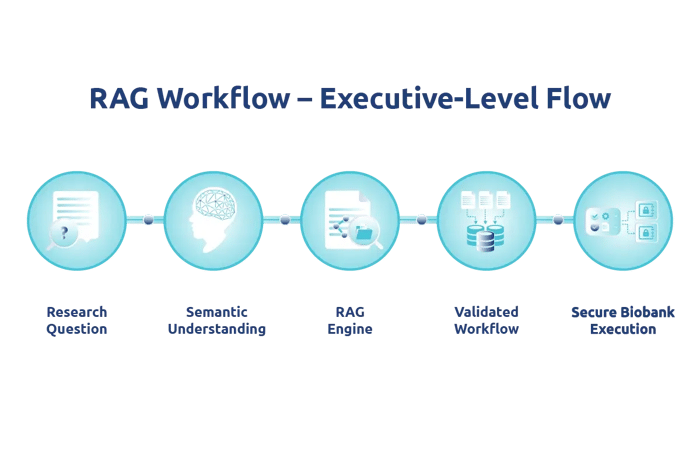
Key elements of the solution:
- Governed metadata knowledge graph
Unified data definitions across two biobanks using both internal and industry-standard models (OMOP 5.4) to ensure consistent understanding of research concepts.
- RAG-driven workflow automation
Translated natural-language research questions into fully validated, ready-to-execute analytical workflows, reducing manual effort and ensuring consistency across biobanks.
- Agentic LLM orchestration
Used specialized agents for query interpretation, script creation, validation, and guardrails, ensuring accuracy and reproducibility across environments.
- Secure and scalable architecture
Implemented a governed, enterprise-grade foundation that supports large-scale ingestion, enrichment, and analysis across biobanks while maintaining strict security controls.
Together, these capabilities showed that cross-biobank research can be standardized, automated, and scaled without compromising security or compliance. The PoV validated a repeatable model for onboarding additional biobanks and supporting future R&D initiatives, all within an 8-week delivery window.
The Outcomes
The Proof of Value demonstrated that a unified metadata foundation and RAG-driven workflows can streamline cross-biobank analysis and reduce operational effort. Over just 8 weeks, the approach proved scalable and suitable for expanding to additional biobanks and research teams.
KEY RESULTS:
- Cross-biobank feasibility validated, enabling consistent analysis across two environments with different metadata structures.
- Reusable workflows created, replacing manual, ad-hoc coding with governed, repeatable analytical steps.
- Metadata alignment achieved, supporting both internal models and the OMOP 5.4 standard for future extensibility.
- Delivered end-to-end within 8 weeks, including unified metadata integration, workflow automation, and strategic recommendations.
The PoV showed that a metadata-driven approach can standardize research processes, reduce duplicated effort, and improve governance across secure biobank environments. It provides a clear path to scaling insight generation while lowering operational overhead and strengthening the consistency of analytical outputs across the organization.
Curious what’s possible in your environment?