
7 minute read
Quick Answer
AI decision traceability is the ability to reconstruct which knowledge, rules, and sources produced a specific AI decision. It depends on a record the system writes as it reasons, carrying the entities retrieved, relationships traversed, sources cited, and rule versions applied. Ontologies, knowledge graphs, GraphRAG, and provenance metadata are what populate that record.
The record is far more useful when it exists at the time of the decision. A retrieval path reassembled weeks later tends to read as an argument about what probably happened rather than evidence of what did.
That distinction tends to land on the Chief Data Officer rather than the AI team, because it is an architecture question well before it becomes a compliance one. By the time an auditor asks, the design decisions that shape your answer were usually made quarters earlier.
The cost of getting it wrong is rarely a fine. It tends to show up as reviewer time spent reassembling reasoning by hand, use cases waiting on review, and governance that grows in headcount faster than in coverage.
At a glance
- AI decision traceability is reconstructable evidence of how an output was produced, and depends on architecture rather than policy.
- A decision record requires roughly 10 fields, and many organizations can populate only part of it today.
- Tolerance for an unrecorded retrieval path falls sharply as decisions move from advisory to autonomous.
- Four layers populate the record in sequence: ontologies, knowledge graphs, GraphRAG, and provenance metadata.
- Each layer depends on the one beneath it, so gaps compound downward.
- Versioning is the most commonly missed requirement, since a decision made last quarter must be resolved to the policy that was in effect then.
- For a CDO, the return is a first-governed domain that later domains reuse, rather than a rebuild for each use case.
What a decision record must contain
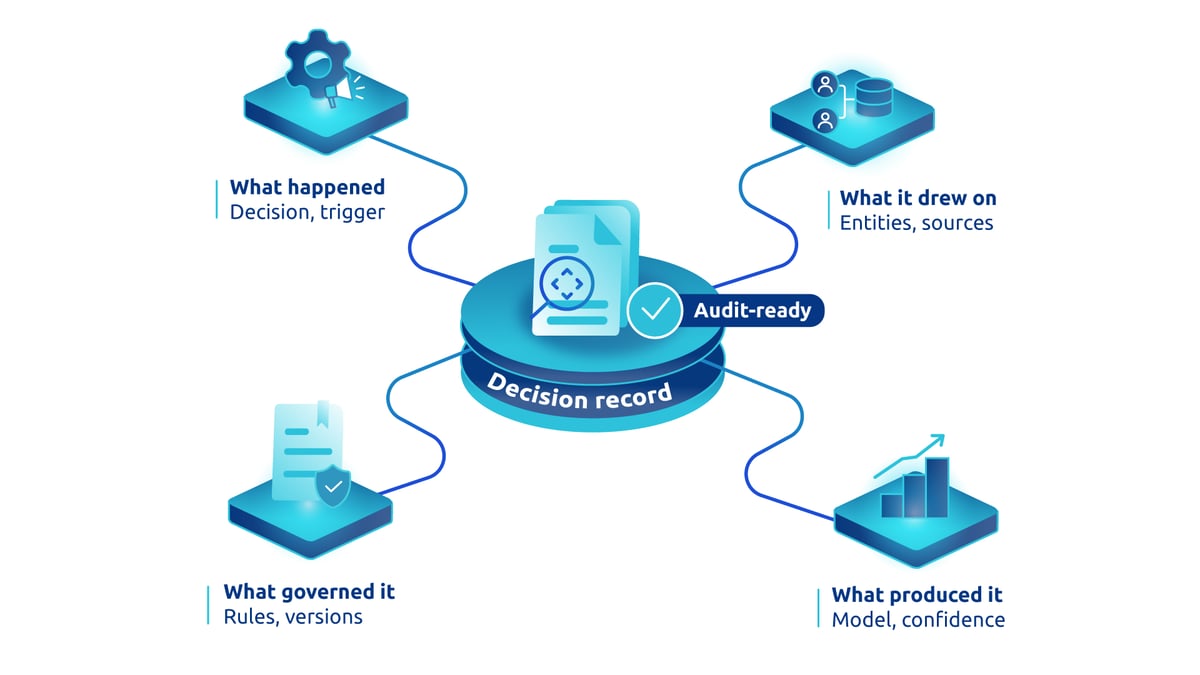
A traceable decision record typically includes a defined set of fields. Checking your current stack against them is a useful first step before scoping governance work.
|
Field |
What does it answer under audit |
|
Decision or recommendation |
What was concluded or actioned |
|
Query or trigger |
What prompted the system to act |
|
Entities retrieved |
Which concepts the reasoning drew on |
|
Relationships traversed |
How the system connected those concepts |
|
Source documents cited |
Where each claim originated |
|
Rule or policy version applied |
Which version of the rule governed the outcome |
|
Effective date of each source |
Whether the source was current at decision time |
|
Approving owner |
Who is accountable for the definition used |
|
Model and prompt version |
What produced the reasoning |
|
Confidence or escalation flag |
Whether a person should have intervened |
Most stacks populate the first three rows and reconstruct the rest under pressure. Closing that gap is much of what separates how decision governance extends data governance as a discipline from making it operable, and the gap is measurable, since each unpopulated field tends to translate into reviewer hours per audit cycle.
Why AI decision traceability has to be designed in, not added
The fields above can only be populated if the system knows what it retrieved and why. Logging captures that a query happened and what came back, not the reasoning between, which is the part under review.
Decision criticality sets how much that matters. An advisory recommendation a person reads carries some tolerance for an unrecorded path. A human-in-the-loop workflow carries less. An autonomous action carries almost none.
That last case is where governed agentic AI becomes largely structural. When an agent acts before a person reviews, the record may be the only evidence available, so agentic AI governance without one risks being a policy with no artifact behind it.
The four layers that populate the record follow, each depending on the one before it.
Ontologies: making policy definitions machine-readable
Start from the record. The rule or policy version field is difficult to populate unless policies exist as versioned, addressable objects rather than PDFs in a document store.
An ontology is a formal, versioned model of the concepts, roles, and relationships a decision draws on. What counts as a customer or a reportable event stops being implicit and becomes declared. The semantic layer for AI readiness carries those declarations to downstream systems.
How a policy statement becomes machine-readable
Take a rule requiring escalation when a client's risk classification changes materially within a reporting period. Machine-readable means the subject entities are modeled, the conditions are expressed against those entities rather than in prose, and the rule carries an effective date and an owner.
Without this, two AI systems can reach different answers to the same question because they are working from different implicit models. Neither is wrong. Neither is defensible, either, which is the harder problem for a CDO to explain upward.
Sustained ontology management keeps those definitions accurate as obligations change, which is the kind of ongoing capability most teams run with specialist support rather than staffing permanently. The Roche policy assistance work shows this at the corpus layer, unifying scattered policy content into a semantic knowledge base in six weeks so guidance resolves to a governed definition rather than a retrieved paragraph.
Knowledge graphs: representing the reasoning path
A graph is only as coherent as the ontology beneath it. Populate one from inconsistent definitions and you get a structure that looks traversable while encoding the same ambiguity in edges.
With a sound ontology, a decision becomes a traversal: these entities, these relationships, in this order. That traversal is written into the record, inspectable rather than inferred, which turns AI decision auditability from an aspiration into a query.
The contrast that matters is claim-level provenance against document-level citation. Vector-only retrieval can return a correct answer while leaving the reasoning opaque, and "the document contains this somewhere" is hard to defend in review.
Scale is the objection large enterprises raise here. The AbbVie work is a useful counterweight: more than 33 million scientific articles unified into an AI-ready semantic platform, with entities typed and linked rather than indexed as text. Knowledge graph solutions at that volume are an engineering problem with known patterns, not a research one, which is what makes the delivery timeline predictable enough to fund.
GraphRAG: making retrieval traceable
GraphRAG has nothing to traverse without the graph, which is why the sequence of layers is not arbitrary.
The mechanism is what a citation attaches to. Standard RAG retrieves chunks by similarity and can only cite the chunk it returned. GraphRAG traverses modeled relationships, so the citation attaches to the specific fact and its source rather than the passage containing it.
This is what populates the entities-retrieved, relationships-traversed, and sources-cited fields at decision time. The record is a byproduct of how retrieval works rather than an additional reporting step someone has to build.
The business consequence is worth stating plainly. GraphRAG services help reduce the risk that a use case stalls in compliance review, especially when decisions require traceable evidence across multiple sources.
Carrying provenance metadata
Provenance is best treated as metadata the layers beneath emit rather than a layer bolted on top. Treating it as an add-on is one of the more common reasons traceable AI programs fall short of their audit requirements.
The carrying question has three parts. Metadata attaches at the entity and relationship level, not the document level. It is written at retrieval time, not on review. What survives is the source, effective date, approving owner, and version.
Versioning is the requirement most programs miss
A decision made last quarter should resolve to the policy version in effect then, not the one live today. Without that, historical audit tends to break down even when current traceability looks complete, and remediation scope can expand to every decision in the period.
The BSI compliance navigator shows what this looks like when it is built in. Knowledge graphs over ontologies trace relationships between concepts and the standards database, with version indicators and document history surfaced to the user rather than buried, delivered in six weeks.
This is where data lineage and AI decision lineage separate. Data lineage traces a report back to its source tables. Decision lineage traces a conclusion back to the rules and evidence behind it, a different graph and a different AI audit trail.
ABN AMRO's regulatory trade data hub shows the pattern in a demanding setting, combining semantic enrichment with real-time compliance logic. Audit-ready traceability for MiFID II compliance is measured by the number of reviewer hours saved.
How the layers stack
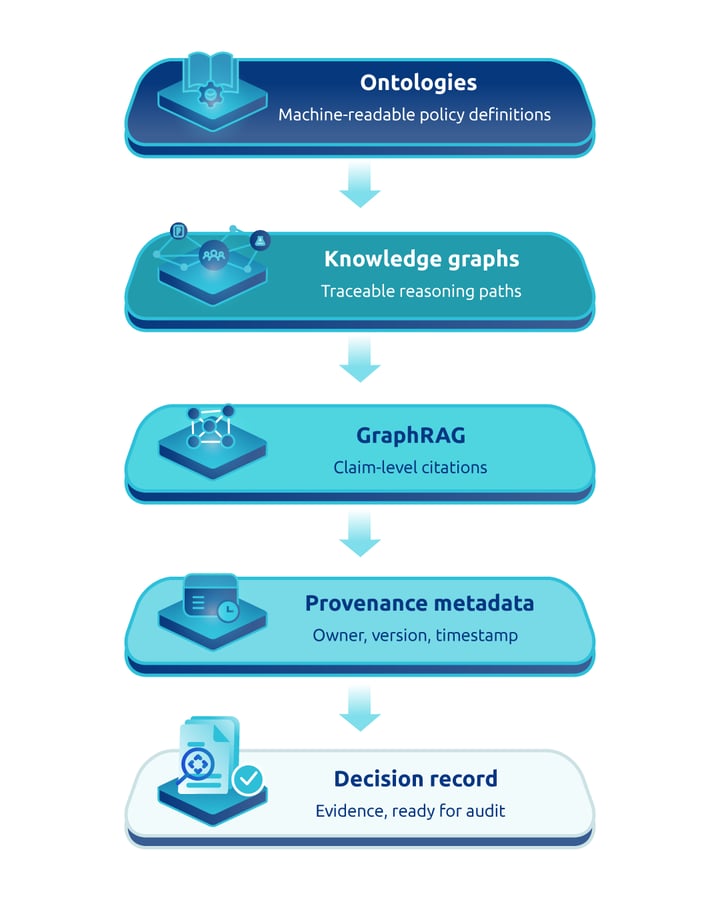
Decision governance relies on a connected stack, where each layer builds on the one below to provide the structure, context, and traceability needed for trustworthy AI decisions.
|
Layer |
Depends on |
Record fields it populates |
What breaks without it |
|
Ontology |
Nothing, this is the base |
Rule version, policy definition, effective date |
Two systems, two answers, no arbiter |
|
Knowledge graph |
Ontology |
Entities retrieved, relationships traversed |
Provenance stops at the document |
|
GraphRAG |
Knowledge graph |
Sources cited at claim level |
Output is plausible but unauditable |
|
Provenance metadata |
All three |
Owner, version, timestamp, lineage |
The record has to be reconstructed by hand |
Scoping your first decision domain
Pick one high-stakes decision domain and build the semantic foundation for it. Enterprise-wide modeling rarely survives a first budget cycle, and the AI governance architecture you need is provable at small scale.
Four questions establish readiness before scoping begins:
- Can your teams trace how an AI-produced answer was reached last week?
- Do your policy documents carry effective dates and named approvers in a machine-readable form?
- Are the relationships between decisions and their governing rules modeled anywhere?
- Would an auditor find your decision reasoning explicit or implicit?
Selecting the domain
Choose on criteria rather than enthusiasm. The decisions should recur at scale, an external party should be able to challenge them, the policy corpus should be bounded, and an owner should exist to approve definitions. Compliance guidance, regulatory reporting, and editorial policy tend to fit. A domain failing either of the last two will stall regardless of the first two.
Scoping checklist
- Decision types in scope are enumerated
- Policy corpus is identified and has a named owner
- Definitions are agreed with the business, not just data
- Record fields are specified against your own stack
- Retrieval is scoped by access rights
- Versioning and effective dates are in place
- Escalation thresholds are defined
- An audit rehearsal is scheduled before go-live
Accelerators such as Datavid Rover compress scoped builds when the domain, policy corpus and source landscape are clearly defined. That timeline makes the first domain fundable, and later domains reuse the same semantic AI governance foundation.
Building a decision domain you can defend
The outcome to aim for is specific. A decision domain where AI-generated recommendations carry their policy sources, rule versions, and data lineage without a reviewer assembling that record by hand. For a CDO, that helps move AI governance from a standing commitment toward a demonstrable board-level position.
A free assessment shows which fields your stack populates today and which get reconstructed by hand.