
7 minute read
Quick answer
Enterprise AI readiness is the ability of your data, systems, and semantic infrastructure to support AI that produces trustworthy, explainable, production-grade outputs. Most assessments measure data quality and governance and miss the layer where enterprises actually stall: semantic structure the AI can reason over, which is usually built fastest with partners who have delivered it in regulated settings.
Most enterprises assess AI readiness as a data quality or governance question, pass on paper, then stall in production because their data carries no structured meaning for the AI to reason over. The assessment said ready. The audit trail says otherwise.
For the Chief Data Officer, that gap between passing a readiness review and shipping trustworthy AI is usually the most expensive line item nobody budgeted for. What follows is a working way to assess readiness and a clearer view of where the actual gap tends to sit.
At a glance
- AI readiness rests on four stacked layers, and the semantic layer most assessments skip is where enterprise AI adoption tends to stall.
- Pilots that move fast and production that stalls usually points to a semantic gap, not a model or prompt problem.
- Typical ai readiness assessment inputs cover infrastructure, data quality for AI, and governance, which are necessary but rarely sufficient.
- Clean, well-governed data with no machine-readable model of meaning still tends to produce confident but ungrounded outputs.
- Semantic readiness means ontologies, knowledge graphs, and a shared layer that lets AI trace conclusions to entities and sources.
Why the data readiness for AI gap is bigger than most enterprises realize
The pattern is familiar to most senior data leaders. Pilots move fast, production stalls, and the failure gets attributed to model choice, prompt engineering, or "not enough data." The remediation budget then follows the misdiagnosis.
Here is what usually happened instead. The organization checked data quality, integration coverage, and governance maturity, passed all three, and still found its AI hallucinating, contradicting policy, or producing answers nobody could trace to a source. The inputs were fine. The reasoning had nothing to stand on.
The real gap tends to be structural: the data lacks a machine-readable model of what its entities mean and how they relate. Clean data with no meaning is still close to unusable for reliable AI, which is why the fix is rarely more cleanup or more governance. It is a semantic foundation the AI can reason against, and diagnosing that early tends to be far cheaper than funding a second cleanup program that addresses the wrong layer.
What most AI readiness assessments measure
Typical assessment inputs group into three areas
- Infrastructure and pipelines, covering compute and access
- Data quality and integration, covering accuracy, duplicates, and lineage
- Governance and skills, covering policy, compliance posture, and team capability.
These areas get real things right. They surface genuine blockers around access, lineage, and compliance readiness, and are necessary preconditions for anything downstream. An AI implementation readiness review that skipped them would miss real risks.
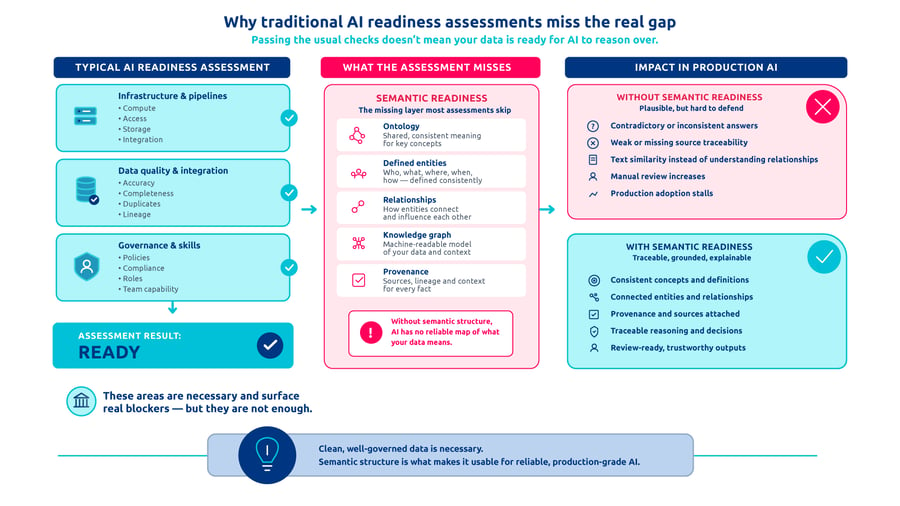 What they tend to miss is whether the data has semantic structure the AI can reason over. A well-governed data lake is still a lake, not a knowledge model, and no amount of governance maturity converts one into the other.
This is much of why enterprise AI projects stall between pilot and production, why outputs feel plausible yet hard to defend, and why the same organizations pass readiness reviews and still struggle to ship. For a CDO, it also explains why readiness spend keeps rising without the production rate following, and why an assessment that covers the semantic layer usually pays for itself in avoided rework.
The four layers of enterprise AI readiness
A more useful ai readiness framework treats readiness as four stacked layers. Each depends on the one below it, and skipping any of them creates a specific failure mode further up.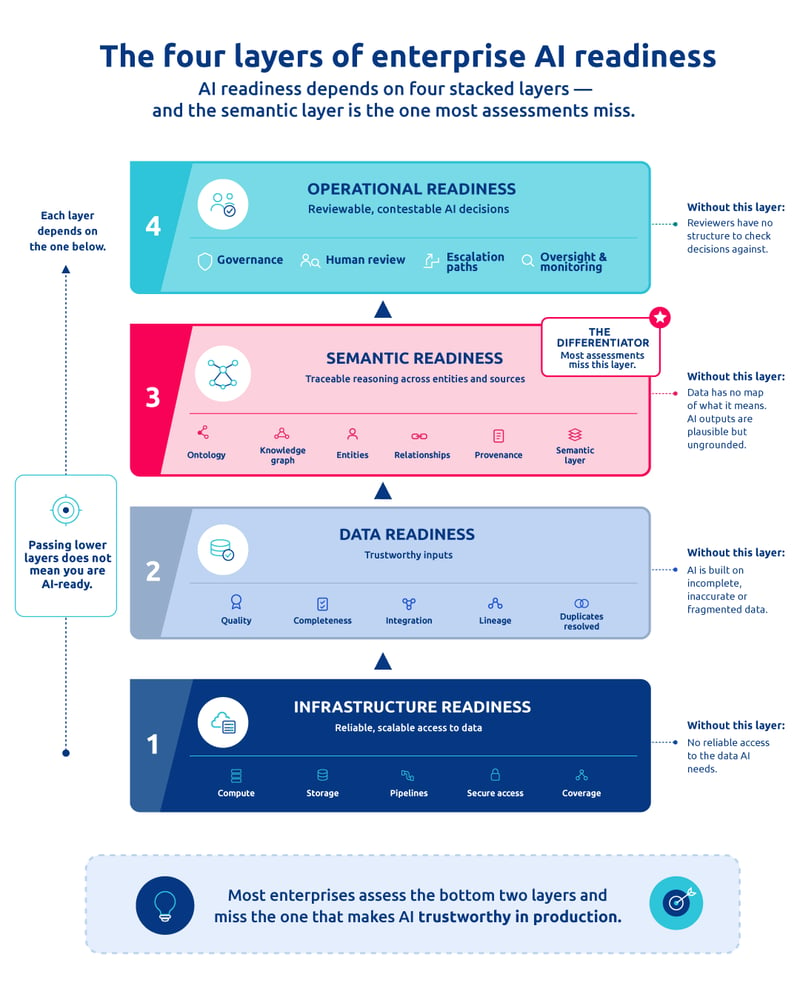
Infrastructure readiness
The foundation: compute, storage, secure data access, pipelines, and coverage across the systems AI will draw from. Work here usually sits with data engineering and data integration teams, and pays off in reliability rather than capability.
What passes at this layer is dependable access to the data. What still fails without the layers above is simple: there is nothing structured to reason over.
Data readiness
Data readiness for AI covers quality, completeness, and integration of the underlying assets: clean records, resolved duplicates, documented lineage, and coverage across the systems that matter.
What passes here is trustworthy inputs. What still fails: the AI has data but no map of what it means, which is why data quality for AI is necessary and rarely sufficient on its own. Teams that treat this as enterprise data management work rather than a one-off cleanup tend to hold the gains longer.
Semantic readiness
This is the layer most assessments skip. Ontologies define what the entities are, knowledge graphs connect them with relationships and provenance, and the semantic layer for AI readiness makes those relationships available to downstream AI as governed, structured knowledge.
What passes here changes the character of the output. The AI can reason across entities, relationships, and sources rather than pattern-matching on text, which is the difference between "the model generated an answer" and "the model reached a conclusion that can be traced." It is also the layer where prior delivery experience shows most, since definition choices made early are expensive to revisit once systems depend on them.
Operational readiness
Governance, human-in-the-loop workflows, escalation paths, and the reviews that keep AI outputs aligned to business rules in production. This layer extends the data governance program most enterprises already run.
What passes here: AI decisions can be reviewed, contested, and improved. What still fails without semantic readiness underneath: reviewers have little structured evidence to check the AI against, so review becomes opinion and review headcount grows with output volume.
Why the semantic readiness gap is where enterprises actually stall
Infrastructure and data quality make AI possible. Semantic structure makes it reliable. Without the second, the first two tend to produce confident but ungrounded outputs, which is the most expensive kind of wrong in a regulated setting.
The mechanism is plain. Vector similarity and keyword retrieval hand the AI text chunks that look related but carry no defined relationships. A semantic layer, built on an ontology and populated as a knowledge graph, gives it a map of entities, relationships, and provenance to reason across instead.
What changes in practice is defensibility. Outputs from systems built on a governed GraphRAG architecture can often trace retrieval paths to specific entities, source documents and defined relationships. A plausible answer becomes a defensible one, which is often what separates a use case that clears review from one that waits quarters for sign-off.
Not every AI workload requires the same semantic depth. Semantic readiness becomes critical when AI must answer knowledge-intensive questions, reason across systems, support regulated workflows, or explain outputs back to their source.
The Roche Helios platform shows what this looks like in practice. By treating semantic readiness as infrastructure rather than an afterthought, Roche mapped fragmented clinical trial data to a common semantic model with FAIR principles embedded. The result was 80% fewer manual errors, five times faster trial data processing, 40% lower operational costs, and on-demand audit readiness for the FDA and EMA.
What an AI-ready enterprise architecture looks like in practice
The four layers resolve into one architecture: an infrastructure and data foundation feeding a semantic layer that AI systems reason against, with governance and human oversight around the outputs. Sequencing that build is data architecture work, and the order matters more than the tooling. Three components carry most of the weight.
An ontology-backed semantic layer as the middle tier
The semantic layer sits between raw governed data and the AI systems consuming it, translating source records into business-aligned entities, relationships, and rules. Sustained ontology management keeps those definitions current as obligations change.
What this enables is consistency: shared meaning across systems and use cases, and a single place to apply access controls and definitions rather than duplicating them per pipeline. For a CDO, that single place is where maintenance cost stops multiplying.
A knowledge graph as the populated instance
The knowledge graph is where the ontology meets real data. Entities, relationships, and provenance are stored in a form the AI can traverse rather than merely retrieve, which is what knowledge graph solutions deliver.
The Unifying Biobank work shows the pattern applied to research at scale: a metadata knowledge graph with RAG automation, standardizing biobank research so questions can span collections that previously did not connect.
GraphRAG as the retrieval and reasoning layer
GraphRAG combines graph traversal, vector similarity, and keyword search to feed the LLM structured, verified knowledge rather than loose text chunks.
What this changes: multi-hop reasoning across connected entities, claim-level source citation, and outputs that tend to hold up in audit. It is also where prior investment starts compounding, since each new use case retrieves from the same graph rather than funding its own retrieval build. Accelerators such as Datavid Rover tend to shorten that first build considerably.
A better AI readiness assessment: the questions to ask instead
Instead of asking whether the data is clean and governed, ask whether it is structured for AI to reason over. Four questions give a CDO a sharper read than most scorecards:
- Can we define the core entities in our domain and their relationships in a form the AI can query, or only describe them in documentation?
- When our AI produces an answer, can we trace it back to specific entities, relationships, and source documents?
- Do our access controls, business rules, and definitions live in one shared layer, or are they duplicated across pipelines and applications?
- When a subject matter expert reviews an AI output, do they have structured evidence to check against, or only the AI's own confidence?
If the answer to any of these is unclear, the gap is usually not more data or more governance. It is the semantic layer they sit on, and closing it early tends to cost less than funding another remediation cycle later.
Closing the real AI readiness gap
Infrastructure, data, and governance readiness matter, but they tend to be preconditions. For knowledge-intensive enterprise AI, real readiness often depends on the semantic layer, and until it exists, the rest of the stack struggles to produce trustworthy AI at production scale.
An AI transformation strategy that skips it tends to keep repurchasing the same pilot, where one that builds the layer once tends to get the next use case for a fraction of the first.
Ask the four questions above of your own stack.
If any answer is unclear, a free assessment shows where your semantic readiness sits and what closing the gap would take.