
5 minute read

As enterprises rush to deploy AI, one truth becomes impossible to ignore: AI success doesn’t start with the model, it starts with the data.
At Datavid, we've seen how organizations that invest in semantic data foundations transform the way they use AI, moving from experimentation to explainable, compliant, and business-aligned intelligence.
The AI Hype vs. the Reality
Every enterprise wants to lead in artificial intelligence. From copilots to chatbots and predictive analytics, AI is now part of almost every business strategy.
Beneath the excitement lies a familiar obstacle: AI isn’t failing because of the models, it’s failing because of the data.
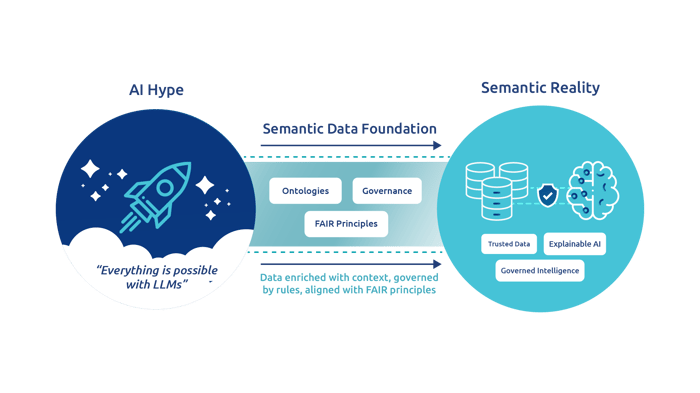
While models can generate content and answer questions, they can only reason with what they understand. Most enterprise data, scattered across silos and formats, lacks that understanding.
Data is often:
- Fragmented and duplicated across systems
- Poorly described or missing metadata
- Ungoverned, creating “shadow AI” risks
- Untrusted, especially in regulated environments
The result is AI that sounds impressive but can’t be trusted in production.
The real barrier isn’t the technology itself. It’s that data isn’t yet AI-ready.
What “AI-Ready” Data Really Means
“AI-ready” doesn’t just mean clean or centralized.
In reality, AI-ready data is:
- Trusted: verified and governed under clear policies
- Contextual: enriched with business meaning and relationships
- Reusable: modeled for interoperability across teams and tools
When data is enriched with business meaning, it becomes explainable, auditable, and reusable. It’s the difference between having a dictionary and telling a story - semantics connect words into meaning.
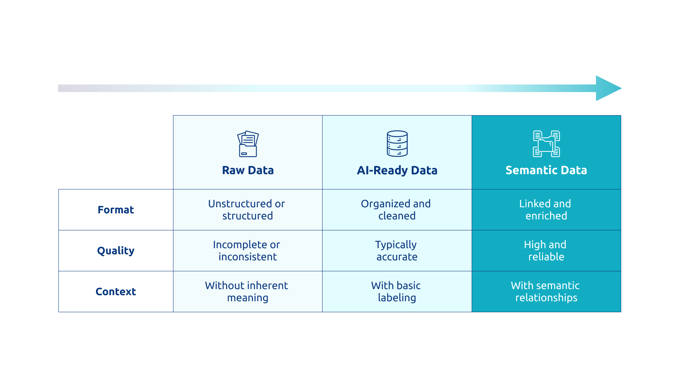
AI-ready data isn’t just about technology. It’s about building the foundation that makes your enterprise information understandable by both humans and machines.
Beyond the Lakehouse: Adding Meaning to Scale
Platforms like Snowflake or Databricks excel at storing and processing vast amounts of data. What they don’t provide by default is an understanding of what that data actually represents.
Without semantics, AI models interpret data at face value, often missing context or producing hallucinations.
With semantics, data comes with:
- Embedded business rules and hierarchies
- Explicit relationships between entities
- Defined governance and lineage
- Built-in compliance constraints

Together, the semantic layer and data fabric form the backbone of an AI-ready architecture, combining scale with meaning and turning raw information into governed, reusable knowledge.
What Is a Semantic Data Foundation?
A semantic foundation (or semantic data layer) is a knowledge-rich abstraction that harmonizes enterprise data into a common vocabulary aligned with business meaning.
A semantic data foundation is at the heart of any semantic data platform, uniting meaning, governance, and scalability across the enterprise.
It connects the entire data ecosystem through three core layers:
- Create – where knowledge graphs and semantics enrich raw data
- Connect – where governance and policies ensure control
- Consume – where AI, search, and analytics deliver insights
Together, these layers make the data fabric intelligent.
Key components include:
- Ontologies and taxonomies that define domain concepts
- Metadata enrichment to add business context
- Encoded rules and policies for compliance
- Lineage and access control for trust and traceability
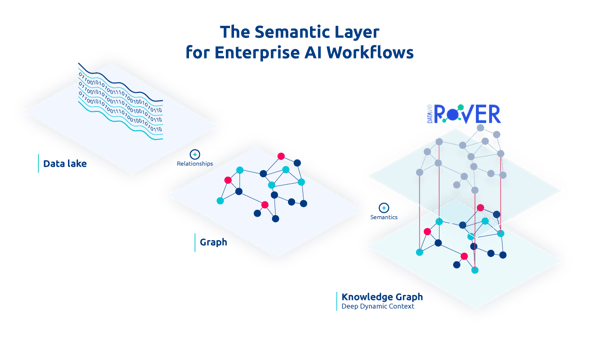
Instead of having fragmented silos, a semantic foundation unites them into a coherent knowledge graph - making data findable, interpretable, and reusable across teams and applications.
How Semantics Supercharge AI
When semantic data foundations are in place, AI moves from experimental to explainable.
Here’s how semantics amplify AI outcomes:
- Faster AI deployment: data is already harmonized and contextualized
- Built-in governance: business rules ensure outputs respect compliance requirements
- Fewer hallucinations: AI interprets data through meaning, not assumptions
- Explainability: every output can be traced back to governed sources
In essence, semantics make AI trustworthy.
A governed semantic layer for AI doesn’t just support FAIR principles, it operationalizes them.

By making metadata rich, access governed, and models interoperable, FAIR becomes a practical framework for reliable, transparent AI.
These principles aren’t abstract - they’re already driving measurable results in leading enterprises.
Real-World Impact: From R&D to Compliance
Semantic foundations aren’t theory, they’re already transforming how enterprises work.
Across industries, semantic foundations are powering breakthroughs that range from faster drug discovery to automated compliance and intelligent search.
- Pharma & Research: Semantic enrichment using ontologies and chemical relationships enables scientists to explore millions of research documents, reducing information-retrieval time from days to minutes.
- Regulatory compliance: Rules and constraints are embedded directly in the semantic layer, ensuring AI outputs automatically align with legal and ethical standards.
- Knowledge management: Enterprises are replacing manual search with semantic search, allowing users to surface relevant insights by concept rather than keyword.
- AI copilots: When grounded in enterprise ontologies, they generate domain-specific, factually accurate results - reducing risk and increasing adoption.
Each example demonstrates one principle: AI succeeds when data has meaning.
Want to see how semantics deliver real research impact?
Discover how a global scientific organization used a semantic data foundation to accelerate discovery and AI readiness. 
The CDO’s Roadmap: How to Start Building Semantic Foundations
Building a semantic data foundation doesn't require a complete overhaul of your systems.
Most organizations already have the tools and infrastructure they need, what’s missing is a structured, semantic approach to make data meaningful, governed, and reusable. The key is to start where value is clearest, prove impact quickly, and expand with confidence.
Here’s how CDOs and data leaders can begin:

- Identify a high-value domain – choose an area like R&D, compliance, or policy management where data reuse has tangible ROI.
- Model semantics on existing platforms – leverage your current cloud or data lake investments, semantics integrate across them. If your organization already uses a data fabric, the semantic layer acts as its intelligence layer, linking data products to business rules, metadata, and governance policies. Together, they operationalize the data fabric to make it truly AI-ready.
- Start small, scale smart – pilot one domain, prove the value, then expand incrementally.
- Embed governance and pipelines early – semantics work best when aligned with existing data workflows and FAIR principles.
Our experience shows that organizations succeed when they approach semantic implementation as an evolution, not a replacement.
By progressing domain by domain and reusing proven a semantic data model, teams can demonstrate measurable impact within weeks.
This pragmatic approach minimizes risk, accelerates adoption, and creates a scalable foundation that grows with the business.
Want to see how this approach can work in your environment?
Datavid Rover helps enterprises build semantic data platforms in as little as 6 to 8 weeks, delivering early business value while setting the stage for long-term scalability. 
From AI Hype to Business Impact
AI is no longer a lab experiment - it’s becoming the competitive edge of modern enterprises.
But sustainable success depends on what lies beneath the models: trusted, semantic data.
When organizations invest in data that’s governed, contextual, and enriched with meaning, they build the foundation for explainable AI, automated compliance, and accelerated innovation.
AI doesn’t succeed on raw data.
It succeeds on trusted, semantic data layers that make intelligence reusable, explainable, and enterprise-ready.
These foundations form the backbone of a modern semantic data platform, enabling enterprises to scale AI confidently across their data ecosystem.
What’s holding your organization back from building trustworthy AI?
It’s not your models - it’s your data foundation.