
7 minute read
Quick answer: GraphRAG for legal compliance combines knowledge graphs with large language models to give legal and compliance teams AI grounded in regulations, contracts, and policies. It maps relationships between statutes, clauses, and obligations rather than retrieving isolated text chunks. The result is traceable, auditable answers that hold up under regulatory scrutiny, with fewer of the rework cycles that stall enterprise legal AI projects.
Legal data is inherently relational. Statutes reference other statutes, contracts cite clauses from related agreements, and a single regulatory amendment can ripple through dozens of internal policies.
Most AI retrieval still treats this web as flat text. Surface-level matches follow, and so does the slow erosion of trust from compliance teams who cannot defend the answers.
That gap is where GraphRAG for legal compliance, sometimes called graph retrieval augmented generation for legal work, has started to reshape regulated-industry AI.
This article walks through what it does, where the return shows up first, what it costs to deploy, and how to decide between building in-house and partnering.
At a glance
- Standard RAG breaks down on legal queries that require cross-referencing statutes, missing-clause detection, or multi-jurisdictional reasoning.
- GraphRAG produces claim-level citations with full source lineage, satisfying audit and regulatory expectations.
- Value shows up first in contract review, regulatory change management, and audit preparation, with measurable time savings in each.
- Build vs buy depends on ontology depth and internal capacity, not just budget or headcount.
- Most production deployments take 6 to 8 weeks with the right accelerator patterns, with ontology design as the heaviest lift.
Why standard RAG falls short for legal and compliance
Traditional RAG retrieves passages based on text similarity. For straightforward lookups, that works. But legal and compliance questions rarely behave like simple lookups. They involve cross-referenced statutes, multi-jurisdictional regulations, and interconnected contract clauses that similarity-based retrieval cannot reason across.
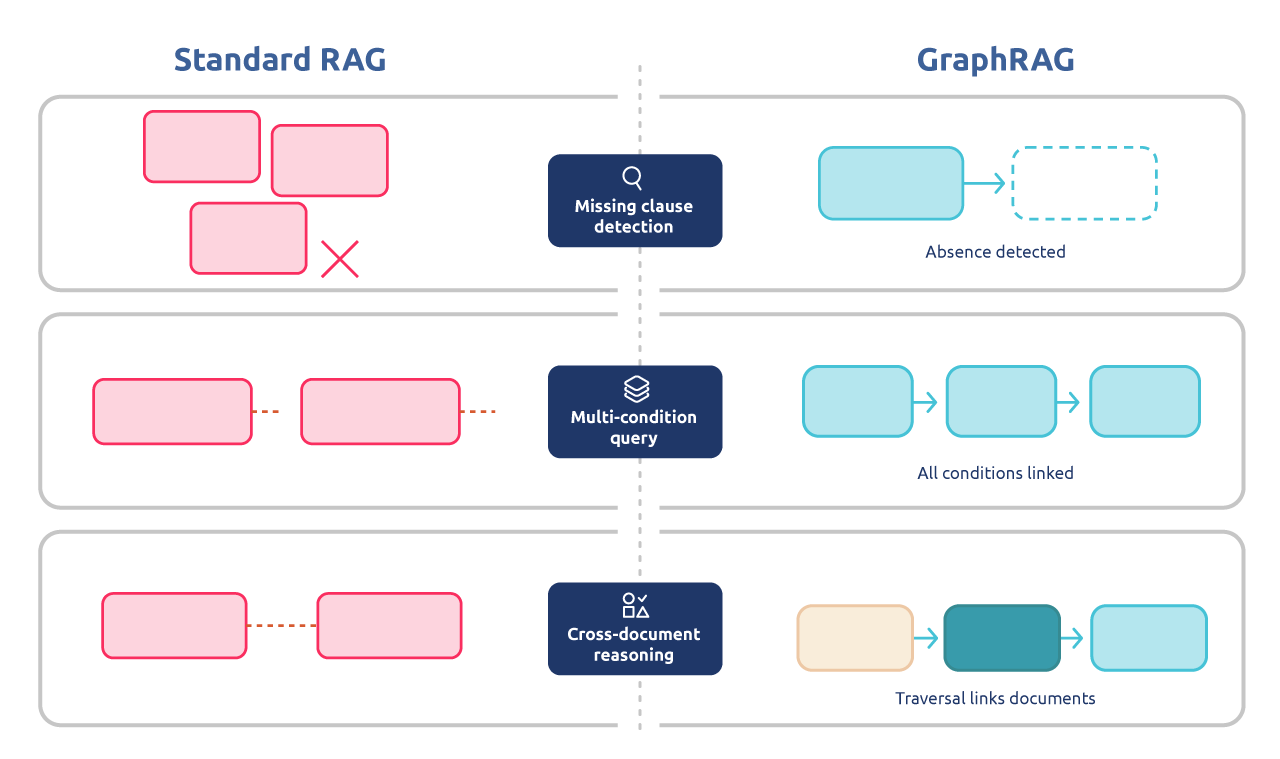
Three query types break vector-based RAG almost immediately:
- Negative searches: "Which vendor contracts lack a data breach notification clause?" Vector search struggles with absence because there is no matching text to retrieve.
- Multi-condition queries: "Find policies that require encryption and data residency but exempt internal research." That combines inclusion and exclusion logic across documents.
- Cross-document reasoning: "How does the 2024 amendment to this regulation affect obligations defined in our master services agreement?" That requires connecting a public statute to a private contract.
For compliance teams, inaccurate retrieval is not a minor inconvenience. It creates audit risk and erodes stakeholder trust in AI-assisted decisions. RAG for legal documents needs a stronger foundation than similarity search alone can provide.
How GraphRAG grounds legal AI in structured knowledge
GraphRAG replaces flat text retrieval with relationship-aware retrieval. Instead of returning the closest matching paragraph, it surfaces connected knowledge: entities, relationships, and pathways that reflect how legal concepts actually relate to each other.
The LLM reasons over structured input the way an experienced compliance analyst would, with citations at each step.
From text chunks to connected knowledge
Legal concepts are modeled as nodes such as statutes, clauses, obligations, and exceptions, with typed relationships connecting them. When a query comes in, the system traverses those connections to assemble multi-hop reasoning paths before the LLM responds.
A vector-based approach might return three paragraphs mentioning "data retention." A graph-grounded approach returns the linked set: the retention obligation, its parent regulation, applicable exemptions, and the internal policies implementing it.
This is where knowledge graph solutions turn isolated documents into queryable intelligence.
Built-in explainability for regulated environments
Every GraphRAG response traces back to specific source nodes and relationship paths. For regulated industries, traceability is a compliance requirement, not a feature. "The model said so" does not hold under regimes like GDPR, DORA, HIPAA, or SOX.
Graph-based provenance gives compliance teams the answer they need: which regulation, which clause, which version, and which internal policy each response was built from.
Reasoning that scales across jurisdictions
A knowledge graph can model how the same obligation differs across jurisdictions. A retention rule might require seven years in one region and five in another. Flat document retrieval cannot untangle those variations reliably.
A graph can, which is why LLM grounding for legal data increasingly starts with a graph layer rather than a vector index alone.
GraphRAG vs traditional RAG for legal documents
The comparison below focuses on the legal and compliance tasks where teams evaluating GraphRAG legal approaches typically see the gap most clearly.
|
Legal or compliance task |
Traditional RAG |
GraphRAG |
|
Cross-referenced statutes |
Returns matching paragraphs in isolation |
Traverses relationships between linked statutes and amendments |
|
Detecting missing clauses |
Cannot reliably find what is absent |
Identifies contracts where required clause nodes are not present |
|
Multi-jurisdictional rules |
Treats each region's text as unrelated |
Models how the same obligation differs by jurisdiction |
|
Audit citations |
Document-level citation or none |
Claim-level lineage tied to source clause and version |
|
Regulatory change impact |
Keyword search across policy libraries |
Maps every internal policy connected to the changed regulation |
For the complexity of legal and compliance work, GraphRAG fits the structural reality of the domain. Teams gain the reasoning depth and traceability regulated environments demand, without sacrificing the generative fluency the LLM layer provides.
Where GraphRAG for legal compliance delivers measurable value
GraphRAG is not a general-purpose upgrade over standard RAG. The return shows up clearly in three legal and compliance workflows where relationships and provenance matter most.
For each, there are concrete metrics worth tracking from day one.
Contract analysis and review
GraphRAG enables contract queries standard search cannot reliably answer. Find contracts missing a specific clause. Identify agreements with conflicting terms. Surface cross-references between related documents.
What to measure: hours per contract reviewed, percentage of required clauses surfaced correctly, and missed-clause rate compared to manual review baselines.
Regulatory change management
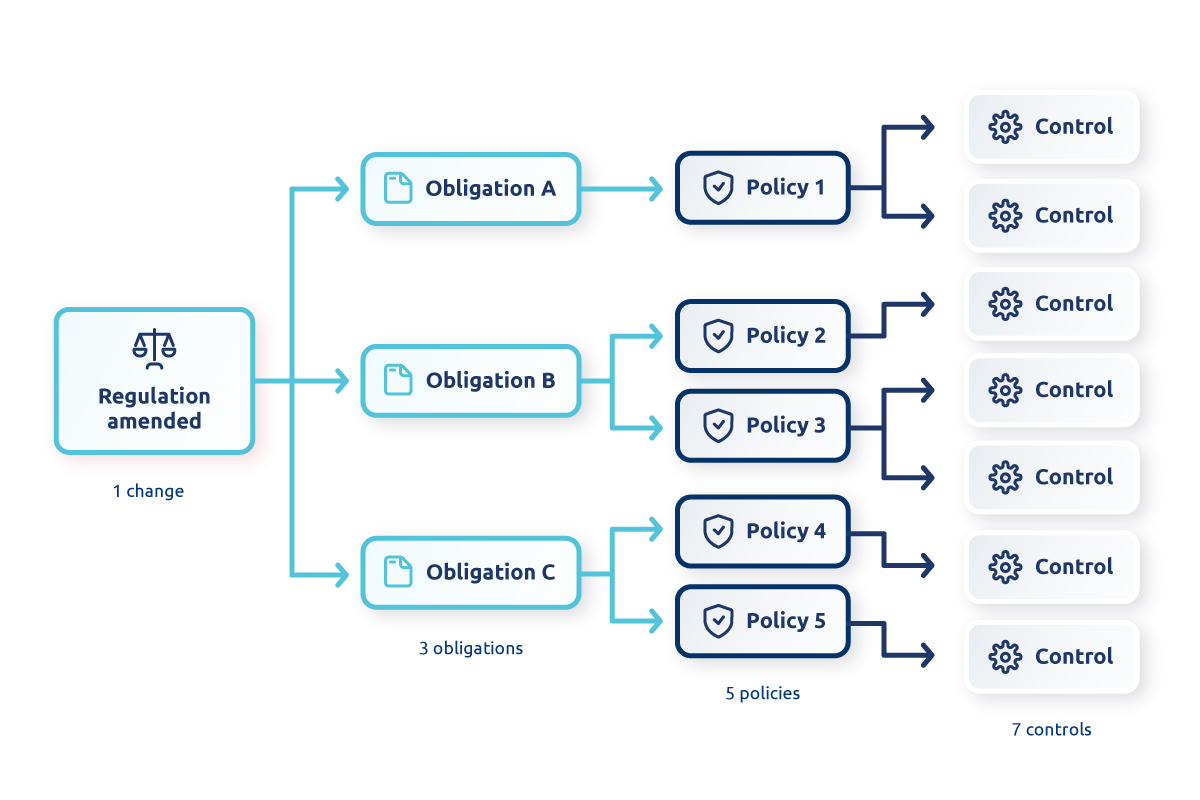
When a regulation is amended, the graph maps which internal policies, obligations, and controls are affected. Compliance teams get an impact assessment instead of a keyword search across policy libraries.
What to measure: time from regulatory amendment to a complete impact assessment, and the number of dependent policies identified per amendment.
A single regulatory amendment rarely impacts one document in isolation. One change can cascade through multiple obligations, policies, and operational controls, making manual tracking difficult and error-prone.
Audit readiness and provenance tracking
GraphRAG produces answers with full source lineage: which regulation, which clause, which version. That cuts audit preparation cycles and gives auditors something they can verify directly.
What to measure: hours spent preparing audit evidence, time from query to defensible citation, and audit cycle length over time.
Datavid's GraphRAG services help enterprises build this governed, traceable AI layer on top of existing legal and compliance data. The patterns draw on regulated-industry deployments like the BSI Compliance Navigator case study.
Build vs buy: How to decide
GraphRAG deployment is rarely a binary choice between in-house and packaged. 3 patterns dominate enterprise decisions:
- Build in-house: Full ontology design, graph infrastructure, and retrieval pipeline owned by internal teams. Highest control, highest cost, slowest to value. Practical only for organizations with established data engineering and ontology expertise.
- Buy a packaged product: A vendor-supplied GraphRAG tool covers retrieval and a generic ontology. Fast to deploy, limited customization for jurisdiction-specific or domain-specific legal nuance.
- Hybrid with a partner: Accelerator patterns plus partner-led ontology design tuned to your domain. Most common path for regulated industries that need depth without rebuilding from scratch.
The decision usually comes down to 4 factors:
- Depth of legal domain customization required (boilerplate contracts vs heavy regulatory specificity)
- Internal AI and data engineering capacity, especially around ontology modeling
- Data sensitivity and where the graph and retrieval layer can be hosted
- Time pressure on the first defensible use case
If you are responding to a near-term audit or a regulatory deadline, the hybrid path is usually the only one that fits the timeline. A purely build-in-house approach often takes a year or more to reach equivalent maturity.
Cost, effort, and the risks to watch
Most teams underestimate where the work actually sits. The hardest part is not connecting the LLM. It is building a shared structure for how the business defines, labels, and connects its information.
With accelerator patterns, a production-ready first deployment typically takes 6 to 8 weeks. If that structure needs to be designed from scratch, the timeline can extend by several months.
Cost usually breaks down across four areas: information model design, source document preparation, retrieval and graph setup, and ongoing governance. The LLM itself is rarely the largest line item.
The risks worth watching:
- Information drift: Without governance, the system can slowly move away from how the business actually uses its data, which weakens retrieval quality.
- Over-engineering: Modeling every possible relationship adds cost without always adding value. Start with the use cases that pay back first.
- Weak source enrichment: If documents are poorly structured or inconsistently labeled, the graph reflects those gaps, and the LLM has more room to fill in the blanks.
- Vendor lock-in: Heavy reliance on one platform can make future changes harder and more expensive, especially if data structures are tied to proprietary formats.
- Change management: Compliance and legal teams need to trust the system and adopt new query patterns. Without that adoption, the investment underperforms.
Datavid pairs accelerator patterns with AI services grounded in enterprise data to keep the cost profile predictable and the governance posture defensible.
Is your organization ready for GraphRAG?
Readiness depends less on the LLM you pick and more on how connected, governed, and accessible your legal knowledge already is.
A few questions worth asking:
- Do legal and compliance teams spend more time searching for regulatory information than acting on it?
- Are AI pilots producing answers compliance cannot verify or trace?
- Is legal knowledge scattered across disconnected systems, formats, and jurisdictions?
- Can you quickly identify which internal policies are affected when a regulation changes?
- Are audit preparation cycles consuming weeks of manual effort the team could redirect elsewhere?
If several of these match your situation, GraphRAG compliance work is likely the missing layer between your data and trustworthy legal AI.
Build explainable legal AI with GraphRAG
The real value of GraphRAG goes beyond better search. It produces trustworthy, auditable AI grounded in your organization's legal and regulatory knowledge. That is the distinction compliance teams need when adopting AI without giving up traceability.
The organizations getting the most out of this approach treat graph structure as a first-class part of the AI stack rather than as an afterthought layered on after vector search disappoints.
If you are looking to improve audit readiness and reduce manual effort across legal and compliance workflows, evaluate how GraphRAG can strengthen legal AI with traceability and control.