
9 minute read
Quick answer
An AI governance maturity model grades how far an organization can prove control over its AI, across 5 levels that run Ad hoc through Optimized. Your level is usually set by the weakest thing you can evidence, and for many enterprises that is the data each AI system reads.
Many regulated enterprises now have an AI policy, a governance committee, and a list of approved tools. The harder moment comes when the board or an auditor asks how mature the program is and wants evidence. When that evidence is missing, approved AI projects can stall, and the business may carry regulatory risk it has yet to measure.
That question often lands with the chief data officer (CDO), who owns the data each AI system reads and is increasingly accountable for how AI uses it. A maturity model turns it into a defensible score.
Datavid (a C5i company) sees a similar pattern across regulated programs, where the level a team can prove often depends more on its data than on its policies.
At a glance
- Each level is defined by the evidence an auditor can check, so writing more policy rarely moves a program up on its own.
- A scorecard of 6 dimensions, applied to 1 live use case, gives a level the board can verify.
- Programs often stall at Level 3, where data means something different in each system and lacks lineage.
- The levels map to US and international AI standards and to EU AI Act deadlines moved by the July 2026 amendment.
- Each step up is 1 focused move, and the move into Level 4 usually happens in the data layer the AI reads from.
What does an AI governance maturity model measure?
An AI governance maturity model measures how well an organization can account for its AI systems and the controls around them. Because the grade rests on what you can hand an auditor, a live record of each system tends to count for more than a long list of policies.
An AI maturity model grades the extent to which AI is used, while an AI governance framework defines the controls a program needs. The governance maturity model grades how well those controls work in practice.
For enterprise AI governance, that grade gives responsible AI governance claims something a reviewer can check. For a CDO, it also shows which data work would move the program up.
The 5 levels of AI governance maturity
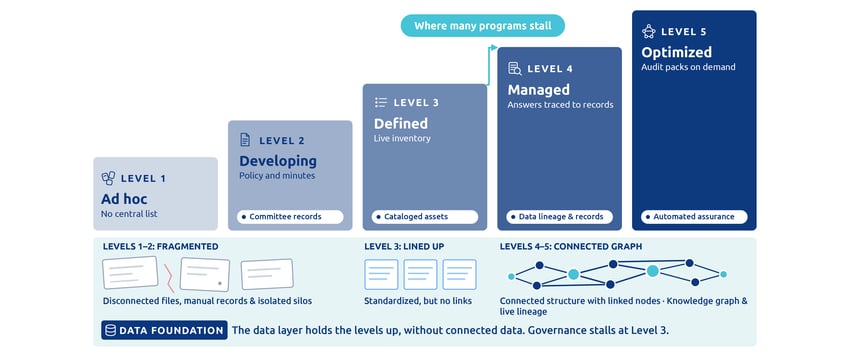
AI maturity levels in governance usually run Ad hoc through Optimized, and a level counts only when the program can produce its evidence on request. A gap in the data foundation tends to cap the level, whatever the policies say.
|
Level |
What governance looks like |
Evidence you can show |
Data foundation underneath |
|
Ad hoc |
AI in use across teams with no central list |
Little or none |
Each team feeds AI its own extracts |
|
Developing |
A policy and a committee, with manual checks after the fact |
A policy and meeting minutes |
Definitions differ by system |
|
Defined |
Each AI system inventoried with an owner and a risk tier |
The inventory itself |
Sources mapped, but meaning and lineage not shared |
|
Managed |
Controls run where AI reads data |
Any answer traced to its records on request |
Access checked at retrieval and lineage kept per output |
|
Optimized |
Governance lives in a shared semantic foundation |
Audit packs on demand and new use cases approved in weeks |
Definitions and access rules inherited by each new use case |
At Level 3, each AI system is listed in an AI model inventory with an owner and a risk tier, updated at each stage of the AI lifecycle governance. Level 4 is where controls move into the data layer, with access checked at retrieval and human review set by decision criticality.
Datavid's semantic layer and knowledge graph work tends to sit at this level, since those layers carry meaning and access rules with each record.
Why do many AI governance programs stall before Level 4?
Many programs stall before Level 4, often because their policies struggle to reach the data. Rules written at Levels 2 and 3 are hard to enforce on data that means different things in each system and has no record of its origin.
The International Association of Privacy Professionals (IAPP) found in its 2025 governance report that 77% of organizations are working on AI governance. Proving it works tends to stall on 4 data gaps.
- Definitions differ by system: a "patient" or "counterparty" in 1 source may not match the same term in another, so a rule about it applies unevenly.
- Lineage is missing: the team may not be able to follow an AI answer back to the record and version it came from.
- Access is checked in the application: an AI retrieving across sources may surface records the person asking isn't cleared to see.
- What the model read goes unrecorded: when an answer is challenged, the trail may have to be rebuilt by hand.
A data governance maturity model and an AI governance maturity model meet at this point, since both rest on the same foundations. A semantic layer gives systems a shared description of the data, and a shared ontology records which definition wins when 2 sources disagree.
With both in place, policy can be applied to the data itself. For the CDO, that is where data governance work starts to pay off in audit terms.
How to assess your AI governance maturity
A regular AI governance assessment can pay off. A 2025 Gartner survey of 360 respondents found that organizations that regularly assess AI system performance and compliance were more than 3 times as likely to derive high value from generative AI.
An AI governance maturity assessment works best on 1 live use case. Scoring a whole estate at once tends to average away the gaps that matter, and 1 round can follow 4 steps.
- Pick 1 live use case: choose an AI use case leadership already cares about.
- Gather the evidence: collect what you could hand an auditor right now for that use case.
- Score the 6 dimensions: rate each on a scale of 1 to 5 using the scorecard.
- Plan the next move: set the work that lifts your lowest dimension, then reassess.
The 6 dimensions to score
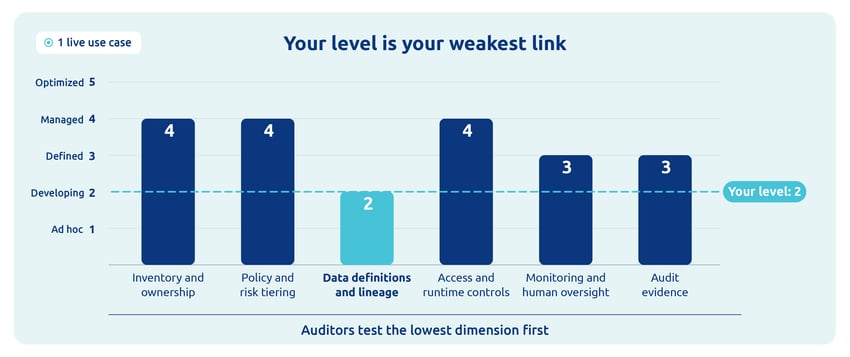
An AI governance checklist asks whether a control exists, and the scorecard asks whether you can prove it. For each dimension, there's 1 question to ask and the evidence that earns a 4 or 5.
Inventory and ownership
Can you list each AI system this use case touches, with a named owner? A score of 4 or 5 takes a live inventory entry with the owner, risk tier and data sources.
Policy and risk tiering
Is the use case classified by the decisions it affects? The bar for a high score is a documented risk tier tied to clear review rules.
Data definitions and lineage
Do sources agree on core terms, and can outputs be traced back? A high score rests on shared definitions under data governance and lineage for each answer.
Access and runtime controls
Are permissions checked for the person asking at retrieval? To score well here, you'd show logs of access decisions per user and per record.
Monitoring and human oversight
Is output quality watched, and are reviews routed by criticality? Monitoring alerts and a record of each human review earn the top scores.
Audit evidence
How long would an audit pack take to produce? A 4 or 5 means you can produce one on request without manual reconstruction.
How to read your score
Your level is best read as your lowest dimension, since an auditor tends to test the weakest link first. A use case that scores 4 for access controls and 2 for lineage would likely fall under Level 2 for audit purposes.
Who runs it and how often
The CDO generally runs the assessment with the AI governance lead and the business owner of the use case, since each holds part of the evidence. Reassess every 6 months or so, and again when a new use case or regulation lands.
Many teams run the first round in-house, then bring in an outside review when the score has to hold up before a board or a regulator.
How to move up 1 level
A CDO often finds an AI governance roadmap easier to fund when each stage has 1 clear move and an output the board can see. Each move includes a common mistake that can cost a quarter, and together, the moves form a practical AI governance operating model.
Reaching Level 2: name owners and write the rules
Write an acceptable-use policy, name an owner for each AI system and give a committee clear decision rights. A common mistake is writing detailed policy for tools nobody has inventoried, which leaves the committee approving rules it struggles to apply.
Reaching Level 3: inventory each system with the data it reads
Build the inventory, assign risk tiers, and agree on definitions for the data behind each use case. The output is an inventory an auditor can test. A common mistake is listing systems without their data sources.
In the Neuro-Insight project, Datavid designed a shared data model with standard identifiers and agreed metric definitions. Scattered spreadsheets moved into 1 queryable store, where automated checks flagged structural problems before dashboards refreshed.
Reaching Level 4: enforce controls where AI reads data
Check access at retrieval, keep lineage for each answer, and route review by criticality. The output is any AI answer traced to its records on request, which is the core of decision traceability.
The common mistake is bolting controls onto the model instead of the data layer. A model guardrail can filter an answer, but it usually keeps no record of the sources behind it.
Kept in the data layer, lineage can also shorten audit prep, since the trail behind each answer is already there when a reviewer asks. That is the focus of audit trail services built for regulated enterprises.
Reaching Level 5: reuse the foundation for each new use case
Shared metadata and semantics can let each new use case inherit its controls. Gartner research found that organizations deploying AI governance platforms were 3.4 times more likely to achieve high effectiveness in AI governance.
The Datavid Rover semantic data platform adds metadata management that tracks lineage and ownership across sources. A common mistake here is buying tooling before the metadata exists, since governance platforms generally report only what the data layer records.
How the 5 levels line up with AI standards and regulation
The NIST AI Risk Management Framework (AI RMF) from the US National Institute of Standards and Technology is voluntary and splits the work into 4 functions: Govern, Map, Measure, and Manage. A Level 2 program usually covers Govern, and Level 3 adds Map, while Measure and Manage tend to arrive at Level 4.
ISO/IEC 42001, often shortened to ISO 42001, is a certifiable standard for an AI management system. At Level 2 it expects documented AI policy and roles, and by Level 4 an auditor can sample controls along with their records.
The EU AI Act sets the firmest deadlines. Regulation (EU) 2026/1744, known as the Digital Omnibus on AI, pushed back its main high-risk deadlines. Rules for high-risk uses, such as hiring and credit scoring, now apply from 2 December 2027, and rules for AI built into regulated products, such as medical devices, apply from 2 August 2028.
A Level 3 inventory can help identify which systems are high risk before the first deadline. At Level 4, logging and human oversight show those controls working in practice.
Mapped this way, the levels provide a CDO with 1 set of evidence that can support NIST, ISO 42001, and EU AI Act reviews at the same time. Much of that evidence usually comes from the data layer, so data compliance controls built there once can serve each review as its deadline arrives.
What Level 4 governance looks like in regulated enterprises
Level 4 is easier to picture through real programs in regulated settings. Only 1 of these 2 programs runs AI agents directly. The other is a clinical data platform built to the Level 4 evidence standard, which an AI system reading from it can inherit. Each maps to scorecard dimensions you can set against your own lowest score.
Life sciences: faster, reusable research across 2 biobanks
A global pharmaceutical company needed its researchers to run analyses across 2 biobanks that described the same data differently, which meant duplicated effort and manual, ad hoc coding. In an 8-week proof-of-value for this biobank research program, Datavid aligned the metadata from both biobanks into a governed knowledge graph.
The result was a reusable, governed research workflow that reduced duplicate work, improved consistency across both environments, and gave the company a repeatable model for onboarding more biobanks. AI agents operate within guardrails on that shared data, showing that data definitions and runtime controls pay off together.
Life sciences: audit-ready clinical data at lower cost
The Roche DCH clinical data platform holds over 1 billion documents across 360+ trials, with built-in audit trails, role-based access controls, and metadata lineage. That traceability helps make regulatory submissions smoother and faster.
The business case went beyond compliance. Release cycles shortened to days instead of weeks, manual data wrangling dropped, and the program reported cost savings in the tens of millions. For a CDO, it shows that the access controls and audit evidence that inspections focus on can sit alongside measurable gains in cost and speed.
Start your AI governance maturity assessment with 1 use case
A maturity score is most useful when it points to the next move. A free AI readiness assessment can act as an outside check on your own scorecard before you commit budget to the next level.
You bring 1 AI use case, and the review can place its data foundation against Levels 3 and 4. You come away with a clearer view of where the gaps sit and what the data work to close them would involve.
Data experts from Datavid's semantic AI services team run the review, and the output can feed into the plan you take to the board.
Score the use case leadership cares about most, fix its weakest dimension, and let the next level follow from that evidence.
Identify gaps in your AI governance maturity and data foundation. Get expert guidance on the next steps.
