
7 minute read
Quick Answer
Decision governance is the discipline of governing the AI-driven decisions your organization makes, not just the data behind them. It extends data governance rather than replacing it, and it is what keeps an AI-produced decision defensible under audit.
Agentic AI, LLM-driven workflows, and GraphRAG have moved the governance boundary. In some workflows, answers now trigger actions or recommendations before a person has fully reviewed the reasoning behind them.
For the Chief Data Officer, the practical question has shifted from whether the data is correct to whether the resulting decision would hold up in front of a regulator. What follows is where that gap opens and what closes it.
At a glance
- Decision governance covers the policies, controls, and infrastructure that make AI-driven decisions traceable, policy-aligned, and reviewable, where data governance covers the inputs on which those decisions rest.
- Data governance remains a precondition for decision governance, so the shift extends existing investment rather than replacing it.
- Traditional data governance often focuses on the data up to the point it reaches the model, leaving the AI output and the reasoning behind it less governed.
- Decisions are only governable when the system has something structural to attach a policy or audit trail to, which is what ontologies, knowledge graphs, and a semantic layer provide.
- Four capabilities carry most of the weight in practice: decision lineage, policy alignment at retrieval, scalable human review, and reconstructable explainability.
|
Capability |
What it controls |
Enabled by |
Risk reduced |
|
Decision lineage |
How an AI answer was produced |
Knowledge graph, metadata, provenance |
Untraceable outputs |
|
Policy alignment |
Whether the answer follows rules and access rights |
Ontology, semantic layer, RBAC |
Policy breaches |
|
Human review |
When people intervene |
Workflow design, escalation rules |
Over-automation |
|
Reconstructable explainability |
Whether the decision can be reviewed later |
GraphRAG, source citations, logs |
Audit failure |
Decision governance vs data governance: how does it differ?
Decision governance is the set of policies, controls, and infrastructure that make AI-driven decisions traceable to their sources, aligned to business rules, and reviewable by humans. Data governance asks whether the data is correct. Decision governance asks whether the decision is defensible.
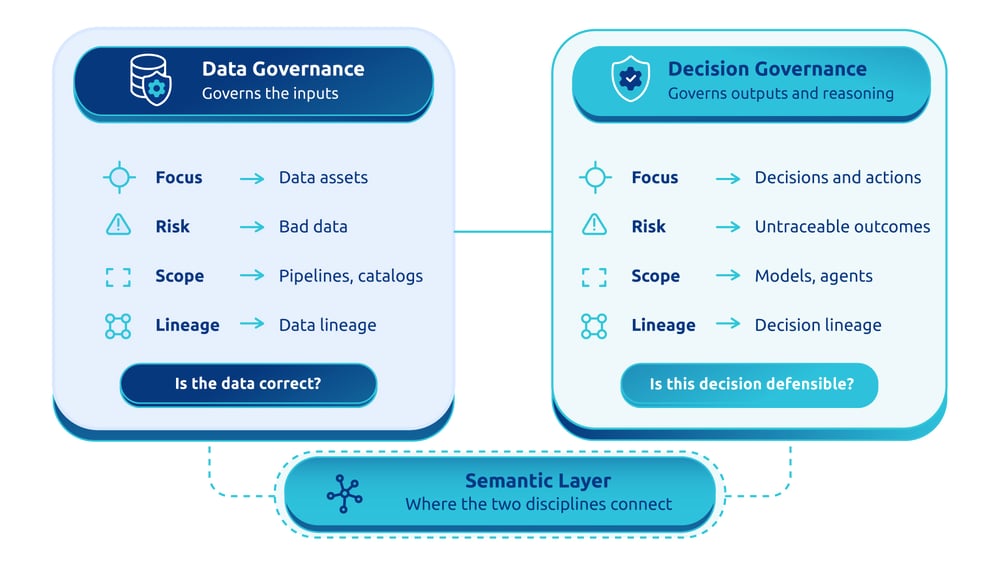
Data governance is still necessary, but on its own, it is no longer sufficient. It governs the inputs. Decision governance governs the outputs and the reasoning that produced them, which is where regulatory exposure now tends to concentrate.
| Aspect |
Data governance |
Decision governance |
|
Focus |
Data assets |
Decisions and actions |
|
Primary risk addressed |
Bad data |
Untraceable outcomes |
|
Scope |
Pipelines, catalogs, quality |
Models, agents, workflows |
|
Traceability |
Data lineage |
Decision lineage |
|
Question it answers |
Is the data correct? |
Is this decision defensible? |
This is also the cleanest way to think about data governance vs data-driven decision-making. The first keeps the inputs trustworthy, the second uses them, and decision governance is what sits between the two once a machine is doing the deciding. Anyone asking how data governance improves decision-making is really asking about that middle layer.
A mature data governance solution is a precondition for decision governance, not a substitute for it. The semantic layer for AI readiness is where the two disciplines connect, and building that connection once tends to serve future AI use cases that follow.
Why data governance alone falls short when AI makes the decisions
Traditional data governance often focuses on the point where governed data reaches the model, while model and AI governance may not always capture the full decision path across retrieval, reasoning, action and review.
That boundary made sense when a human read the output and took responsibility for what happened next. It holds up less well now that AI produces answers which trigger workflows, populate regulatory reports, and shape decisions several steps downstream.
Three developments have moved that boundary.
- Agentic AI workflows now act directly on enterprise systems.
- LLM-based assistants deliver answers straight to regulated teams.
- GraphRAG applications reason across connected knowledge sources rather than retrieving single documents.
The consequence is worth stating plainly to your risk committee. An AI output that cannot be traced to its source, aligned to a policy, or reviewed against a business rule creates much the same audit exposure as an unlogged transaction, and in regulated industries, that is a material problem.
Decision governance is the natural next layer rather than a rebuild. Most of the work sitting in your existing catalog, lineage, and quality programs carries forward, which is why the CDO case for it usually reads as an extension of a funded program rather than a new one.
The semantic foundation that makes decision governance possible
You can only govern what the system can reason about. If AI outputs are grounded in unstructured text and vector similarity alone, there is nothing structural to attach a policy, an entity, or an audit trail to. The decision may arrive without a reliable record of how it was reached.
A semantic foundation changes that in three plain steps. Ontologies define what the entities are. Knowledge graphs connect those entities with meaning and relationships. A semantic layer makes those relationships available to downstream AI systems as governed, structured knowledge rather than loose text.
What this changes for the decision itself
When implemented on a governed knowledge foundation, outputs from a GraphRAG-based system can often be traced to specific entities, relationships, and source documents. That turns "the model said so" into "the model concluded X because of relationship Y in policy Z." For the CDO, the difference is the gap between an AI program that clears compliance review and one that stalls there indefinitely.
GraphRAG services, knowledge graph solutions, and sustained ontology management are the usual delivery route. Accelerators such as Datavid Rover tend to compress the build, which matters when governance work competes for budget against visible AI features.
Roche Policy Assistance shows how a semantic knowledge base can help policy answers trace back to underlying content, creating a stronger foundation for governed AI-assisted workflows.
What decision governance looks like inside the enterprise
Decision governance becomes concrete through a handful of capabilities. Four carry most of the weight, and each maps to a benefit a CDO can defend in a budget conversation rather than an abstract improvement in posture.
.png?width=1000&height=563&name=Illustration%20for%20blog-Data%20vs%20Decision%20Governance-What%20decision%20governance%20looks%20like%20(2).png)
Decision lineage that maps every AI output to a source
Every answer, recommendation, or automated action is linked to the entities and documents that produced it, much as data lineage links a report back to its source tables. The audit question changes from "can we reconstruct this" to "here it is."
ABN AMRO shows how traceability and semantic enrichment can support audit-ready reporting, which is the kind of foundation decision governance requires.
Policy alignment enforced at the semantic layer, not the prompt
Business rules, regulatory obligations, and access controls can be encoded in the ontology and enforced during retrieval. Decisions then cannot rely on data the requester should not see, or reach conclusions the policy does not allow.
This is where role-based access control and audit trails intersect with the knowledge graph itself. Prompt-level guardrails are easier to build but harder to evidence, which is usually what a regulator asks for.
Human review that scales with the volume of AI decisions
Governed agentic workflows are the mechanism here. Humans stay in the loop for exceptions and high-stakes calls, while the semantic layer handles routine reasoning with traceability intact.
The ROI argument is straightforward. Review capacity is fixed, AI output volume is not, so governance that scales without proportional headcount is what allows adoption to continue past the pilot stage.
Explainability that holds up in an audit
Decisions produced by GraphRAG can be reconstructed after the fact: which entities were retrieved, which relationships were traversed, which source documents were cited. This is the difference between "the model said so" and a defensible decision record.
The connection between knowledge graphs and AI integration is what makes that reconstruction possible, since the reasoning path is recorded in the structure rather than inferred afterwards.
Moving from data governance to decision governance
This is an extension of the data governance investment you have already made rather than a rebuild. Most enterprises have done the catalog, lineage, and quality work. Decision governance sits on top of it, which is why the incremental cost can be lower when organisations reuse existing catalog, lineage, quality and governance investments.
A few questions tend to surface the gap quickly:
- Can your teams trace how an AI-produced answer was reached?
- Do your AI outputs respect the same access controls as the underlying data?
- Can compliance reviewers reconstruct a specific decision after the fact?
- Do your agentic workflows remain aligned to business rules end to end?
If the answer to any of those is unclear, the gap is usually not more tooling. It is a semantic foundation the AI can reason against, built with partners who have done this in regulated settings, and reused by later use cases rather than rebuilt for each one.
The next chapter of enterprise AI governance
Data governance kept data correct. Decision governance keeps decisions defensible, and the semantic foundation is what makes the second possible. For a CDO, this is less a new mandate than the point where existing governance work starts paying for itself across the AI portfolio.
Assess whether your AI decisions are traceable, policy-aligned and audit-ready.