
9 minute read
Quick answer
Agentic AI plans and carries out multi-step tasks toward a goal with limited human supervision. The first agents worked inside 1 application, and newer ones are starting to hand off work across Customer Relationship Management (CRM), Enterprise Resource Planning (ERP), and data platforms. That shift tends to hold up when agents read the same definitions, lineage, and access rules.
Your CRM copilot can summarize an account and draft a renewal email in seconds, because the data it needs sits in 1 system. Ask an agent to check that account’s unpaid invoices in the ERP, and it may return 2 matching customers or none. That second step is where many enterprise AI agents are heading.
The terms vertical and horizontal have different meanings in AI. They often describe whether a tool serves a specific industry or multiple industries. Here, they refer to where an agent operates: a vertical agent works within a single application, while a horizontal agent works across multiple applications. By this definition, even a CRM copilot designed for every industry is still a vertical agent.
Horizontal work raises 1 question for the Chief Information Officer (CIO) setting AI strategy and the Chief Data Officer (CDO) who owns the data. Do the agents read the same version of the business? A semantic foundation is 1 way to give them that shared version, a pattern Datavid (a C5i company) sees across regulated enterprises adopting agents.
At a glance
- Gartner forecasts that 40% of enterprise applications would include task-specific AI agents by the end of 2026.
- The Financial Industry Regulatory Authority (FINRA) flags agents that act beyond their intended scope and action chains that are hard to reconstruct.
- Wrong entity matches passed quietly between agents are a common failure in horizontal AI.
- Shared definitions, sourced records, and per-step access checks can keep agents aligned on meaning.
What does agentic AI mean in an enterprise?
In an enterprise, agentic AI manifests as agentic workflows, such as approving a refund or updating a supplier record across 2 systems. The agent decides on the next step, calls a tool, and checks the result before moving on.
Where the actions happen shapes much of the risk in agentic AI use cases, so it’s a sensible starting point for strategy.
The first wave of agents was vertical
Vertical AI agents are built into 1 application and serve 1 team, such as a service assistant in a ticketing tool. They read that application’s data and follow its rules, so they tend to be quick to deploy and easier to govern.
Gartner predicted in August 2025 that 40% of enterprise applications would include task-specific AI agents by the end of 2026, up from less than 5% in 2025. Those agents are largely vertical AI by design, since vendors build them into their own products.
The catch is that real work rarely stays in 1 application. A customer complaint can touch the service desk, the order system, and the contract store, and a vertical agent sees only their slice of the case. Vertical agents can deliver quick wins within a single team, but the greater savings usually lie in workflows that span data silos across applications.
What changed to make agents horizontal?
Horizontal AI describes agents that run workflows across systems and departments. It started to look practical once models could plan several steps ahead and open protocols connected agents to tools and to each other.
Orchestration then let specialist agents share 1 workflow, which is where enterprise data starts to matter more.
Models that can plan and use tools
Large language models can now break a goal into steps, pick the right tool, and call Application Programming Interfaces (APIs) with structured inputs.
Results still vary by task. For a Chief Technology Officer (CTO), the shift is that an agent can carry some tasks across several calls without someone stitching them together.
Open protocols for tools and for other agents
The Model Context Protocol (MCP) gives agents a standard way to connect to tools and data. Anthropic contributed it to the Linux Foundation’s Agentic AI Foundation in December 2025, by which time more than 10,000 MCP servers had been published.
The Agent2Agent (A2A) protocol, created by Google, does the same between agents. It became an open project at the Linux Foundation in June 2025 with more than 100 companies behind it.
Agents sold by different vendors may start handing jobs back and forth, which can give a CIO more room to add capability with less lock-in.
Orchestration across departments
AI agent orchestration assigns each part of a workflow to a specialist agent and passes the results along. In multi-agent systems, 1 workflow can start in the CRM, check credit terms in the ERP, and finish with a contract from the document store.
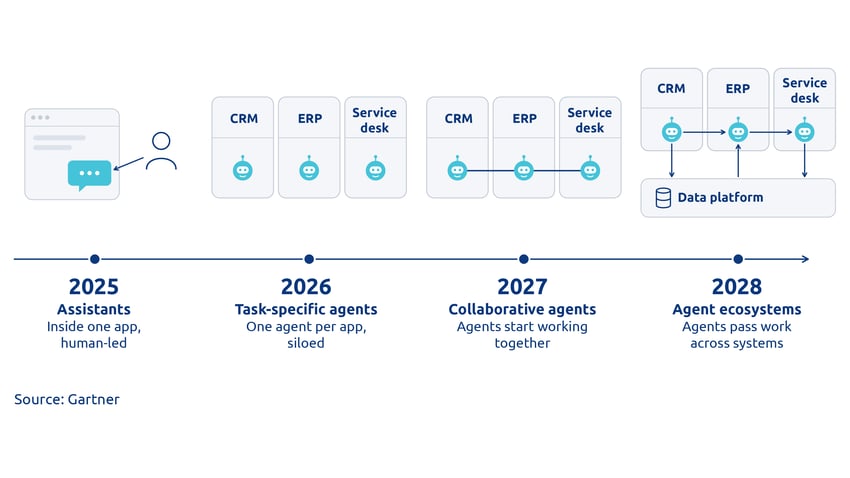
Agent orchestration leans on sound AI integration with the systems involved, since a handoff between agents is also a data handoff. Gartner’s view of agents in enterprise apps puts these shifts on a timeline, with the horizontal turn in 2028.
- 2025, assistants: built into most enterprise apps, still dependent on human input.
- 2026, task-specific agents: agents that handle set tasks inside 1 app.
- 2027, collaborative agents: about 1 in 3 implementations combine agents with different skills.
- 2028, agent ecosystems: specialized agents working together across applications.
Horizontal vs vertical AI agents compared
Horizontal vs vertical AI comes down to what each agent depends on. A vertical agent relies on 1 application’s data, owners, and controls, while a horizontal agent depends on many of each.
That difference shapes where errors show up and which team may have to answer for them before an auditor.
|
Dimension |
Vertical AI agents |
Horizontal AI agents |
|
Scope |
1 task for 1 team |
A workflow across departments |
|
Systems touched |
1 application, such as the CRM |
CRM, ERP, document stores and data platforms |
|
Data it reads |
1 set of records and definitions |
Many systems, each defined differently |
|
Ownership |
The application owner |
Shared across IT, data and business teams |
|
How it fails |
Inside the app, where errors surface to the user |
Between systems, where a wrong match can pass unnoticed |
|
Governance needed |
The application’s permissions and audit log |
Access checked per action, with a full trail |
Vertical agents are often the better fit for tasks that stay inside 1 team. In many cases, horizontal agents are worth the extra governance once a workflow crosses departments, where a mismatch can propagate through several agents before anyone notices.
Why do many horizontal agents break in large enterprises?
Inside 1 application, an agent inherits 1 set of definitions. Across 20 systems, it may inherit 20.
Gartner expects over 40% of agentic AI projects to be canceled by the end of 2027, citing escalating costs, unclear business value, or inadequate risk controls.
Many of the risks in cross-system work trace back to 3 breaks in meaning and evidence. The 3 breaks sit mostly in the data layer, where a CDO can start the fixes.
Systems often define customer, product, and patient their own way
A CRM, an ERP, and a Know Your Customer (KYC) system may hold records for the same manufacturing group and mean something different by them. An agent joining them on company name has to pick 1 meaning per step.
|
System |
What customer means there |
What an agent may get wrong |
|
CRM |
An account, often the parent group |
Sending a group offer to a subsidiary on its own contract |
|
ERP |
A sold-to party, usually 1 per subsidiary |
Marking the whole group overdue because of 1 late invoice |
|
KYC system |
A legal entity with verified owners and a risk rating |
Applying 1 entity’s risk rating to its sister companies |
Product and patient records also drift apart, since a product code or patient ID can differ across systems.
Meaning can get lost between agents
A handoff in multi-agent AI passes data to the next agent, but the assumptions behind it rarely travel along. If the first agent filtered accounts to 1 region, the second may treat that shortlist as the full customer base. Neither agent erred on its own terms, yet the result can still be wrong.
A shared model that carries definitions and filters along with the data can help keep a downstream agent from acting on half the picture, before the error spreads to other systems.
Agent actions can become hard to reconstruct
A chain of agents can touch several systems in seconds, and each step may log only its own part.
FINRA flags this in its 2026 oversight report. It notes that agents may act beyond their intended scope and that chains of agent actions may be difficult to trace afterward.
Teams that trace AI decisions record agent actions against the data they touched, which helps keep answers defensible.
What does agentic AI look like in life sciences and banking?
Life sciences and banking answer to strict regulators, so they’re a quick test of whether agents can cross systems and still leave evidence. Agentic AI examples from both sectors often establish a shared data model before agents act.
Regulated agentic use cases tend to depend on that order, because an auditor is likely to ask a person and an agent the same question: where did this answer come from?
Roche’s policy questions answered from 1 knowledge graph
Agentic AI in pharma often starts with compliance, where answers have to cite policy. Roche's compliance advisors were fielding about 10,000 policy inquiries a year. The answers sat in PDF documents, intranet pages, spreadsheets, and databases.
Datavid built a working prototype in 6 weeks that integrated those sources into a single knowledge graph with role-based access. Employees received faster answers, with many queries resolved instantly, and advisors gained time to handle complex cases. That governed knowledge base can also lay the groundwork for agentic compliance workflows, since any agent added later can draw on it.
A common product model for machines in the field
In the life sciences, agentic AI is also making inroads. A global organization with deep crop protection expertise stored product data in disconnected systems, while its automated sprayers, sensors, and digital farming tools needed data ready for consumption.
Datavid helped design a common product model that aligned the sources under consistent definitions and traceable lineage, with data delivered to the machines in real time. Field teams and partners gained instant access to accurate product data, and automated flows cut manual processing. The definitions came first, and the machines came after.
A bank customer with 3 different records
Take an illustrative Anti-Money Laundering (AML) investigation, not drawn from a client project. An agent pulls the customer from KYC, transactions from core banking, and alert history from case management.
In KYC the customer is a legal entity, in core banking a set of accounts and in case management the subject of a past alert. If the agent can’t resolve those records to 1 entity, it may miss a transfer between related companies.
In AML work, agentic AI in banking is more likely to hold up when an ontology and knowledge graph resolve the entity before the agent starts.
That foundation can grow on systems a bank already runs. Datavid extended ABN AMRO’s existing Progress MarkLogic platform for daily reporting under the Markets in Financial Instruments Directive (MiFID II).
What does a data foundation for horizontal agents look like?
A data foundation for horizontal agents can provide them with a shared view of the business. In agentic AI architecture, that view usually sits in a semantic layer for AI agents, mapping business terms to the underlying data.
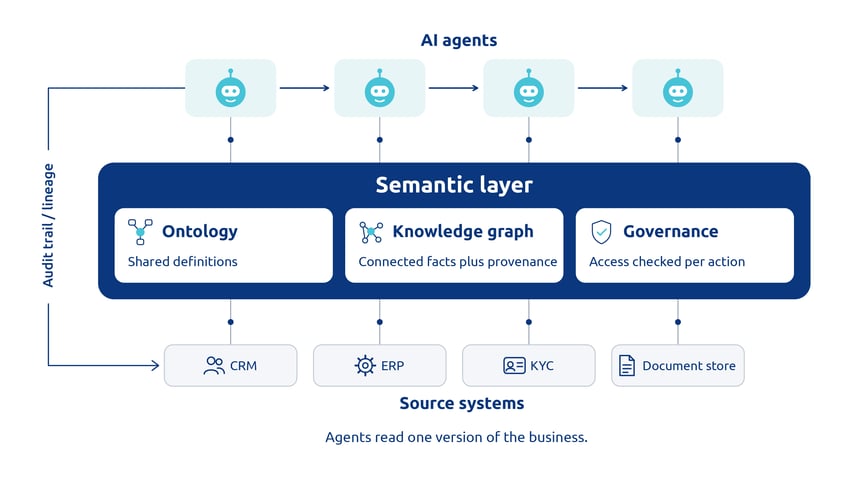
The foundation has 3 parts: an ontology, a knowledge graph, and governance checked at each agent action. Each can be built 1 domain at a time, and together they act as a company brain for agents.
Shared definitions in an ontology
An ontology is a structured model of the business’s core entities and how they relate to one another. Customer, product, and patient each get 1 agreed-upon definition mapped to each system’s version, so agents across different systems can resolve customer issues the same way.
Ontology management helps keep those mappings current and records who approved each definition.
A knowledge graph that connects entities with provenance
A knowledge graph is a network of connected facts about those entities, drawn from many systems, with a source recorded for each fact as provenance. Agents can reason over the connections and trace each answer back to its system.
Building a knowledge graph usually accounts for the larger share of the effort, and keeping it accurate in production depends on assigning a named owner per domain.
Governance checked at each agent action
In practice, agentic AI governance holds up better when access is resolved for the person or agent asking, at the moment of retrieval. A semantic layer can apply those rules per request and log the action against the entities it touched.
That log can serve as the evidence an auditor is likely to request.
Give your enterprise AI agents the same view of the business
Horizontal agents are starting to arrive through applications enterprises already own, so the timing is often set by vendors. The order of work isn’t, and for a CDO a practical move available now is a shared semantic foundation built on AI-ready data.
Before agents cross departments, start with 1 governed use case that can yield a working result in 6 to 8 weeks. Then check where its core entities stand.
- 1 definition per entity: a customer or a product means 1 thing in each system agents read.
- 1 lineage per fact: each value an agent uses traces back to its source record.
- Access checked per action: permissions resolve for whoever is asking, person or agent.
- 1 owner per domain: a named person approves changes to the definitions.
If you’d like an outside view, a free assessment can test those 4 checks against the cross-system workflow your agents are likely to touch first. Datavid’s semantic AI services team runs the review, drawing on what it has learned building the Semantic5i semantic data platform.
Pick that workflow, settle its core definitions, and let the agents that follow inherit them.
Planning agents that work across departments? A low-risk first step is to check where your data stands before they go live.