
7 minute read
Quick answer:
Agentic AI is viable in regulated workflows today, and the constraint is rarely model capability. It is whether the agent's reasoning traces back to governed data. The workflows that ship first tend to be the ones whose controlled vocabulary already exists, or can be built quickly on an ontology and knowledge graph.
Most guidance on agents in regulated settings stops at four controls: immutable logging, role-based access, model version tracking, and a human approval gate. Those record that an agent acted and who signed off. They say little about why the answer was correct, or whether the agent was working from a reliable semantic foundation that gives data consistent meaning across systems.
For a product manager choosing which workflow to pilot, that distinction decides the roadmap. What follows is where agents are deployable now, how to sequence them, and what has to be true underneath, including the semantic foundation needed for agents to reason reliably across enterprise data.
At a glance
- Six agentic AI use cases are deployable in regulated workflows today, each gated by a different evidence requirement rather than by model capability.
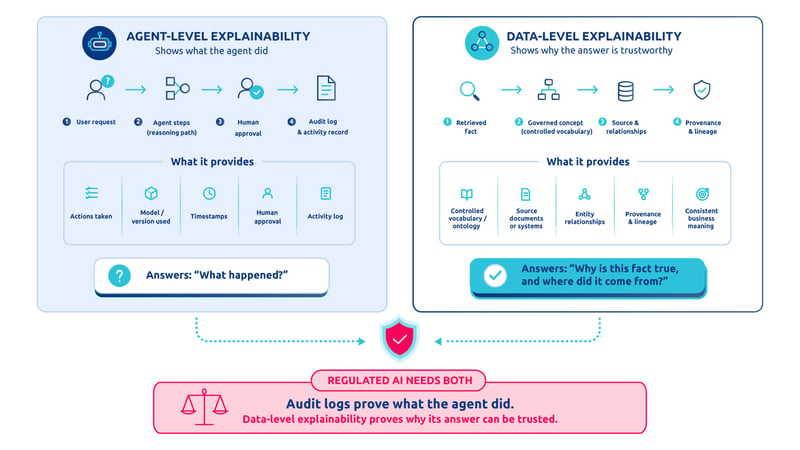
- Agent-level explainability records which steps were taken; data-level explainability establishes why a retrieved fact is true, and regulated review turns on the second.
- Audit logs capture activity but do not establish that a concept meant the same thing in the agent's output as in your submission.
- Named instruments matter: 21 CFR Part 11, GxP and GAMP 5, EU AI Act Articles 12 and 13, BCBS 239, DORA, and MiFID II each shape what evidence a reviewer expects.
- Sequencing beats scope: pilot where the evidence requirement is narrowest and the vocabulary is already governed.
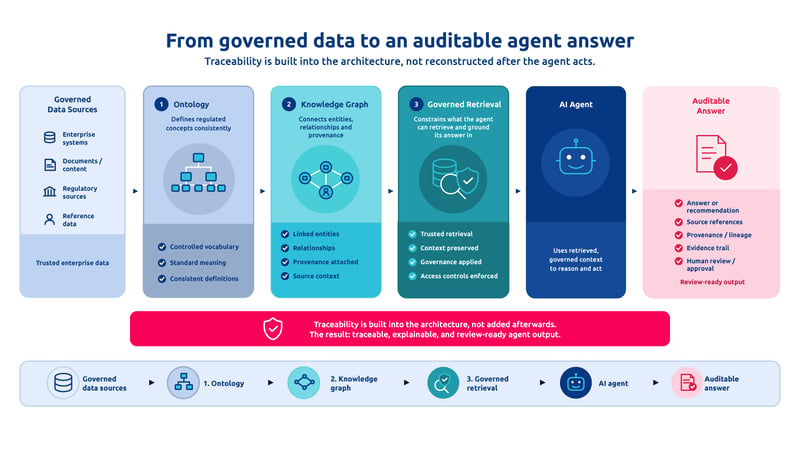
- An ontology, a knowledge graph with provenance, and governed retrieval make the audit trail a property of the architecture rather than a reconstruction exercise.
- For a product manager, the payoff is a shorter path through review and a foundation the next agent reuses.
Where agentic AI earns its place in regulated workflows
There are two kinds of explainability, and most programs only build one. Agent-level explainability shows which steps the agent took and who approved them. Data-level explainability shows why the retrieved fact is true and where it came from. Regulated review turns on the second.
An audit log records activity. It does not establish semantic consistency, which is what an inspector tests when they compare an agent's output against a submission. If "adverse event," "beneficial owner," or "active substance" resolves differently in the agent's answer than in your filing, the log will not help. Agentic AI compliance turns on that consistency more than on the control surface around it.
 The instruments naming that expectation vary by industry.
- In life sciences, FDA 21 CFR Part 11, GxP, and GAMP 5 set expectations around traceability and controlled records.
- In banking, BCBS 239, DORA, and MiFID II address similar requirements around data integrity, governance, and accountability.
- Across industries, EU AI Act Articles 12 and 13 add requirements around logging and transparency.
Each uses different language, but the underlying expectation is similar: organizations need evidence showing where a fact came from and how it was used.
That makes traceability an architecture property rather than a reporting step, which is the argument behind a semantic layer for AI readiness. GraphRAG services can extend that foundation by connecting retrieved information through governed entities, relationships, and source context, helping agents produce answers that are easier to trace and verify.
Building that foundation once tends to cost less than evidencing each agent separately, and the viable use cases are the ones where the evidence already sits in governed form, or can be put there quickly.
Agentic AI use cases in regulated industries
Each use case below is written at the workflow level, because "healthcare" is not something you can pilot. For each, the artifact a reviewer would ask for is named alongside the data that has to exist first.
Regulatory intelligence monitoring and change impact analysis
The agent tracks regulatory publications, interprets what changed, and maps each change to the internal processes, SOPs, and product registrations it affects. This is among the strongest early candidates in both life sciences and banking, since the alternative is analysts reading gazettes and the impact assessment is reusable across product lines.
A reviewer will ask for a defensible trace from a specific regulatory clause to the specific internal control it touches. That requires a governed mapping between regulatory concepts and internal process and product entities, which is the same substrate behind policy compliance with AI.
Pharmacovigilance case intake and triage
In agentic AI life sciences work, this is the highest-volume candidate. The agent ingests adverse event reports across channels, extracts structured case data, checks for duplicates against existing cases, and routes by seriousness and expectedness.
The evidence required is consistent coding of the same clinical concept across every case. That depends on MedDRA and other controlled vocabularies being bound to the extraction step rather than left to the model to approximate, which is data engineering work more than prompt work. Getting it right is what lets triage volume rise without case review headcount rising with it.
Submission dossier assembly and gap checking
The agent assembles module content, checks each required element against the applicable guideline, and flags gaps and inconsistencies before submission rather than after a deficiency letter.
Provenance for every assembled statement back to its source study or document is what a reviewer expects. Document- and study-level lineage must exist beforehand, which is usually the constraint rather than the assembly logic, and closing that gap tends to shorten the deficiency cycle that follows a thin submission.
AML alert investigation and narrative drafting
For agentic AI banking teams, this is where analysts' time is concentrated. The agent gathers the entity, transaction, and relationship history behind an alert, then drafts the investigative narrative for a human analyst to review and sign.
What a reviewer asks for is a reconstructable view of the relationship network on which the conclusion rested, as it stood at the time of the decision. That needs resolved entities and a stable definition of beneficial ownership, both of which tend to be knowledge graph problems rather than model problems. Solving them once serves sanctions screening and KYC review as well.
Control evidence collection for model risk and audit
The agent continuously gathers evidence that controls are operating, assembles it against the control taxonomy, and flags exceptions between audit cycles instead of during them.
The artifact required is the mapping between the control as written and the evidence as collected. A governed control taxonomy has to exist first, otherwise the agent is matching text to text. Teams that build it inside their data governance program tend to spend less of each audit cycle assembling evidence by hand.
Standards and specification maintenance
Publishing and standards organizations are largely absent from other coverage of this topic, though the workflow fits well. The agent detects where a revised standard creates downstream inconsistency across a corpus of dependent documents and proposes affected passages for editorial review.
The dependency chain between the changed clause and each flagged passage is the evidence. That calls for the corpus modeled as linked content rather than stored as files. The BSI compliance navigator shows this in delivery, using knowledge graphs over ontologies to trace relationships between concepts and the standards database, with version indicators and document history surfaced rather than buried.
How to sequence your first agentic AI deployment
Six candidates is a sequencing problem, not a shopping list. The table below scores each against what actually gates it.
|
Use case |
Permitted autonomy |
Evidence a reviewer asks for |
Human checkpoint |
Data prerequisite |
|
Regulatory intelligence |
Drafts impact assessments |
Clause-to-control trace |
Approval before SOP change |
Regulatory-to-process mapping |
|
Pharmacovigilance triage |
Codes and routes, escalates edge cases |
Consistent concept coding |
Review of serious or unexpected cases |
Controlled vocabularies bound to extraction |
|
Dossier assembly |
Assembles and flags, does not submit |
Statement-level provenance |
Sign-off before filing |
Document and study lineage |
|
AML investigation |
Drafts narratives only |
Point-in-time relationship view |
Analyst authors final narrative |
Resolved entities, ownership definitions |
|
Control evidence |
Collects continuously, flags exceptions |
Control-to-evidence mapping |
Audit review of exceptions |
Governed control taxonomy |
|
Standards maintenance |
Proposes edits for review |
Clause dependency chain |
Editorial approval |
Corpus modeled as linked content |
The decision rule is short. Pilot first where the evidence requirement is narrowest and the vocabulary already exists in governed form. Pharmacovigilance often wins on that test because MedDRA is already in place; AML often loses it, not for lack of value but because entity resolution is unfinished. Sequencing on agentic AI compliance readiness rather than on business case alone tends to shorten the path through review considerably.
Enterprise-wide agent autonomy is rarely the starting point, and treating it as one is what tends to produce stalled pilots. A tightly scoped, compliance-heavy workflow with an existing controlled vocabulary gives a product manager a defensible win and a foundation the next agent reuses, so the second deployment usually costs a fraction of the first.
The data foundation that makes agent decisions auditable
Three layers carry the evidence requirements in the table above, and they build in order. Sequencing that build is data architecture work, and the order tends to matter more than the tooling.
- An ontology fixes what each regulated concept means, so "active substance" resolves the same way in the agent's output as in the filing. Keeping those definitions current as guidance changes is ontology management work, and it is where ontologies reduce AI hallucinations in practice. It is also the layer where prior delivery experience shows most, since early definition choices are expensive to revisit once agents depend on them.
- A knowledge graph holds the resolved entities and their relationships with provenance attached. This is what makes a point-in-time relationship view answerable rather than reconstructable.
- Governed retrieval constrains what the agent can ground its answer in. When retrieval traverses the graph, every fact carries its source, so the trace an inspector asks for is emitted as the agent reasons rather than assembled afterwards. GraphRAG services deliver that pattern, and the same architecture underpins AI decision traceability more broadly. For a product manager, this is often what separates an agent that clears review from one that waits quarters for sign-off.
 Delivery evidence exists across both verticals. The Roche policy assistance work unified scattered policy content into a semantic knowledge base in six weeks, so guidance resolves to a governed definition. In banking, ABN AMRO's regulatory trade data hub paired semantic enrichment with real-time compliance logic and audit-ready traceability for MiFID II reporting. Accelerators such as Datavid Rover tend to compress these scoped builds into weeks rather than months, which is often what makes a first agent fundable.
Choosing the workflow to start with
Pilot the workflow whose evidence requirement is narrowest and whose vocabulary is already governed, then reuse that foundation for the next one.
Check which of your candidate workflows already has the vocabulary it needs. A free assessment maps your candidates against their data prerequisites so you can sequence with evidence rather than instinct.