
6 minute read
Quick answer:
Publishers need earlier manuscript risk signals because integrity concerns are becoming much harder to spot. By connecting risk signals across multiple elements within a manuscript, editorial teams can quickly identify higher-risk submissions sooner, while keeping human judgement at the centre of every decision.
Research integrity has always been central to scholarly publishing. It is what ensures that the knowledge we share is sound and credible enough to serve as a foundation for future work. Today, maintaining this integrity has never been more challenging and the pressures are only increasing.
Editorial teams are under pressure to make timely decisions while juggling higher submission volumes and contending with misconduct tactics that are increasingly harder to detect. For years, many editorial workflows have relied on a similar set of first-pass checks: checking scope, validating author details, assessing funding and ethics information, making sure references are current, and running text-similarity analysis.
Those checks still matter.
The challenge is that many of these checks are time-consuming, inconsistent, and disconnected, making it difficult to interpret the larger picture of potential manuscript risk.
A submission may look satisfactory at first, but later questions may arise around author credibility, reference quality, funding disclosures, affiliations, or unusual collaboration patterns. When these signals are identified late in the editorial process, especially after publication, they are harder to investigate, more disruptive to resolve and risk reputational damage.
For publishers, the challenge is how to centralize these checks and carry them out quickly and thoroughly enough to identify which submissions need a closer look, and why.
Integrity screening is shifting toward a more connected view of manuscript risk
While individual manuscript checks are helpful, they are unable to provide a full risk profile on their own.
A manuscript can pass one check and still raise concerns elsewhere. This is why manuscript integrity screening needs to look across the wider submission context.
Integrity concerns can appear across:
- Author credibility
- Unclear authorship contribution, including guest or gift authorship
- Paper mill patterns
- Retracted or problematic references
- Suspicious citation behavior
- Compromized or inconsistent author profiles
- Undisclosed funding conflicts
- Affiliation concerns
- Incomplete or inconsistent submission metadata
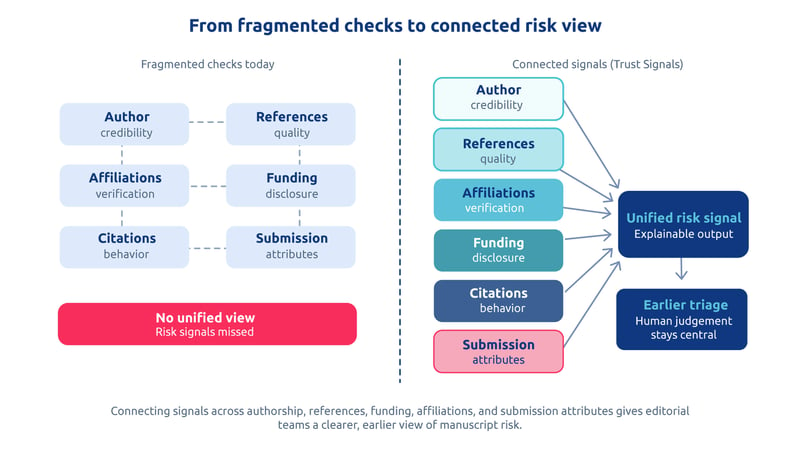
The value is in connecting these signals across multiple elements within the manuscript – authorship, affiliations, references, and funding disclosures, early enough for editorial teams to identify submissions that need closer attention.
This matters because early triage is very different from late-stage investigation.
Early detection allows editorial teams to decide quickly whether to investigate further or desk reject. When issues surface later, the consequences can be more difficult and costly to manage, especially after publication.
Why detecting misconduct is harder for publishers now.
The challenge is not that publishing teams are unaware of research integrity risks. In many cases, they are highly aware of them. The challenge is operational. Integrity checks often happen across different platforms, databases, teams, and points in the editorial workflow. Some checks may be automated. Others may depend on manual searches, editor experience, spreadsheet tracking, or escalation to a specialist team.
This makes consistency difficult.
A managing editor may spot one issue, a research integrity officer may identify another, while a technology team may hold the metadata needed to understand a third. But unless these signals are connected, it can be difficult to interpret the larger picture.
This creates several problems for publishers.
First, manual checks take time. Editorial teams are already under pressure to move submissions forward without adding unnecessary delay.
Second, disconnected checks can create inconsistent triage. Two editors may look at similar cases and reach different conclusions because the supporting evidence is not presented in a consistent way.
Third, borderline cases are hard to explain. If a submission needs to be escalated, research integrity teams need a documented trail of what was found, why it matters, and how it relates to the manuscript.
Finally, technology teams are often asked to support additional review processes without creating more complexity for editors. Any new screening layer has to fit smoothly into existing workflows, not become another disconnected system.
Why this matters to every team involved in publishing integrity
Research integrity is not owned by one team alone. Protecting research integrity requires input from research integrity specialists, managing editors, and publishing technology teams. Each team contributes a different perspective, from evidence and escalation to editorial triage and workflow integration.
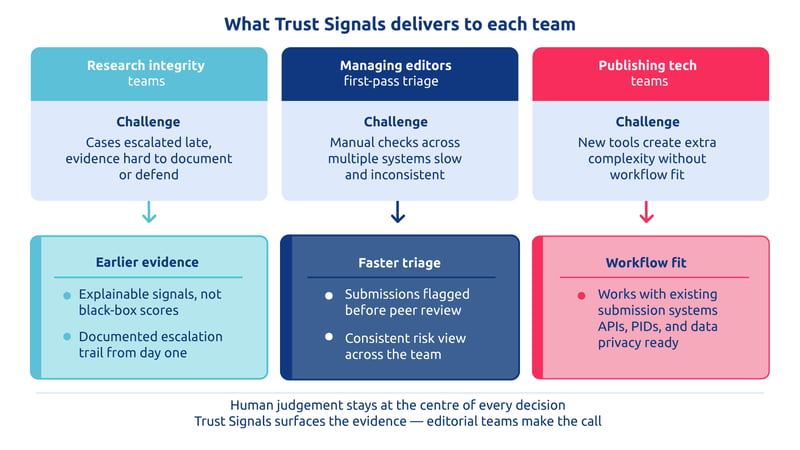
For research integrity teams: earlier evidence matters
Research integrity teams need defensible evidence.
When a case needs to be escalated, it is not enough to say that something “looks unusual.” Teams need to understand which signals were identified, how they relate to the submission, and whether the concern is strong enough to justify further review.
This is where explainability matters.
A risk score should not act as a verdict. It should help integrity teams understand what has been flagged and why. This is especially important when avoiding false positives, documenting decisions, or supporting internal escalation.
Late-stage investigations can be harder, more expensive, and more contentious. Retractions, expressions of concern, and public corrections can also affect the journal and/or publisher’s reputation.
Earlier evidence gives research integrity teams a better starting point.
For managing editors: first-pass checks are becoming a bottleneck
Managing editors are often responsible for keeping manuscripts moving through the submission process.
They need to make sure submissions are complete, relevant, compliant, and ready for the next stage. At the same time, they need to avoid unnecessary delays for manuscripts that do not warrant further investigation.
This is difficult when checks are manual or scattered.
If editors are expected to look across multiple systems to validate authors, references, funding, affiliations, and ethics information, first-pass screening can become slow and inconsistent.
Earlier manuscript risk signals can help managing editors to triage more efficiently. Instead of spending the same level of manual effort on every submission, teams can move papers through quickly while still identifying which papers require closer inspection.
The goal is not to remove editorial judgement. It is to give editors a clearer view earlier in the process.
For publishing technology teams: workflow fit is critical
Technology teams play a critical role in making research integrity screening scalable.
They need to consider existing editorial platforms, APIs, connectors, data privacy, reliability, metadata quality, and support burden. A tool that creates extra complexity may not be sustainable, even if the idea behind it is valuable.
For this reason, a tool should be able to work smoothly with existing submission data, persistent identifiers, and editorial processes. It should support structured checks without forcing editors to manage another disconnected system.
For publishing technology teams, the question is practical: can this fit into the workflow securely, reliably, and without unnecessary technical burden?
What modern manuscript integrity screening should include
Modern manuscript integrity screening should help publishers connect signals that are often reviewed separately.
A stronger screening layer should be able to:
- Use authoritative data sources and persistent identifiers where possible
- Check for retracted or problematic references
- Support author and affiliation verification
- Surface suspicious patterns across citation and collaboration networks
- Provide explainable outputs, not black-box scores
- Help teams triage risk before peer review or publication
- Keep editorial teams in control of final decisions
- Fit into existing publishing workflows
Research integrity decisions are rarely based on one signal alone. The value comes from identifying and interpreting multiple signals together to help make risk patterns easier to detect and review.
From fragmented checks to explainable Trust Signals
Trust Signals is Datavid’s approach to structured, evidence-based manuscript screening.
It helps publishers move from fragmented checks to a clearer view of potential manuscript risk. Rather than relying on individual checks in isolation, Trust Signals analyzes submissions using multiple trust markers creating a coherent picture of risk that no single check can provide.
The goal is to help editorial teams understand which submissions may need closer attention, and why.
For a more detailed product overview, you can also download the Trust Signals brochure.
Trust Signals supports checks across areas such as author resolution, reference integrity, affiliation verification, funding and disclosure completeness, and other manuscript-level attributes. It uses authoritative sources and persistent identifiers, such as ORCID, ROR, Crossref, and Crossmark, at a high level to help support more evidence-based screening.
The system is designed to provide explainable outputs, so teams can understand what has been flagged rather than relying on a black-box score.
That distinction matters.
A score should not replace editorial judgement. It should help editorial teams make better informed decisions earlier in the workflow. Trust Signals helps surface the evidence that may otherwise remain scattered across manual checks and disconnected systems, while humans stay in control of the final decision.
For publishers, this can support three important outcomes:
- Faster triage for managing editors
- Clearer escalation evidence for research integrity teams
- Better workflow fit for publishing technology teams
In other words, Trust Signals is not just a screening tool. It is a way to bring manuscript risk signals into a more connected and explainable view.
Here you can learn more about how research integrity is scored and how Datavid approaches trust marker integrity screening.
What publishers should do next
For publishers reviewing their current approach to manuscript integrity screening, the first step is not necessarily to replace existing checks.
It is to understand where those checks happen today, how consistent they are, and whether they give teams a clear enough picture early in the workflow.
Useful questions to ask include:
- Where do integrity checks happen today?
- Which checks are still manual?
- Which checks are difficult to connect or interpret together?
- Which risks are not covered by existing screening tools or first-pass checks?
- Can editors see why a submission has been flagged?
- Can research integrity teams explain and document escalations?
- Can technology teams integrate screening into existing workflows?
- What does success look like in an early access pilot?
These questions can help publishers identify where early risk visibility is strongest, and where manual or fragmented processes may be creating unnecessary workload.
Research integrity will always require human judgement. The challenge is making sure that judgement is supported by clear, connected, and explainable evidence.
Earlier manuscript risk signals can help editorial teams spot potential concerns sooner, triage submissions more consistently, and focus attention where it is needed most.
Ready to explore earlier manuscript risk signals?
Trust Signals helps publishers assess manuscript integrity across authors, references, affiliations, funding, and metadata, with explainable signals that support editorial judgement.

And apply for the Early Access Program to help shape the next generation of manuscript integrity screening!