
6 minute read
Quick answer
Research integrity teams need earlier manuscript risk signals because late-stage concerns are harder to investigate, explain, and resolve. By connecting evidence across authorship, references, affiliations, funding, disclosures, and submission context, teams can identify higher-risk manuscripts sooner while keeping human judgement at the centre of every decision.
Research integrity teams are often called in to investigate manuscripts that could have been desk rejected much earlier. Multiple anomalies may have been spotted at different stages, but individually, these concerns may not be enough to raise a red flag.
By the time it gets to the RI team, solutions are rarely simple.
The earlier concerns can be supported with clear evidence, the easier they are to handle.
That is why manuscript risk signals matter. They do not replace research integrity judgement. They give teams a clearer starting point for deciding which submissions need closer attention, and why.
The costs of detecting manuscript risk too late
The later an integrity concern is identified, the harder it becomes to investigate, explain, and resolve.
A concern identified before peer review can be reviewed, clarified, escalated, or cleared with less operational impact. A concern identified after peer review, acceptance, or publication can become much more complicated and time-consuming. 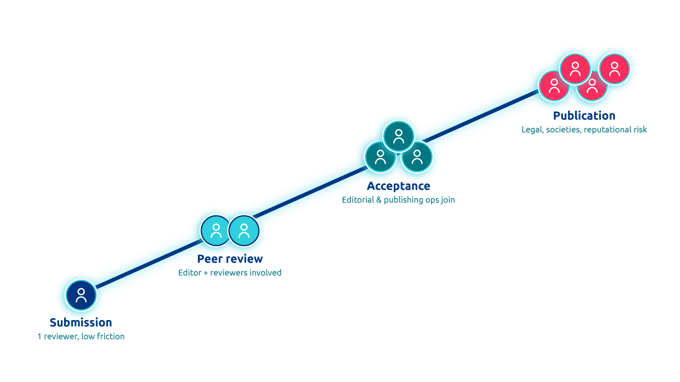
By that stage, more people may be involved. More documentation may be needed. More internal coordination may be required. The conversation may need to include editors, authors, journal teams, societies, publishing operations, legal or compliance teams, and senior stakeholders.
Late-stage concerns can also carry reputational risk. Retractions, expressions of concern, corrections, or public disputes can affect trust in a journal, and/or journal publisher.
For research integrity teams, the challenge is not only identifying potential concerns. It is finding them early enough to act with confidence and enough context to make the right decision.
Earlier manuscript risk signals can help reduce that pressure by surfacing connected evidence before a concern becomes more disruptive.
Research integrity teams need evidence, not just alerts
Alerts are only useful if they come with context.
Flagging a manuscript is not enough on its own. Research integrity teams need to understand what triggered the concern. A signal is only useful if the team can understand what triggered it, how strong it is, and what it means in the context of the entire manuscript.
This matters because research integrity decisions are rarely straightforward. A single irregularity may not justify escalation. A missing field, an unusual author profile, or a problematic reference may need further review, but it should not automatically be treated as evidence of misconduct.
At the same time, several connected signals may suggest that a manuscript deserves closer attention.
Research integrity teams therefore need more than a warning. They need a clear evidence trail that supports careful judgement.
That evidence trail should help answer practical questions:
- Which signals were identified?
- How do they relate to the manuscript?
- Are they isolated concerns or part of a wider pattern?
- Is the concern strong enough to escalate?
- Could this be a false positive?
- What should be documented before a decision is made?
A risk score should not act as a verdict. It should help research integrity teams understand what has been flagged and why.
Why individual checks do not always reveal the overall risk picture
Publishers already perform many integrity checks. The issue is not a lack of checks. It is that individual findings are often difficult to connect into a coherent view of potential manuscript risk.
One check may raise a concern around authorship. Another may reveal an issue with references. Individually, each finding may appear explainable.
This is where disconnected checks create a problem.
When potential issues are scattered across systems, spreadsheets, manual searches, email threads, and editorial notes, it becomes harder to see the full picture. 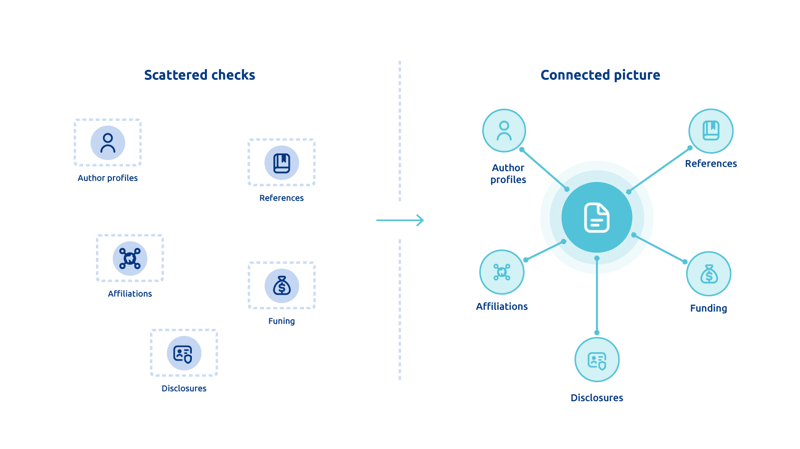 It also becomes harder to explain why a manuscript was escalated to the research integrity team or why it was cleared.
Connecting manuscript risk signals early allows for an informed decision on what the next steps should be: continue processing or escalate to the research integrity team.
What a connected picture can reveal to RI teams
An early, connected picture of manuscript risk can help teams avoid overreacting to isolated anomalies that may have a reasonable explanation. They also help teams detect broader patterns that only become visible when multiple signals are reviewed together.
Early, signals help research integrity teams identify patterns that deserve closer review.
These signals are not proof of misconduct. They are early indicators that help teams decide where further investigation may be needed.
Relevant signals may include:
- Author credibility or inconsistent author profiles
- Unclear authorship contribution, including guest or gift authorship
- Retractions or problematic references
- Suspicious citation behaviour
- Undisclosed or incomplete funding information
- Affiliation concerns
- Paper mill patterns
- Incomplete or inconsistent submission metadata
- Unusual collaboration or co-authorship patterns
The value is not simply in checking these areas separately. The value is in connecting them.
For example, an incomplete disclosure may not be enough to escalate a manuscript. An unusual author profile may not be enough either. But when several concerns appear together, the manuscript may need closer attention.
Earlier signals give research integrity teams a better starting point. Instead of waiting until a concern is raised later in the process, teams can review connected evidence earlier and decide whether the manuscript should move forward, require additional information or be escalated.
Earlier, connected signals can reduce false positives, not increase them
Research integrity teams do not want to flag more manuscripts unnecessarily. They want to flag the right manuscripts with better context.
False positives matter. They create unnecessary workload for editorial and integrity teams. They may also create unfair concern around authors or submissions that do not warrant further action.
This is why explainability is essential.
A black-box score can create more uncertainty, not less. If a system flags a manuscript but does not explain why, the research integrity team still needs to do the work of interpreting the concern.
Earlier manuscript risk signals should help reduce that burden by showing what was identified, how signals connect, and where the concern may sit in the wider submission context.
The goal is not to create more suspicion. It is to give integrity teams better evidence for deciding which concerns deserve further review.
This is especially important for borderline cases.
Borderline cases require judgement, documentation, and discussion. Earlier, explainable signals can help teams make those discussions more consistent and more defensible.
They can also help teams clear submissions with more confidence when the evidence does not support escalation.
How Trust Signals supports evidence-based integrity screening
Trust Signals is Datavid’s approach to structured, evidence-based manuscript screening.
It helps research integrity teams connect signals that may otherwise remain scattered across manual checks, systems, and workflows.
Trust Signals analyzes submissions across multiple trust markers, bringing together signals related to authors, references, affiliations, funding, disclosures, and manuscript-level attributes. It is designed to support explainable outputs, so teams can understand what has been flagged and why.
The aim is not to decide the outcome of a manuscript.
The aim is to provide earlier, clearer evidence so research integrity teams can investigate, escalate, or clear submissions with greater confidence.
For research integrity teams, this can support three important needs:
- Earlier identification of manuscripts that may require closer review
- Clearer evidence trails for escalation and documentation
- Human-led decisions supported by connected, explainable signals
Trust Signals supports editorial judgement rather than replacing it. It helps surface the evidence that may otherwise remain dispersed across manual checks and disconnected systems.
That distinction matters.
Research integrity decisions require context, care, and human expertise. Technology can support that work by making relevant signals easier to identify, connect, and explain.
What research integrity teams should ask next
For research integrity teams reviewing their current screening process, the first step is not necessarily to replace existing checks.
It is to understand where new concerns arise, how evidence is documented, and where signals are difficult to connect.
Useful questions to ask include:
- At what stages do integrity concerns usually become visible in the publishing pipeline?
- Which checks are still manual or inconsistent?
- Which findings are difficult to connect into a clear evidence trail?
- Can the team explain why a manuscript was flagged?
- How are borderline cases documented and escalated?
- Where do false positives create unnecessary work?
- How can earlier evidence help teams make a faster decision
- What should be measured in an early access pilot?
These questions can help research integrity teams identify where earlier visibility could reduce workload, improve escalation, and support more confident decision-making.
Research integrity will always require human judgement. The challenge is making sure that judgement is supported by clear, connected, and explainable evidence.
Ready to explore earlier manuscript risk signals?
Trust Signals helps publishers assess manuscript integrity across authors, references, affiliations, funding, disclosures, and manuscript-level attributes, with explainable signals that support editorial judgement.

You can also apply for the Early Access Program to help shape the next generation of evidence-based manuscript integrity screening.