

How research integrity
is scored
A transparent, evidence-based approach to scoring manuscript integrity — adapted to field, author history, and context.

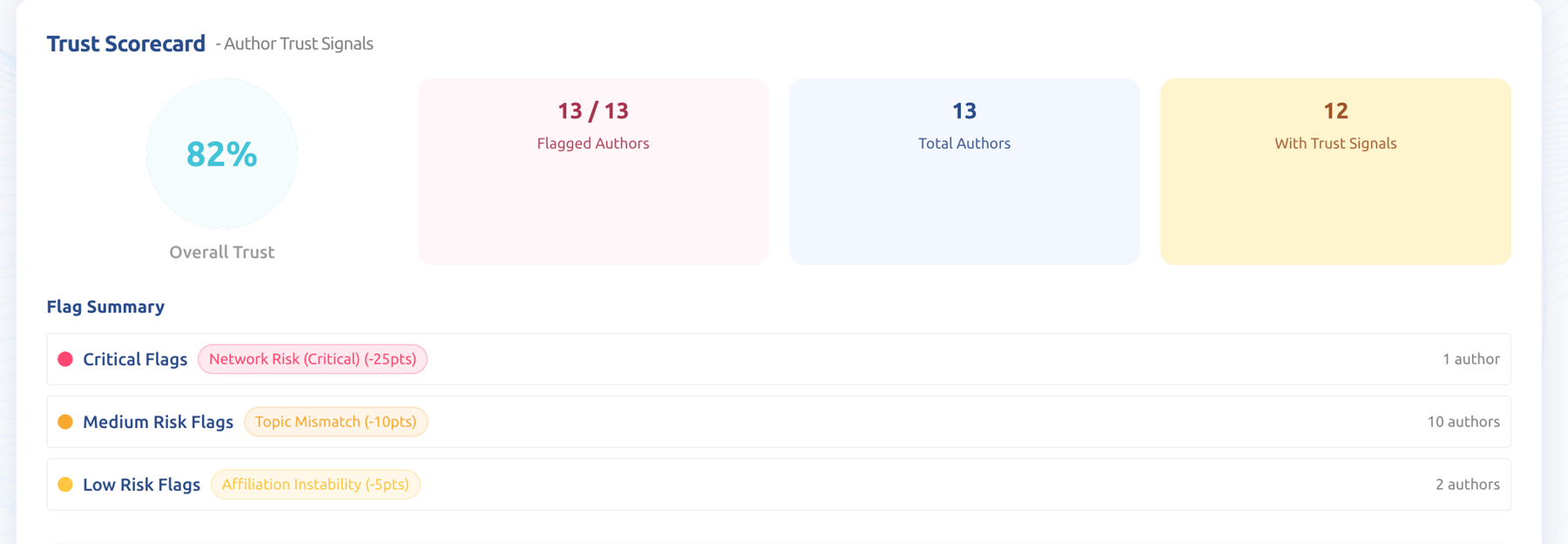
Trust Signals automates what takes hours if not days to do. Tunable, we let editors evaluate manuscript markers by field norms, career stages, and collaboration patterns.
Trust markers from authoritative sources
Analyzed Trust Signals looks at 30+ trust markers from authoritative sources such as ORCID, Crossref, OpenAlex, and ROR.
Dimension |
What we look for |
What it tells you |
|---|---|---|
Author credibility & verification |
Detects identity mismatches, authorship anomalies, and topic misalignment between a manuscript and an author’s established research history — helping identify patterns often associated with paper mills. |
Confirms legitimate authorship, research expertise, and alignment with the subject matter of the submission. |
Reference quality & integration |
Verifies institutional affiliations and collaboration patterns through ROR and OpenAlex data. |
Ensures the manuscript builds on trustworthy sources. |
Institutional trust & affiliations |
Assesses the reliability of cited literature through retraction checks, journal validation, and citation-pattern analysis. |
Confirms organizational accountability and research provenance. |
Transparency & compliance |
Checks for complete funding, data availability, and trial registration disclosures. |
Confirms adherence to open-access and ethical publishing standards. |
Define "trust" the way you need to
Tune weights and thresholds to match your editorial policies or risk tolerance.
Whether you prioritize author verification, funding transparency, or reference integrity, the system adapts – keeping your workflows consistent while improving speed and confidence.
How the scoring is determined
1) Individual markers
Assessed using adaptive thresholds that adjust for discipline and career stage.
2) Dimensional scoring
Grouped into four dimensions, each contributing proportionally to the overall score.
3) Composite trust score
The weighted result, shown on a 0-100 scale:

85–100 LOW RISK
Standard review

70–84 MODERATE RISK
Enhanced editorial review

50–69 ELEVATED RISK
Deeper investigation

BELOW 50 HIGH RISK
Comprehensive analysis needed
Why it matters
Trust Signal scoring doesn’t replace editorial judgment - it enhances it.
By surfacing explainable, evidence-backed insights, editors can focus on what truly matters: quality, originality, and ethical rigor.
Priority access for editors and publishers committed to research integrity

No spam. We'll only contact you when your access is ready.