
8 minute read
Quick Answer: GraphRAG for banking and finance combines knowledge graphs with LLM retrieval to ground AI in a bank's own structured data. For banking CDOs, the return shows up in three places: AI pilots that pass model risk review and reach production, regulatory examination cycles that drop from weeks to days, and AML investigations freed from manual context assembly.
Most banks have already invested in generative AI, but few have seen real returns. Pilots impress in demos and stall before production because the underlying data is fragmented, ungoverned, and untraceable enough to clear model risk review.
GraphRAG for banking and finance closes that gap by giving LLMs a foundation banking CDOs can defend to examiners and risk committees.
The return is concrete: AML investigations that close in hours rather than days, examination cycles measured in days rather than weeks, and AI use cases that ship to production.
This article walks through the business case, how GraphRAG compares to traditional RAG, and where ROI lands first.
At a glance
- GraphRAG turns stalled AI pilots into production deployments by giving LLMs a governed foundation that passes model risk review.
- Multi-hop graph reasoning answers banking questions vector-only RAG cannot, including links across accounts, devices, counterparties, and transactions.
- Audit-ready provenance cuts evidence assembly time for Basel III/IV, MiFID II, DORA, and AML/KYC examinations from weeks to days.
- Use cases compound: fraud, AML, regulatory reporting, risk, and relationship management share one foundation.
The banking and finance knowledge challenge
Banking data is both massive and fragmented. A single global bank may run dozens of core systems across retail, commercial, capital markets, and wealth divisions, each producing transaction records, customer profiles, risk signals, and disclosure reports.
The data sits across legacy mainframes, cloud warehouses, document repositories, and third-party platforms, often duplicated and rarely linked.
The result is a knowledge problem, not a storage problem. Connecting accounts, counterparties, and transactions into a coherent picture takes manual work that slows AML investigations, stretches regulatory report cycles, and inflates evidence assembly costs.
Data integration projects help, yet most stop at loading data into a lake without modeling the relationships between entities. That is why so many banking AI investments fail to clear model risk review. Vector similarity retrieves text chunks that look alike but misses the structural connections that matter for regulated work.
How GraphRAG addresses banking and finance complexity
GraphRAG pairs knowledge graphs with retrieval-augmented generation so LLMs reason over structured, relationship-aware data rather than flat text.
For banking, this shifts AI from retrieving documents to reasoning across connected knowledge: accounts, counterparties, instruments, regulations, and the links between them.
For banking and finance teams, graph retrieval-augmented generation represents an architectural shift: it gives CDOs a way to make AI outputs defensible, reusable, and easier to govern across business lines.
From text chunks to connected knowledge
Traditional RAG breaks source material into chunks, embeds them as vectors, and retrieves whatever looks semantically closest. That approach struggles in banking because answers rarely live in one place.
GraphRAG banking patterns retrieve differently: they pull entities (accounts, counterparties, instruments), relationships (ownership, transactions, approvals), and metadata, then hand the LLM a grounded picture to reason from.
The bigger shift is multi-hop reasoning. A query like "which accounts share a device with counterparty X and have transacted with flagged entity Y in the past 90 days" cannot be answered by similarity search, but a graph traversal answers it directly. Knowledge graph solutions become the foundation CDOs can defend in model risk review and the reasoning layer LLMs need to stay factual.
Explainability built in
Every GraphRAG answer traces back to the nodes and edges used to produce it, which means claim-level citation rather than document-level hand-waving.
That translates directly into evidence assembly cycles measured in days rather than weeks. For the banking CDO, explainability is a regulatory requirement, and LLM grounding banking data has to be demonstrable.
Basel III and IV capital adequacy reporting, MiFID II transaction transparency, DORA operational resilience, and AML/KYC audit trails all demand evidence of how a conclusion was reached.
Pairing LLMs with graphs gives compliance teams the provenance they need while letting analysts work at AI speed. Responsible AI built on FAIR data principles becomes the default state of the system.
Context that scales
Context orchestration is the quiet ROI driver of GraphRAG. Rather than stuffing the model with entire document collections, the graph feeds the LLM only the verified subset of data a query needs.
That reduces hallucinations and keeps inference costs predictable, while reproducible outputs are exactly what model validators and bank examiners expect.
How GraphRAG compares to traditional RAG
Banking CDOs often ask whether GraphRAG is worth the added modeling effort over a straightforward RAG deployment. The answer is yes once compliance, multi-entity reasoning, and audit demands enter the picture.
A direct comparison shows where RAG for banking data breaks down and where graph-grounded retrieval takes over.
|
Banking task |
Traditional RAG |
GraphRAG |
|
AML link analysis across accounts |
Misses connections across devices, addresses, and beneficial owners |
Multi-hop traversal exposes hidden links between accounts and counterparties |
|
Regulatory report lineage (Basel, MiFID II) |
Returns relevant text without a path to the source record |
Pulls figures with full lineage from filing back to source transactions |
|
Audit defensibility |
Document-level citation, often without the specific clause |
Claim-level citation tied to a specific entity, transaction, or rule |
|
Multi-jurisdictional obligations |
Flat text retrieval, no awareness of regional variants |
Models how the same obligation differs across regimes |
|
Negative or multi-condition queries |
Struggles with "which accounts lack X" or threshold combinations |
Handles structured queries combining graph traversal and metric filters |
Traditional RAG still has its place for narrow knowledge bases such as internal FAQs, but it cannot carry the regulated workloads CDOs are accountable for once questions cross entity boundaries.
GraphRAG for banking and finance use cases
GraphRAG applies wherever banking decisions depend on connecting multiple data points. Four use case families show the highest GraphRAG ROI in Datavid client engagements, each tied to a specific business pressure:
Fraud detection and anti-money laundering
Fraud rings rarely leave a clean trail in a single dataset. They share devices, addresses, beneficial owners, or transaction patterns across accounts that look unrelated at the surface.
Graph traversal surfaces these hidden connections by following relationships multiple hops deep, something vector search cannot do.
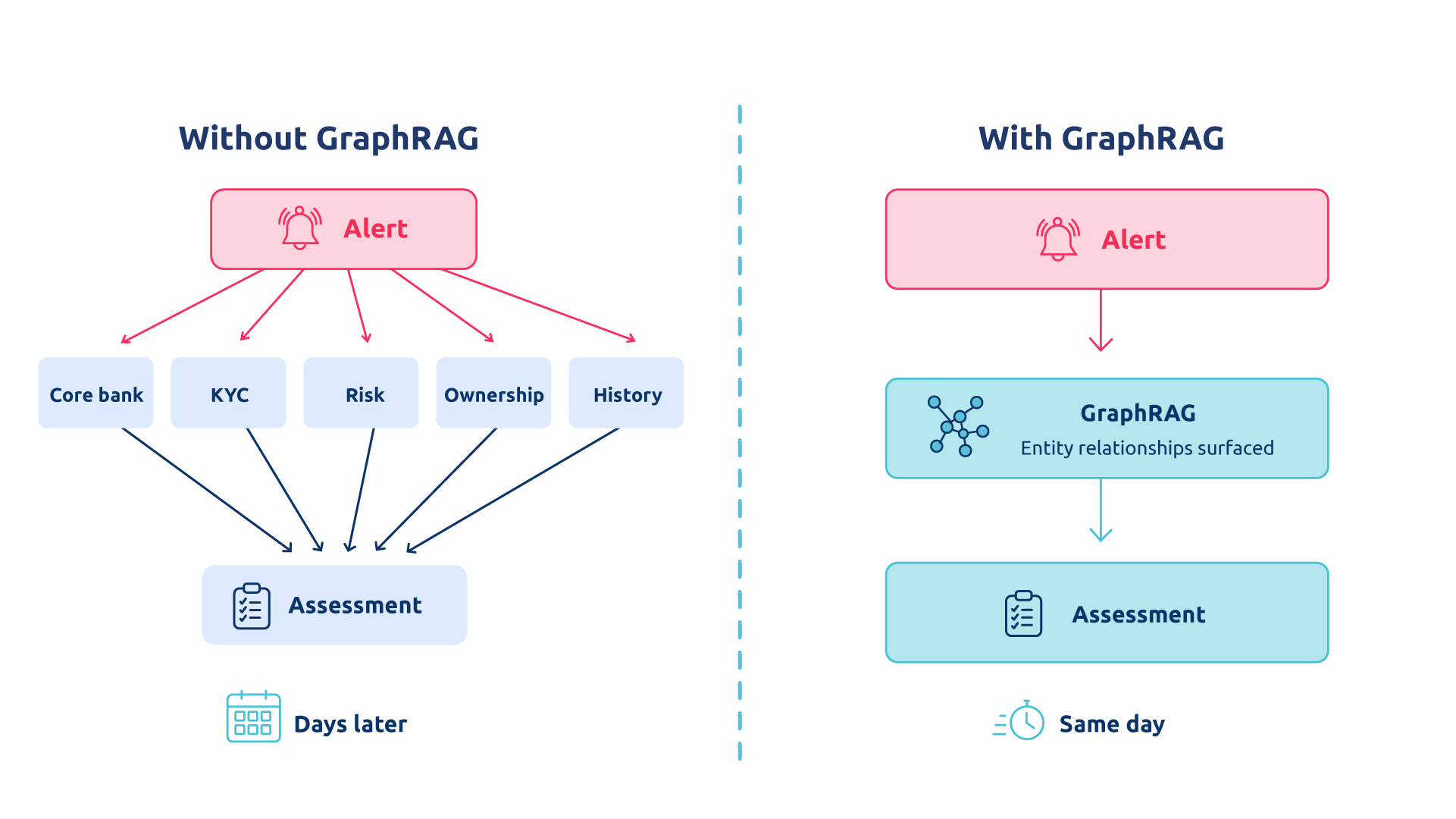
For AML specifically, GraphRAG finance AI helps analysts cut through false positives by grounding case summaries in the entity relationships behind an alert. Investigators spend less time stitching context together, which translates into lower investigation cost per alert and faster suspicious activity reporting.
For the CDO, AML is where GraphRAG ROI typically shows up first.
Regulatory reporting and compliance
Assembling regulatory filings is a reconciliation exercise that consumes enormous manual effort. GraphRAG automates much of the heavy lifting by pulling data from governed sources with full lineage, letting teams trace every figure to its origin.
Reports for MiFID II, Basel III/IV, and similar obligations become faster to produce and easier to defend, meaning shorter examination cycles and lower audit fees.
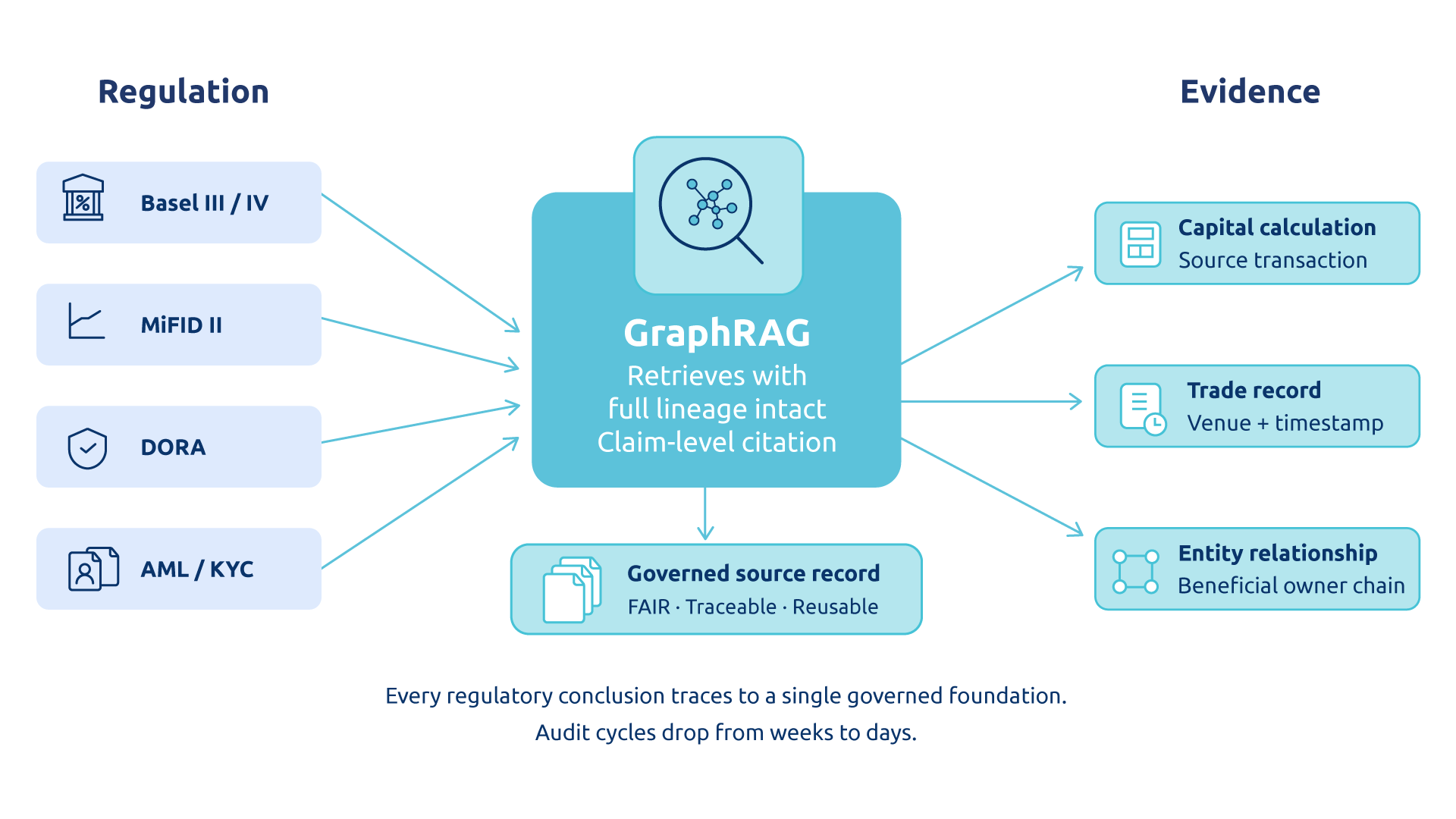 How GraphRAG maps to common banking regulations:
|
Regulation |
Core requirement |
How GraphRAG supports it |
|
Basel III/IV |
Capital adequacy reporting with auditable calculations |
Full data lineage from reports back to source records and transactions |
|
MiFID II |
Transaction transparency and best execution evidence |
Claim-level citation linking trades to counterparties, venues, and timestamps |
|
DORA |
Operational resilience and ICT risk documentation |
Governed knowledge graph with role-based access and traceable reasoning paths |
|
AML/KYC |
Investigation trails and suspicious activity reporting |
Multi-hop relationship discovery across accounts, entities, and beneficial owners |
|
SOX / internal controls |
Evidence of control effectiveness and change history |
Metadata lineage showing who accessed, changed, or approved which data |
Risk assessment and credit evaluation
Credit and counterparty risk decisions depend on connecting customer profiles, financial statements, market signals, and exposure data, none of which live in a single system. GraphRAG brings those signals into a queryable graph and grounds LLM-driven risk summaries in connected data.
For the CDO, that means risk assessments stop showing up as audit findings and model validation cycles get shorter.
Customer intelligence and relationship management
Relationship managers at commercial and private banks rely on a full picture of each client across accounts, products, transactions, and service interactions.
GraphRAG maps those relationships into a queryable graph and lets an LLM produce account briefings, cross-sell recommendations, and retention-risk flags tied to specific data.
For the CDO, this is the rare upside outside compliance: client revenue tied directly to data quality.
What a GraphRAG architecture looks like in banking
A production GraphRAG stack a CDO can defend in front of risk and audit committees typically includes:
- Ontology and taxonomy design: work with compliance, risk, and business teams to model accounts, instruments, counterparties, and regulatory entities along with their relationships, building on industry standards like FIBO where they apply rather than starting from scratch.
- Hybrid retrieval: combine graph traversal, vector embeddings, and keyword search so each query pulls the right mix of structured and unstructured content.
- Agentic workflows: chain reasoning, summarization, and validation so compliance and reporting tasks run end-to-end with human checkpoints.
- Semantic enrichment: turn contracts, filings, and communications into connected knowledge by tagging entities and linking them into the graph.
- Governance and access control: apply role-based permissions, audit trails, and metadata lineage so the right people see the right data.
- Rapid deployment accelerators: production-ready results in six to eight weeks using pre-built pipelines.
Datavid's AI-ready lakehouse patterns build on these same components for banking clients.
The impact on banking and finance teams
For banking CDOs, the test of any AI investment is what survives examiner scrutiny, model risk validation, and audit cycles. GraphRAG changes the underlying data foundation, which changes what AML, regulatory reporting, and risk functions can deliver.
The operational return shows up in three places.
For data and AI leaders
CDOs and CDAOs need AI that clears model risk validation, not just demos that impress steering committees. GraphRAG provides a regulator-grade data foundation where every AI output traces to source records, and the same graph supports AML, MiFID, and Basel reporting without rebuilding the stack each time.
The result is fewer audit findings tied to data lineage gaps, AI use cases that pass model risk on first review, and a smaller backlog of business requests stuck on data integration.
For risk and operations teams
For AML investigators and risk officers, GraphRAG removes the manual context assembly that fills most of the analyst day. Each alert arrives with pre-assembled context: linked accounts, beneficial owners, and device matches pulled from the graph in one query.
Credit officers query connected counterparty data in a single view instead of reconciling core banking, KYC, and exposure systems by hand. The CDO sees lower investigation cost per alert and shrinking AML backlogs.
For compliance and regulatory teams
For compliance functions, GraphRAG turns audit evidence assembly into a system property. Every Basel III/IV capital figure traces to source transactions, every MiFID II best-execution claim points to specific trade timestamps, and every AML/KYC investigation produces a defensible reasoning path.
CDO compliance partners report shorter examination cycles, fewer findings tied to lineage, and weekend evidence assembly replaced by routine queries.
Is your organization ready for GraphRAG?
Readiness is less about technology maturity and more about operational pain. A few honest questions tell banking CDOs whether the ROI works:
- Are AML investigations stretching out because case context lives across core banking, KYC, and transaction monitoring systems?
- Are your AI pilots struggling to move past proof-of-concept and into production?
- Can you defend AI outputs to examiners with claim-level citations?
- Is your knowledge scattered across legacy mainframes, cloud warehouses, and document repositories?
- Do regulatory examinations still consume weekends from senior compliance staff?
If most of these hit home, GraphRAG is the missing layer in your data architecture, and the return lands in the first use case.
Building explainable AI for banking and finance
GraphRAG is not a better search tool. It is the data foundation banking CDOs need to deliver AI that survives examiner scrutiny, clears model risk review, and reduces evidence assembly cycles.
That is the line between AI investment that stalls and AI investment that compounds across business lines. Datavid's GraphRAG services help banking organizations cross that line with senior-led teams and proven accelerators.
To reduce compliance overhead and move AI beyond pilots, see how GraphRAG can scale governed, auditable banking AI.