
9 minute read
Quick answer: GraphRAG for pharma combines knowledge graphs with retrieval-augmented generation to ground LLM outputs in structured pharmaceutical data. For product managers building AI features in pharma, the difference is practical: instead of an assistant that hallucinates or gives inconsistent answers, you get a feature that retrieves verified entities, follows real relationships, and behaves predictably across user sessions.
If you are a product manager shipping AI features in pharma, you have probably hit the same wall. The demo is impressive. Then answers drift, hallucinations get caught, and adoption flatlines. The model is rarely the problem. The retrieval layer is.
The business impact is consistent. AI pilots stall before production because output quality cannot clear the user trust bar. Knowledge stays fragmented across clinical, research, and regulatory systems. Evidence discovery stretches into days. Researchers duplicate existing work. And when a feature reaches regulatory review, the lack of traceable reasoning becomes the release gate.
GraphRAG grounds LLM responses in connected knowledge rather than isolated text fragments. This article helps you evaluate whether it fits your roadmap, where it improves user-facing reliability, and what a realistic first pilot looks like.
At a glance
- AI features in pharma fail on adoption, not on intelligence. Users abandon assistants that hallucinate, contradict themselves, or cannot show their working.
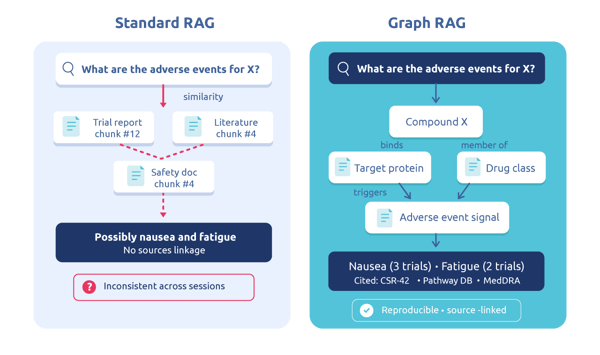
- Standard RAG retrieves text chunks by similarity, producing inconsistent answers and shallow context. This is the root cause behind most AI feature reliability complaints.
- GraphRAG grounds responses in a knowledge graph, so the same question returns the same reasoning path with verifiable citations.
- Product managers can use GraphRAG to ship features that behave like domain experts: connected, traceable, and consistent.
- Choosing GraphRAG is a product decision as much as a technical one. Pilot scope should reflect feature criticality, data readiness, and trust threshold.
If you are scoping an AI feature and weighing GraphRAG against other approaches, a Datavid expert can talk through the trade-offs for your specific product context.
The pharma knowledge challenge
Pharma products draw on some of the most connected data in any industry. Clinical protocols, molecular structures, patient records, regulatory filings, and literature share entities such as compounds, diseases, genes, and pathways. A goldmine for products, a minefield for engineering.
The data rarely sits in one place. Clinical workflows run on EHRs and CTMS platforms. R&D data lives in LIMS. Regulatory content flows through dedicated systems. Literature lives in separate repositories.
For product managers, that fragmentation shows up in user-visible problems: confident answers that turn out wrong, queries returning different responses on different days, hallucinated citations getting screenshotted and shared. Each chips away at adoption.
Why search and standard RAG fall short
Keyword search cannot cross these boundaries, and standard vector-based RAG has its own limits. Embedding search surfaces similar-looking documents but misses multi-hop relationships. Connecting a gene to a protein to a pathway to a disease requires reasoning across entities that no single document contains.
For RAG for pharma data, incomplete answers cost user trust. Once a pharma user sees the AI invent a citation or miss a known drug interaction, the feature becomes a liability they route around.
Why knowledge graphs are important
For pharma products, where the value of an answer depends on traversing relationships, treating documents as flat text caps your feature quality. Knowledge graph solutions close this gap by making relationships first-class citizens of the data model.
Once relationships are explicit and queryable, the AI features built on top inherit that structure. Answers become reproducible, citations defensible. The user experience feels like working with a domain expert rather than a confident guesser.
How GraphRAG for pharma addresses complexity
GraphRAG brings together three capabilities that translate directly into product quality: graph-grounded retrieval, built-in explainability, and context orchestration.
For teams shipping GraphRAG pharmaceutical features, these levers determine whether users keep coming back.
From text chunks to connected knowledge
Standard RAG retrieves passages based on vector similarity. GraphRAG queries a knowledge graph where compounds, targets, trials, and adverse events are defined entities linked by explicit relationships. The system traverses from one node to another, surfacing reasoning paths similarity search misses.
A user asking about a candidate compound rarely wants just a literature snippet. They want the target protein, known adverse events, and affected patient populations surfaced together with the connections visible.
Ontology-driven structures such as MedDRA, SNOMED, and ATC align the graph with how pharma users already think, returning answers that feel native to the domain.
Datavid covers this in the piece on merging large language models and knowledge graphs.
Explainability built in
Every answer GraphRAG produces traces back to source entities and relationships in the graph. Users can see which nodes the system visited and how the reasoning chain came together.
LLM grounding pharma teams build into their products depends on this traceability. When a user can click an answer and see the source path, the feature stops being a black box. Power users start citing it in their own work, the strongest signal of product-market fit you can get for an AI feature.
Context that scales
GraphRAG feeds the LLM only the entities and relationships relevant to the query, filtered by role-based access and metadata lineage. From a product perspective, this is what makes features behave consistently as data grows.
Standard RAG retrieval quality often suffers as the corpus grows: more documents can mean noisier results and more contradictions. A well-governed GraphRAG implementation can mitigate that, since every new entity strengthens the reasoning surface, provided the graph is maintained and kept current.
That is why GraphRAG services tend to move pharma AI features from pilot demos toward production tools users rely on daily.
How GraphRAG compares to traditional RAG
Product managers evaluating retrieval approaches need a side-by-side view of what each method delivers, and what each implies for feature reliability, adoption, and time to a usable release. The table below frames this from a product decision lens, not just a technical one.
|
Decision criterion |
Traditional RAG |
GraphRAG |
|
Retrieval method |
Vector similarity on text chunks |
Graph traversal combined with vector and keyword search |
|
Reasoning depth |
Single-hop, surface-level matches |
Multi-hop across entities and relationships |
|
Answer consistency |
Varies between sessions |
Reproducible reasoning paths |
|
User-facing explainability |
Document-level citation, often none |
Claim-level citation with source lineage |
|
Behavior as data grows |
Quality often degrades with corpus size |
Quality can improve with a well-maintained graph |
|
Adoption risk |
High once users catch hallucinations |
Lower thanks to verifiable outputs |
|
Path to a usable release |
Quick to prototype, slow to validate |
More upfront design, lower iteration cost later |
The gap widens as features move from FAQ-style assistants into workflows where users act on the AI's output. Standard RAG looks faster on day one, but the cost shows up later as poor reviews, support load, and stalled adoption.
GraphRAG carries a higher upfront design effort and lower long-term iteration cost, particularly where user trust is the bottleneck.
GraphRAG use cases across the drug lifecycle
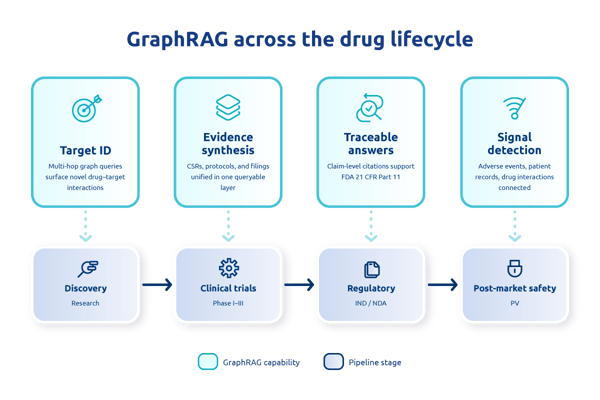
Three product areas show the sharpest improvement from grounded retrieval: research copilots, regulatory and clinical assistants, and safety monitoring features.
Each is a workflow where connected reasoning translates directly into a better user experience.
Target identification and drug repurposing
Multi-hop graph queries let research copilots identify novel drug-target interactions and surface candidates for repurposing. From a user's perspective, the feature behaves like a senior researcher who knows the field.
Take a research user working on a cardiovascular drug. A standard RAG assistant returns related papers. A GraphRAG copilot follows relationships to pathways active in neurodegenerative conditions, then to compounds that already cleared Phase I, and presents the chain with citations.
That is the difference between a feature users glance at once and one they build into their daily workflow. Datavid's guide to knowledge graph implementation for pharma R&D goes deeper into how these graphs are built.
Clinical trials and regulatory submissions
GraphRAG-powered assistants pull insights from Clinical Study Reports (CSRs), trial protocols, and regulatory filings into a single queryable layer. Teams preparing IND or NDA submissions can run evidence synthesis across hundreds of documents and get answers with direct citations.
Literature reviews that took weeks compress into days, with traceability submission users need. The system cannot generate claims without a backing entity in the graph, removing a major class of product failure for regulatory features.
Safety monitoring and pharmacovigilance
Post-market safety features depend on connecting adverse event reports, patient records, drug interaction data, and molecular profiles. These sit in separate systems with different schemas, making consistent behavior hard to deliver.
GraphRAG unifies them in a single graph and surfaces polypharmacy risks or safety signals that siloed databases miss. When a signal appears, the user sees the exact reasoning path, turning a notification into something they can act on.
That level of integration between LLMs and private knowledge platforms is what makes pharmacovigilance features usable in production.
Scoping an AI feature where GraphRAG might fit? A short conversation with Datavid's team can help frame the trade-offs and prioritize where to start. Book a discovery call.
The impact on pharma teams
GraphRAG affects how different users experience the AI features you ship. For product managers, mapping that change across stakeholders helps you prioritize the rollout, plan validation, and set roadmap expectations.
For data and AI leaders
Platform decisions made by data and AI leaders shape what your roadmap can deliver. When retrieval is graph-grounded, features that stalled in proof-of-concept because output quality could not clear the trust bar become shippable.
Datavid's AI services move teams from pilots to production-ready features, expanding what you can commit to in your release plan.
For research and operations
Research and operations users drive your adoption metrics. They spend a surprising fraction of their time searching instead of acting, and a feature that surfaces connected knowledge from a single interface changes that pattern.
The product feels more like a colleague than a search box, the UX shift that turns initial usage into sustained adoption.
For compliance and regulatory teams
Compliance and regulatory reviewers are often the gate between a beta feature and general availability. GraphRAG hands them a traceable reasoning path for every AI-assisted answer, letting them sign off without reconstructing logic after the fact.
For product managers, this turns regulatory review from a release blocker into a predictable step in the launch checklist.
Datavid's work on FAIR principles and responsible AI covers the governance side.
Is your organization ready for GraphRAG?
GraphRAG readiness, from a product perspective, is less about the technology and more about whether your team has a feature worth grounding, data connected enough to support it, and a clear definition of user success.
Self-assessment for fit
Ask yourself the following:
- Do users complain about your AI feature giving inconsistent or contradictory answers?
- Has adoption stalled because power users caught hallucinations or wrong citations?
- Are your AI features stuck in beta because the reliability bar is hard to clear?
- Do users routinely ask "where did this answer come from?" without a good way to show them?
- Do regulatory or compliance reviews block your AI features from going generally available?
- Is the underlying knowledge for your feature scattered across systems your retrieval layer cannot connect?
If three or more of these resonate, GraphRAG likely addresses a real product gap.
What to look for in a GraphRAG solution
Pharma product teams often prioritize:
- Ontology integration: support for industry standards (MedDRA, SNOMED, ATC).
- Answer consistency: reproducible reasoning paths returning the same answer across sessions.
- Provenance and source lineage: every answer traces back to specific entities and documents your interface can render.
- User-facing explainability: citations and reasoning chains your front-end can display credibly.
- Data readiness fit: the solution helps you assess whether your data is connected enough, or whether semantic enrichment is needed first.
- Integration complexity: realistic compatibility with the data sources, content repositories, and AI services already powering your product.
- Validation tooling: the ability to test outputs at scale, so you can measure feature quality before each release.
- Access control: role-aware retrieval that respects existing permissions.
What a realistic first pilot looks like
Readiness does not require a perfect dataset or a fully built knowledge graph upfront. It requires a defined feature, structural connectivity across the data sources it depends on, and a stakeholder ready to make the trade-offs that come with semantic enrichment.
A realistic first pilot covers a single user-facing feature, integrates two or three high-value data sources, and includes a clear user-quality metric from day one. The goal is not to prove GraphRAG works in general, but that it lifts a metric users care about.
Risks to weigh include data quality gaps that surface once relationships are made explicit, integration complexity with legacy systems, and change management for users used to keyword-driven workflows. None are dealbreakers, but each shapes pilot scope.
Build explainable AI for pharma with Datavid
GraphRAG is about AI features users trust enough to keep using. The difference shows up in feature reliability, adoption curves, and the feedback you get when an AI feature stops being a novelty and becomes a tool people rely on.
Datavid builds connected data foundations, knowledge graphs, and GraphRAG systems for life sciences organizations moving AI features from beta into something users adopt at scale.
If you are weighing GraphRAG as part of an AI feature roadmap, start a conversation with a Datavid semantic AI expert to think through a sensible first pilot for your product.