
4 minute read
.png)
There is a pattern we keep seeing across enterprise AI programmes.
The initial investment is made.
The first pilots generate interest.
The opportunity appears real.
But when organisations try to move from experimentation to wider adoption, a different set of questions takes over.
Can the output be trusted?
Can it be explained?
Can it be governed?
Can it stand up to audit, compliance, and business scrutiny?
This is where many enterprise AI programmes begin to slow down.
Not because the models stopped improving, but because the data environment around them was never designed to support trusted, governed AI at scale.
Despite significant investment in large language models (LLMs) and retrieval-augmented generation (RAG), many organisations are still struggling to turn promising AI pilots into reliable enterprise capabilities.
For CDOs and enterprise leaders, the challenge is no longer proving that AI can generate answers. It is ensuring those answers are trustworthy, explainable, and fit for use in a governed business environment.
This is where a new approach is emerging: GraphRAG for enterprise AI. This shift is not about replacing existing approaches, but about strengthening them with better structure, context, and governance.
The real reason enterprise AI fails is not the model
Over the past two years, model performance has improved dramatically.
Accuracy is higher. Costs are decreasing. Capabilities are expanding.
And yet, enterprise AI is not scaling at the same pace.
The reason is simple:
AI is only as reliable as the data it retrieves.
In most organisations:
- Data is fragmented across systems
- Definitions are inconsistent
- Ownership is unclear
- Context is missing
This creates a gap between what AI can do and what enterprises can trust it to do.
Where enterprise AI breaks down
When organizations try to scale AI, the same issues appear repeatedly.
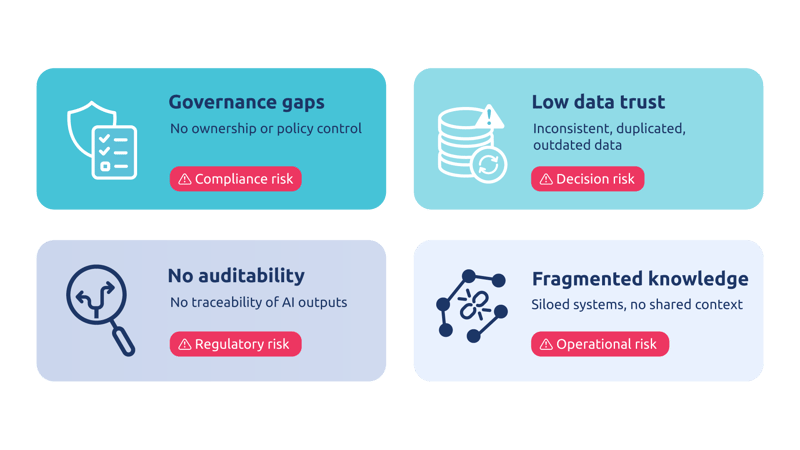
1. Governance gaps
AI systems operate without clear data ownership, policies, or control over what information is being used.
2. Lack of data trust
Content is duplicated, outdated, or inconsistent, making outputs unreliable.
3. No auditability
Teams cannot trace how an answer was generated or which sources were used.
4. Fragmented knowledge
Critical information sits across multiple systems with no shared structure or connection.
For CDOs, these are not technical issues. They are risk, compliance, and investment challenges.
Why traditional RAG is not enough
RAG has helped move AI beyond static models by grounding responses in enterprise content.
However, most implementations still rely on retrieving chunks of text based on similarity.
That can work for straightforward questions. But enterprise decision-making is rarely straightforward.
In real enterprise environments, answers often depend on:
- context spread across multiple systems, documents, and data sources
- relationships between policies, processes, entities, and events
- regulatory or business rules that shape how information should be interpreted
- the ability to trace outputs back to approved sources and justify them under scrutiny
When that broader context is missing, organisations often see the same pattern:
- answers that are technically plausible but incomplete
- outputs that vary depending on which source was retrieved
- limited confidence in high-stakes or regulated use cases
- difficulty validating, governing, and reusing AI outputs across teams
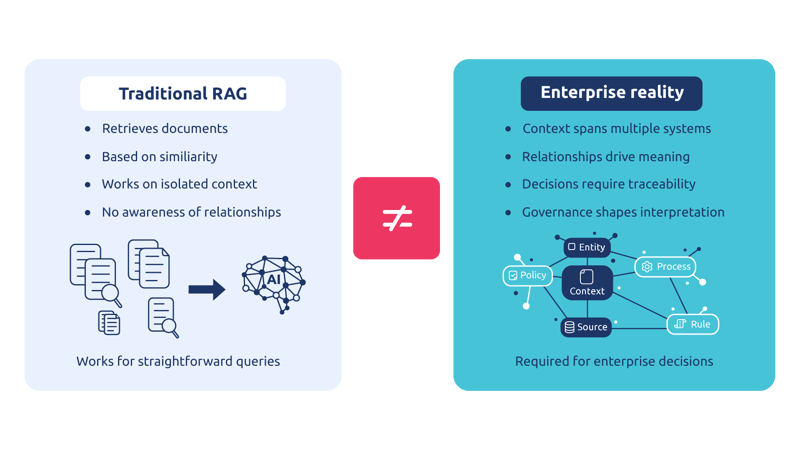 This is not a flaw in RAG itself. It is a limitation of trying to apply document-level retrieval to enterprise knowledge that is inherently connected, contextual, and governed.
In fact, vector-based retrieval remains a critical part of modern AI systems, providing broad recall across large volumes of content.
The challenge is that, on its own, it can struggle to prioritise the right context as data grows more complex and interconnected leading to inconsistent outputs and reduced trust in high-stakes use cases. This is where additional structure becomes critical.
What GraphRAG changes for enterprise AI
GraphRAG introduces a complementary layer to traditional RAG.
By combining semantic retrieval with structured knowledge, it enables AI systems to incorporate connected, contextual information improving the consistency and reliability of outputs in enterprise environments.
Its effectiveness depends on the strength of the underlying data foundation treating it otherwise often leads to fragmented outputs and limited enterprise value.
Fragmented, poorly normalised, or ungoverned data does not just constrain performance; it directly impacts the consistency, trust, and scalability of AI-driven decisions.
In practice, GraphRAG works in conjunction with supporting capabilities to ensure AI outputs are more predictable, reliable, and aligned with enterprise requirements particularly in high-stakes and regulated environments.
.png?width=800&height=450&name=CDO%20GraphRAG%20blog%20-%20From%20Fragmented%20Data%20to%20Governed%20Enterprise%20AI%20(GraphRAG%20Transformation).png)
For enterprise organisations, this changes the outcome in more meaningful ways.
-
Stronger decision-making confidence
By combining semantic retrieval with structured relationships, AI outputs are grounded in broader business context, reducing ambiguity in high-stakes environments. -
Improved traceability and defensibility
Responses are linked back to both source content and underlying relationships, making them easier to validate and explain. -
More effective governance alignment
Structured knowledge layers reinforce how policies, definitions, and rules are applied, supporting more consistent and controlled AI behaviour. -
More consistent enterprise application
By reflecting how knowledge is connected across systems, GraphRAG helps reduce ambiguity and support more repeatable, controlled outcomes across teams and use cases.
For enterprise leaders, the impact is clear: AI becomes easier to govern, easier to justify, and more viable as part of core business and decision-making processes.
From AI prototypes to governed, enterprise AI
Moving from pilot to production requires more than better models.
It requires a foundation that reduces risk, strengthens oversight, and makes AI more viable at enterprise scale.
-
Lower risk exposure
AI outputs need to be grounded in trusted, governed data so organisations can reduce the risk of inconsistency, misuse, and unreliable decision support. -
Greater auditability
As AI becomes part of business processes, organisations need clearer traceability, stronger lineage, and better visibility into how outputs are generated and justified. -
Better investment efficiency
Scaling AI should build on existing data assets, governance frameworks, and enterprise platforms, not depend on duplicating effort or creating disconnected layers of complexity.
Approaches such as GraphRAG support this transition by helping align AI systems with how enterprise knowledge is structured, connected, and governed in practice.
When combined with a strong data foundation and appropriate controls, this enables a shift from experimentation to scalable, governed AI operations.
What this means for CDOs and enterprise leaders
For CDOs, the conversation is shifting from “Can we build AI?” to:
“Can we trust it, govern it, and scale it?”
Adopting approaches such as GraphRAG, alongside strong data governance and architecture practices, enables:
- Reduced risk exposure through better control and traceability
- Improved auditability for compliance and regulatory requirements
- Stronger governance across AI and data platforms
- More effective scaling of AI investments by building on existing data assets and governance foundations rather than creating disconnected new layers
This is not just a technical upgrade.
It is a strategic shift in how AI is governed, justified, and scaled across the enterprise.
If you are curious on how to move beyond AI prototypes and build a scalable, governed foundation,explore how to scale enterprise AI with trust and control.
Or, if you are evaluating your current AI readiness for enterprise environments.