
7 minute read
A product manager's guide to what delayed FAIR does to your roadmap, your AI features, and your reuse across product lines.
Quick answer
FAIR is usually costed as a one-off decision. For a product manager it is really a roadmap decision whose price changes with when you make it: delay it and future AI features, search improvements, and analytics tend to get slower and more expensive to ship, while some legacy datasets fall out of reach for FAIRification altogether. Scoped delivery, combining internal domain expertise with experienced FAIR and semantic data partners, tends to keep prospective FAIR a marginal cost rather than a rebuild between releases.
Introduction
This page gives you the argument, not the definitions. If you own a roadmap with AI, search, or analytics features on it, what follows are the mechanisms by which delayed FAIR slows it, the independent evidence behind them, and the cases where waiting is the right call.
The FAIR data principles life sciences teams rely on are usually treated as a data governance concern. For a product manager they tend to be more direct: much of the difference between AI features that launch, get reused, and pass validation, and features that rebuild the foundation each time. The evidence below puts that in a form your roadmap review and your finance function should both recognize.
At a glance
- Delaying FAIR data principles in life sciences behaves less like a carrying charge than a widening gap, showing up as slower features, repeated AI rework, and blocked reuse across product lines.
- Peer-reviewed research finds retrospective "FAIRification" materially more resource-intensive than FAIR by design, so the work competes with your roadmap for the same engineers.
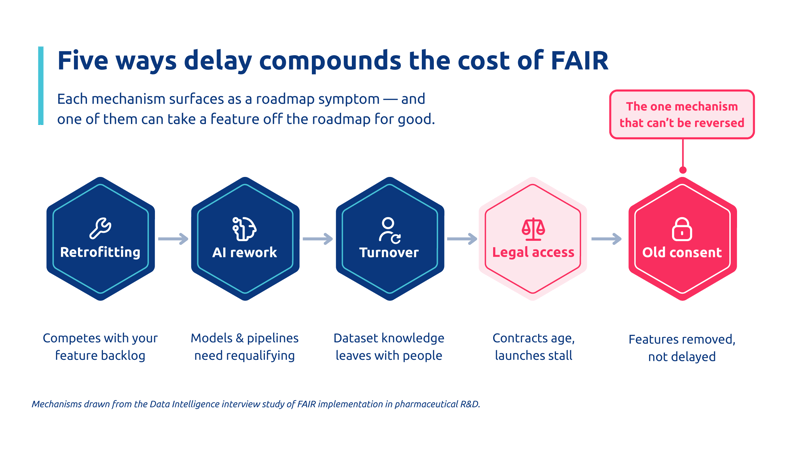
- Five mechanisms compound the cost of delay, each surfacing as a product symptom, and the last of them can leave some datasets effectively unusable for future features.
- The European Commission put the measurable cost of non-FAIR research data at 10.2bn euro per year, and its two largest components map closely onto product delivery time.
- Regeneration can genuinely be cheaper than FAIRification, which is why the delay argument is scoped to data that cannot be regenerated.
- A defer-or-act test with product-led questions lets you sequence datasets by roadmap risk instead of arguing for everything at once.
- Delivered FAIR platforms in clinical trials and biobank research show the prospective route producing faster processing and foundations later features inherit.
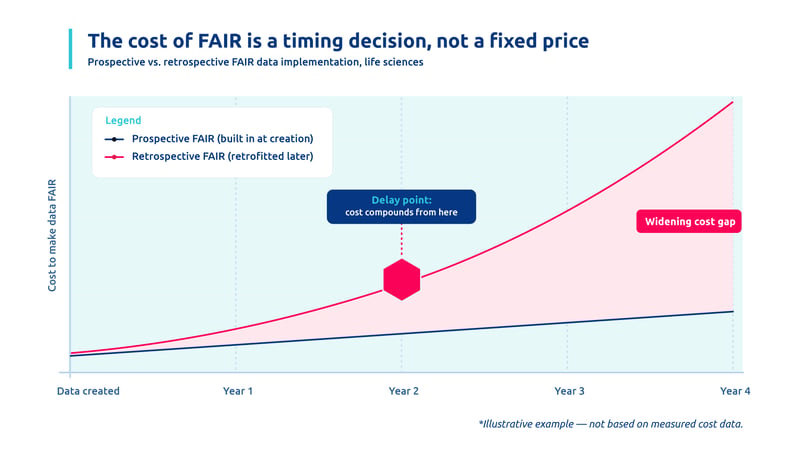
What a year of delaying FAIR data principles in life sciences costs your roadmap
The cost is rarely a flat annual charge. It behaves more like a widening gap between FAIR at data creation and FAIR retrofitted later, and on a roadmap it surfaces as delayed features, repeated rework across AI pilots, slower dataset onboarding, weaker search and discovery, deepening SME dependency, compliance review delays before launch, and reduced reuse across product lines.
For reference, the fair principles themselves compress to one row each:
|
Principle |
What it requires |
|
Findable |
Rich metadata and persistent identifiers |
|
Accessible |
Retrievable by standardized, authorized protocols |
|
Interoperable |
Shared vocabularies and formal knowledge representation |
|
Reusable |
Provenance, licensing, and community standards attached |
That is the last word here on definitions. The prerequisite read is FAIR data principles and responsible AI adoption; this piece covers what delay does to it.
Why delayed FAIR gets more expensive for your roadmap every year
Each mechanism below explains why cost compounds, and each surfaces on a roadmap as a specific delay. The peer-reviewed findings come from the Data Intelligence interview study of FAIR implementation in pharmaceutical R&D, worth naming because most coverage of fair data management runs on unsourced claims.
Retrofitting FAIR later takes the engineers you needed for features
The study found FAIRification resource-intensive "especially when it was carried out retrospectively." Three costs stack: revising legacy data to standards, sunk investment in the systems holding it, and data loss in transformation.
Prospective FAIR tends to be a marginal cost at data creation. Retrospective FAIR tends to become a project with its own budget and timeline, often doubling as data migration work off the legacy systems holding the records. That project usually competes with your feature backlog for the same people. Embedding fair data principles at pipeline design time, as part of data engineering delivery, tends to keep it off the roadmap entirely.
Every AI programme built on ungoverned data becomes rework
Models, pipelines, search indexes, and validation artifacts built on non-FAIR data often have to be redone once the foundation is fixed.In a validated environment, requalification compounds it.
For a product manager scaling AI pilots, this is often the mechanism that bites first. The delay cost is not only hypothetical future remediation; much of it is this year's AI roadmap accruing rework liability with every release, which is the same argument behind AI-readable data in life sciences. Fixing the foundation before the third pilot tends to cost less than requalifying the first two afterwards.
Staff turnover takes dataset knowledge, and your delivery speed, with it
The study reports that high turnover means personal knowledge of datasets is lost, raising the future cost of FAIRifying it. Metadata living in someone's head leaves with them.
The cost of delay is partly a function of who resigns during it, and each departure deepens the SME dependency that already slows releases. Capturing that knowledge as governed metadata now, as enterprise data management work rather than exit interviews, tends to cost less than reconstructing it later.
Legal access questions stall launches, and they get harder to answer
Establishing whether legacy data can even be accessed is expensive in itself, more so across jurisdictions with differing legislation. CRO-generated data often sits under research agreements that constrain reuse.
Little of this resolves by waiting. Contracts age, counterparties merge or dissolve, and the fair data governance question of who may grant access tends to get harder with every organizational change. Cataloguing access terms while counterparties still exist is usually days of work; reconstructing them later can consume a legal budget and stall a launch.
Old consent terms can take features off the roadmap for good
The study records that informed consent from past trials may not have been drawn up in a way that permits reuse. This is the one mechanism where delay may not raise the cost of FAIRification so much as remove the option.
Some data can end up effectively unFAIRifiable. A future feature that depended on reusing it is not delayed so much as removed from the roadmap, which behaves less like a budget line that grows and more like an option that expires.
What the European Commission analysis means for delivery time
The PwC study for the European Commission measured what not having FAIR research data costs annually. The component breakdown, which is often missing from vendor-led discussions, is the part worth taking into a roadmap review:
|
Cost component |
Annual cost |
Share |
|
Redundant storage |
5.3bn euro |
52.39% |
|
Time spent |
4.5bn euro |
43.81% |
|
Licence costs |
360m euro |
3.52% |
|
Double funding and duplication |
25m euro |
0.24% |
|
Research retraction |
4.4m euro |
0.04% |
The top two lines should look familiar. Redundant storage often means the same dataset onboarded repeatedly because nobody found the first copy. Time spent is largely teams searching instead of building. The 10.2bn euro equals roughly 3% of European research expenditure, against a 2016 base of 302.9bn euro, and 78% of the annual Horizon 2020 budget, with a further 16bn euro in foregone innovation estimated separately.
The report's own conclusion is the line to quote: "once the proper infrastructure in place, one could expect the net benefits from the FAIR principles to increase." Benefit rises with time since the foundation was built, which is the same curve your second and third AI features ride. It also finds a positive balance of roughly 2.6bn euro per year, assuming data management costs up to 2.5% of research expenditure.
One limitation, since your finance partner will find it anyway: the analysis does not account for the cost of implementing FAIR. Scoped delivery tends to keep that side small enough to fund without pausing the roadmap.
When delaying FAIR is the right call for your roadmap
Not every dataset belongs on this list, and knowing which to leave off is what makes the rest of the case credible in a prioritization meeting. Regeneration can be cheaper than FAIRification: the study records that maintaining raw genome sequencing files is not cost-effective, since re-sequencing costs less than the archive.
The cost of delay tends to bite hardest on data that cannot be regenerated, which in regulated fair data life sciences work means clinical trial records, regulatory submissions, manufacturing batch records, and pharmacovigilance case histories.A trial is rarely re-run to recover its data, so features built on it inherit whatever state that data is left in.
The defer-or-act test, applied per dataset:
- Is it regenerable at reasonable cost?
- Is it unique or competitively differentiating?
- Is it referenced by a live submission or an active programme?
- Does it sit under consent or contract terms that constrain future reuse?
- Does a planned product feature, AI capability, or search improvement depend on it?
- Would delaying its FAIR treatment push a roadmap item into a later quarter?
Datasets failing the first question and passing any of the others belong in the case, and the two product questions usually decide the order. The study's criteria refine it further: value to a live project, uniqueness, metadata completeness, standard conformance, and age. Sequencing this way keeps the first tranche small enough to fund without a programme review.
How to make the FAIR case for your product roadmap
FAIR is not only a data governance concern. For product managers, it largely shapes whether new AI features can be launched, reused, validated, and maintained without rebuilding the data foundation each time.
The case has four parts: the non-regenerable datasets your roadmap depends on, cost categories finance recognizes, the mechanisms above, and the trigger events that remove sequencing freedom, such as a system decommission or a departing data steward.
The study's cost taxonomy gives you the categories finance recognizes: data steward resource, metadata model development, and reference and master data implementation. It also names ontology and knowledge graph engineering as a required skill, which is where ontology management support tends to cost less than hiring permanently, and gets the first dataset ready in roadmap time rather than hiring time.
Delivery evidence makes the case concrete. The Roche Helios platform embedded FAIR principles into clinical trial pipelines, delivering 80% fewer manual errors, 5x faster trial data processing, 40% lower operational costs, and on-demand FDA and EMA audit readiness. Faster processing and fewer errors are what a roadmap tends to feel as shorter cycles.
The Unifying Biobank work applied an ontology-driven metadata knowledge graph to cross-biobank standardization, which is close to the reuse-across-product-lines problem solved once.
Accelerators such as Datavid Rover tend to compress scoped builds considerably, which matters because a dataset ready in weeks lands inside a release cycle rather than after it. The same foundation can then serve retrieval built on GraphRAG services, so FAIR spend and AI feature spend need not stay separate lines. For the sequence itself, the data centricity and FAIR implementation steps guide covers the how.
The asymmetry your roadmap turns on
Prospective FAIR tends to be a marginal cost absorbed into delivery. Retrospective FAIR tends to become a project competing with your roadmap for the same engineers. And for some datasets there may be no retrospective option at all, which is usually the strongest sentence you can put in front of a prioritization call.
Find out which datasets could slow your roadmap if FAIR waits. A FAIR readiness assessment maps each one against the features that depend on it, so FAIR treatment lands before it becomes a delivery risk.