
7 minute read
Quick Answer
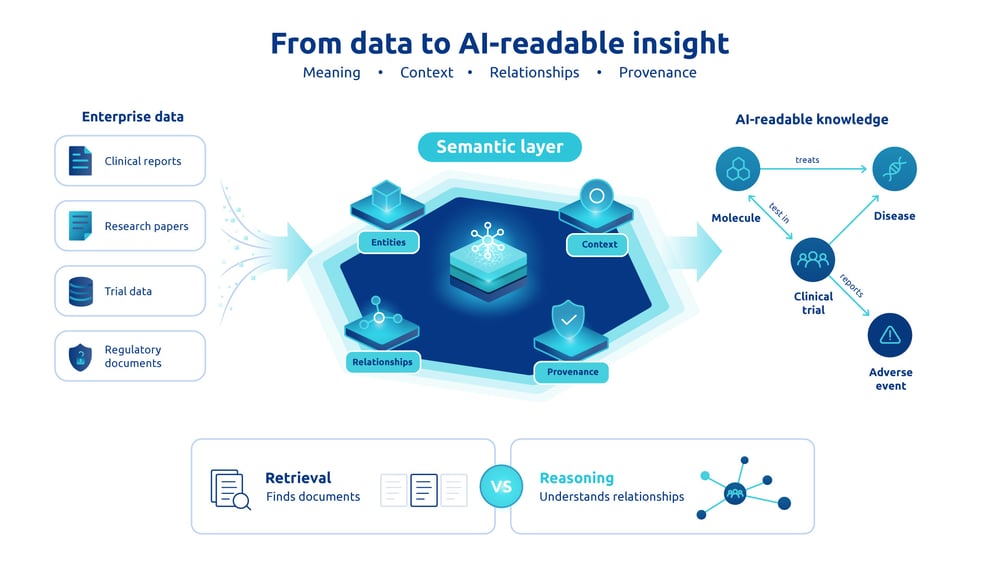
AI-readable data is the semantic layer of AI-ready data: the part that makes scientific entities, relationships, and provenance understandable to machines. For life sciences Chief Data Officers, that layer can matter as much as model choice, because it can be reused across future use cases.
Many life sciences organizations are competing on the wrong layer. Models get bought, and pilots get run, while the semantic foundation that determines what those models can reason across goes unbuilt. Model access is leveling across the industry. The substrate underneath is not, which is why it lands on the CDO's desk rather than the AI team's.
This piece sets out what AI-readability means, why life sciences data is not it by default, and how leading organizations build the compounding layer.
At a glance
- AI-readable data is data whose entities, relationships, and provenance are explicit and machine-traversable, making it a more durable source of advantage in the life sciences than the model itself.
- Clean, structured, and integrated data can all exist without a single scientific concept being machine-understandable.
- Life sciences data resists AI readability because of entity density, provenance requirements, format fragmentation, and decades of vocabulary drift.
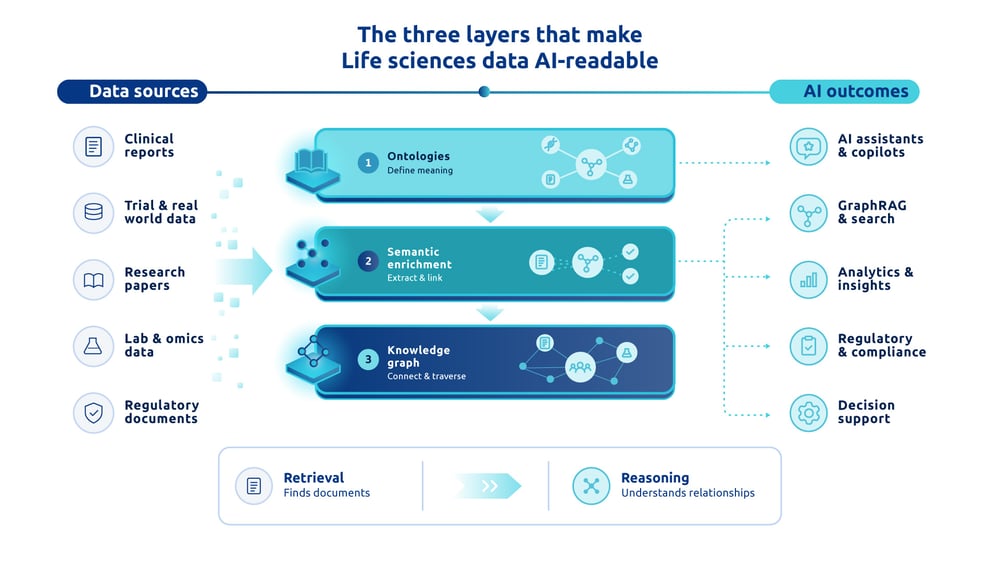
- Three layers do most of the work: ontologies define meaning, semantic enrichment extracts and links knowledge, and knowledge graphs connect it into a traversable structure.
- Explainability and auditability are strongest when they are designed into the data layer, rather than treated as model features added late
- A practical first move for a CDO is to scope a domain and build its ontology first, anchored to an existing workflow.
What "AI-readable" means for life sciences data
AI-readable data is data that carries explicit meaning in a form machines can reason across. Entities are typed, relationships are modeled, and provenance travels with every fact. Retrieval finds a document. Reasoning traverses a structure.
This is not the same as clean data, which means accurate values. It is not structured data, which means rows and columns. It is not integrated data, which means connected pipelines. All three can be in place while many of your scientific concepts remain invisible to a language model.
Consider a clinical study report in a validated repository. It is integrated by any reasonable definition, but the trial arms, endpoints, adverse events, and molecular references in that PDF remain opaque until they have been extracted, typed, and linked. The semantic layer for AI readiness is the mechanism that closes that gap.
Why AI-readable data becomes a competitive advantage
Model providers now offer capabilities broadly comparable to those of most large pharmaceutical companies. That layer is leveling. What levels more slowly is the quality of knowledge your organization puts underneath it, which is the part a CDO controls.
The investment compounds
A point solution serves one use case and expires with it. An AI-ready data foundation is built once and reused across later models, use cases, and regulatory regimes. Later use cases can often become cheaper and faster to deliver when they reuse the same semantic foundation.
For a CDO defending a multi-year data budget, that is a more durable ROI argument than per-project savings, because the asset holds its value while the tooling around it churns. This is why delivery partners should be assessed on whether they leave behind reusable semantic assets, not only working demos.
Trust is architectural, not cosmetic
Explainability, provenance, and audit trails are properties of the data layer. They are not features you add to a model after the fact. Organizations without a connected, governed enterprise knowledge struggle to ship trustworthy AI into regulated settings, largely because they cannot show where an answer came from.
Grounding outputs in trusted sources rather than guesswork is a structural decision made years upstream of any deployment.
The strategic implication is uncomfortable for anyone owning the data agenda. The gap between organizations with an AI-ready semantic foundation and those without looks likely to widen faster than the gap between the models themselves. That is where a defensible position tends to form.
What makes life sciences data hard to make AI-readable
If your organization is not there yet, that is usually structural rather than a competence failure, and worth saying so to the board. Four properties of life sciences data resist machine readability in ways that generic enterprise data does not.
|
Barrier |
What it breaks |
|
Entity density |
A single trial record holds dozens of typed entities with relationships vector similarity cannot recover |
|
Provenance requirements |
Standard retrieval loses the trail back to source, which regulatory submissions require |
|
Format fragmentation |
Articles, CRF and non-CRF clinical data, policy documents, and lab systems speak different structural languages |
|
Vocabulary drift |
The same molecule or endpoint is named differently across teams, systems, and decades |
Vocabulary drift is the one CDOs tend to underestimate. Without an ontology, "cardiovascular event" in one system and "MACE" in another read as unrelated strings. Embedding quality rarely recovers a relationship never modeled, so this work sits in data architecture rather than model selection.
The three layers that make life sciences data AI-readable
Making life sciences data AI-readable is not one project. It is three architectural layers that work together. Ontologies define meaning, semantic enrichment extracts and links knowledge from content, and knowledge graphs connect those entities into a traversable structure. Skip one and the others tend to underperform.
|
Layer |
What it answers |
Why it matters |
|
Ontology |
What do our scientific concepts mean? |
Creates shared meaning |
|
Semantic enrichment |
Where do those concepts appear in content and data? |
Turns documents into structured knowledge |
|
Knowledge graph |
How are entities connected? |
Enables traversal, reuse and GraphRAG |
Get all three, and you hold an asset future models can reason across without rebuilding, which is where the budget case for a CDO gets easier.
1. Ontologies that encode scientific and regulatory meaning
Ontologies define what concepts exist and how they relate. A molecule has an indication, an indication has an endpoint, and an endpoint has an outcome. These relationships are declared once and applied consistently downstream.
In life sciences, ontologies usually align to industry standards such as MedDRA, SNOMED, and ATC, alongside custom therapy area models that reflect how your scientists actually work. Sustained ontology management is what keeps that model accurate as your pipeline and regulatory obligations change, and it is the kind of ongoing capability that often benefits from specialist support alongside internal domain expertise.
2. Semantic enrichment that turns documents into structured data
Semantic enrichment turns scientific articles, clinical records, regulatory documents, and policies into typed, linked knowledge. It does the actual work of making unstructured content readable.
Extracted entities can carry source citations, helping downstream outputs remain traceable from the start. This is much of what makes governed agentic workflows workable under regulation. The system is not reasoning over documents, it is reasoning over structured, provenance-rich claims.
GraphRAG services build retrieval directly on that substrate, which shortens the review cycle that usually stalls deployment.
3. Knowledge graphs that connect entities across silos
Knowledge graphs are where the ontology meets real records. Every entity becomes a node and every relationship becomes an edge, so the model stops being a document and starts being a network.
This is what enables multi-hop reasoning: from a molecule, to its trials, to the sites that ran them, to the adverse events reported, to the publications discussing them. Vector search rarely follows that chain reliably. Graph traversal can, which is why knowledge graph solutions are a common delivery mechanism for questions that span silos.
For a CDO, this is what turns a backlog of cross-functional questions into something answerable.
What mature AI-readable data looks like in practice
The pattern below is not aspirational. Each example is delivered work in a regulated life sciences environment, and each illustrates a different layer operating at scale alongside the business return that justified it.
- Roche Helios: Roche Helios shows how FAIR, audit-ready clinical trial data can create a stronger foundation for AI-ready trial data. Details are in the Roche Helios case study.
- AbbVie PubLab: more than 33 million scientific articles unified into an AI-ready semantic platform, showing ontology and semantic enrichment operating at publication scale. See the AbbVie case study.
- Unifying Biobank: an ontology-driven metadata knowledge graph and retrieval workflow delivered in eight weeks, applying graph plus retrieval to cross-biobank research standardization. See the biobank case study.
- Roche policy assistance: a semantic knowledge base delivered in six weeks, built on reusable accelerators that shorten delivery time on each successive build. Details are in the Roche policy case study.
None of these organizations chose a model first. They built the AI-readable substrate, and the use cases became faster to ship on top of it. That sequencing is the transferable lesson for a CDO weighing where the next tranche of budget should go.
Where life sciences leaders should start
Few CDOs have the appetite for a twelve-step transformation program. What tends to work better is a first move that produces a reusable asset instead of a prototype that dies with its pilot.
Start with a single high-value domain: one therapy area, one regulatory workflow, or one research question senior stakeholders already care about. AI-readable data compounds, but it does not have to start enterprise-wide.
Build the ontology for that domain first. It governs much of what follows and remains one of the most under-invested assets in life sciences data programs. Then anchor the pilot to an existing workflow, such as a policy inquiry or publication triage, rather than to a greenfield use case with no owner.
Finally, weight delivery partners on whether they leave behind a reusable semantic asset rather than a working demonstration. Teams with prior ontology, graph, and enrichment work in regulated environments will usually get you there with fewer rebuilds. The AI-ready enterprise data checklist is a useful reference for pressure-testing that choice before you commit budget.
The compounding advantage
A durable advantage in life sciences AI is unlikely to come from model access alone. It sits in the AI-readable data layer underneath, which is difficult for a competitor to copy and rarely available off the shelf.
Each use case reuses that layer, so the return tends to widen as adoption accelerates.
Assess how AI-readable your life sciences data is, and identify which semantic layer to build first.