
8 minute read
Quick answer
Enterprise AI adoption depends on preparing the data behind each use case. A practical six-step approach helps organizations identify the right use case, connect relevant sources, establish shared definitions, and build a foundation that can support further AI initiatives.
Moving AI from a working pilot into production across multiple systems is often more challenging than building the initial model. A pilot may work with a clean data extract, but production AI needs to work with live information spread across systems, teams, and business functions.
For a CIO or Chief AI Officer, the priority is to identify what needs to be in place before scaling AI and how to demonstrate measurable progress. Datavid (a C5i company) approaches this through six practical steps, starting with a single business use case and building towards a reusable, AI-ready data foundation.
At a glance
- Many enterprises already use AI in some capacity, and the harder step is moving a pilot into production across multiple systems.
- Gartner predicts that organizations will abandon 60% of AI projects that lack AI-ready data through 2026.
- Each of the 6 build steps ends with an output leadership can review, such as a scoped use case or a set of working controls.
- Integration built for reporting may fall short for AI, since AI needs meaning and lineage to travel with each record.
- Readiness comes down to 5 tests a board can check, including a second use case going live in weeks.
How to build the data integration foundation for enterprise AI adoption
A data integration foundation for AI connects the source systems a use case depends on through 1 shared model of what the data means. It also carries lineage and access rules with each record, so answers can be traced and checked.
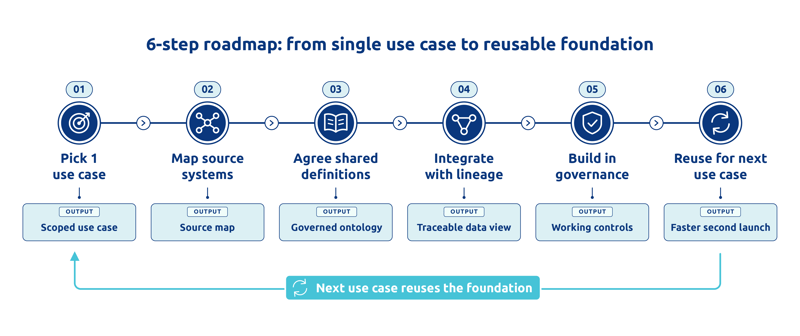
Taken in order, the 6 steps give you an AI adoption roadmap you can present 1 stage at a time, with a deliverable the board can sign off at each stage.
1. Start with 1 use case and the decision it supports
Pick a workflow in which a better decision delivers clear business value, such as a drug safety signal review or a counterparty risk check. Name the decision the AI will inform and who owns it.
Gartner research published in February 2025 defines AI-ready data by the use case it serves. That gives an enterprise AI roadmap a clear scope rule: the data behind the chosen decision must be ready on day 1.
The CIO's call is which workflow goes first, and the output is a scoped use case that names 4 things.
- The decision: what the AI informs and who acts on the result.
- The owner: 1 business lead accountable for the outcome.
- The success measure: how leadership will judge the first release.
- The boundary: what the first release covers and what waits.
The common misstep is opening with an enterprise-wide data inventory, which can take months and stall an enterprise AI strategy before the first use case has an owner.
Datavid engagements tend to start the same way: with a discovery call on the data problem, followed by a pilot built around 1 use case.
2. Map the source systems that the use case depends on
List each system that holds a record the use case needs, who owns it, and where each core entity lives. The output is a source map showing where integration effort will go, and the call to make is which systems belong in the first release.
A frequent mistake is treating the pilot's clean extract as a picture of production, where a clinical data system and a safety database may label the same compound differently.
The Stanford Digital Economy Lab's 2026 study of 51 enterprise AI deployments found transformations measured in weeks at some companies and in years at others. Knowing early where the data sits is one way to stay closer to weeks.
A data discovery service can do much of this mapping up front, cataloging what each system holds before any engineering budget is committed.
3. Agree shared definitions across systems
Business and data owners agree what customer, product, compound, or counterparty means and how those entities relate. The result is a governed ontology, which works like a shared dictionary: when the safety team and the AI look up "compound", they get the same entry.
Someone has to decide which definition wins when 2 systems disagree, and who signs it off. With ontology management in place, these definitions and relationships can be documented, agreed, and reused across connected systems.
4. Integrate with meaning and lineage intact
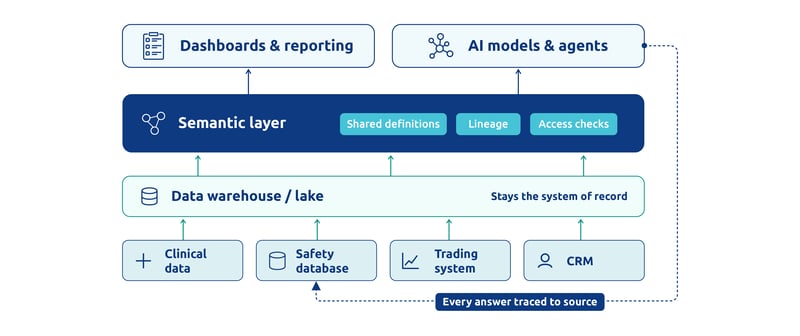
Map each source into the shared model via a semantic layer or knowledge graphs, maintaining provenance for each record so each AI answer can be traced back to its source. This is the core of AI data integration: the data can stay within the systems that own it.
The output is a traceable view of the first use case's data, and the choice to settle is which sources connect live. Much of the engineering effort sits here, so this is where data integration services can pay off first.
This is where data integration services can help connect the required sources while retaining the context needed by AI applications.
5. Build governance into the layer AI reads from
Role-aware access and audit trails work best when they're enforced at the moment the AI reads the data, with human review points for decisions that carry regulatory weight. The output is a set of controls an auditor can see working.
The question to settle is where a person reviews AI output before anyone acts on it. An AI governance framework sets those rules, and building them into the data layer means they can be applied to each request the AI makes.
For regulated teams, this step is often where the payoff starts to show. With data compliance controls in the same layer the AI reads from, much of the evidence for an inspection can come from the system itself.
6. Reuse the foundation for the next use cases
The second and third use cases reuse the ontology and the source mappings from the first one, so each can arrive faster. A strong second candidate shares core entities with the first, so it can reuse the most.
With the Datavid Rover semantic data platform as an accelerator, AI pilots can launch in 6 to 8 weeks. Time to the second use case is the number a board is most likely to watch.
The trap is treating each new use case as a fresh project with its own pipeline, which is the rebuild cost an AI implementation roadmap built on reuse is meant to remove.
Why does reporting integration fail for AI?
Many enterprises already have a data warehouse or lake, but data prepared for reporting may not be suitable for AI. People can review dashboards, spot inconsistencies, and question unusual results. AI models and agents, however, rely directly on the data they receive.
AI needs data that is connected, consistently defined, and traceable to its source. Without this, conflicting information across systems can lead to unreliable answers. Access controls also need to ensure that AI retrieves only information users are authorized to see.
A semantic layer helps address these gaps without replacing the existing data warehouse. It gives reporting and AI applications a consistent view of business information, making it easier to support new AI use cases.
Data integration foundations in life sciences and banking
Life sciences and banking answer to different regulators but face similar pressure on their data. A clinical team may need to show an inspector where a trial value came from, and a bank may need to do the same for a reported trade.
Datavid's work in each sector shows these build steps at production scale.
How Roche Helios mapped clinical trial data into 1 semantic model
The Roche Helios program mapped study-specific forms into a common semantic model, with ontology-based checks validating the data automatically. That covers shared definitions across systems (step 3) and integration with lineage intact (step 4).
The reported results were 5x faster trial data processing, an 80% reduction in manual errors, a 40% reduction in operational costs, and on-demand audit readiness for the US Food and Drug Administration (FDA) and European Medicines Agency (EMA).
How ABN AMRO unified trade data for regulatory reporting
Jaap Boersma, Principal Architect for Capital Markets Solutions at ABN AMRO, put the need plainly: "We need the ability to respond quickly to changing regulatory requirements."
The bank needed client, order, and trade data from siloed internal systems brought into a central trade data hub. Semantic enrichment added metadata and links between records to support lineage tracking, with integration of lineage intact (step 4).
Compliance logic runs as trades arrive and flags reportable instruments in real time, thereby placing governance within the data layer (step 5).
The result was daily compliance with Markets in Financial Instruments Directive II (MiFID II) reporting requirements across all ABN AMRO entities, along with end-to-end traceability.
How do you know your data integration foundation is ready to scale?
Maturity scores can be hard for a board to act on. A clearer definition of ready is 5 tests it can check in 1 review, each backed by evidence the team can show. Passing them suggests the data foundation for AI can carry the next use case.
|
Test |
What you should be able to show |
|
1 definition per core entity |
Each core entity, such as patient or counterparty, has 1 agreed definition used by each connected system |
|
Answers traced to source |
Any AI answer can be followed back to the source record and version it came from |
|
Access enforced at answer time |
A user sees only the records their role allows, checked at the moment the AI responds |
|
A second use case in weeks |
The next use case reuses the shared model and goes live in weeks |
|
A named owner per domain |
Each data domain has 1 accountable owner who signs off changes to its definitions |
When a test fails, the gap can be traced to a specific build step, keeping the fix scoped. For data-level criteria such as metadata and semantic enrichment, the AI-ready data checklist goes a level deeper.
Plan your foundation with a semantic AI readiness assessment
Many AI programs stall between the first pilot and the second use case, often on the data. For a Chief AI Officer weighing the next investment, the first step is to know what the use case needs from the data.
An AI readiness assessment looks at 4 things before any money is spent on the AI data foundation.
- The sources: which systems hold the records the first use case needs, and who owns them.
- The definitions: where core entities mean different things across those systems.
- The lineage: whether each value can already be traced to its source record.
- The access rules: how permissions would apply at the moment the AI answers.
You can leave with a clear project overview to take to the board, along with what you need to decide whether to go ahead.
Datavid's senior-led teams deliver these assessments as part of its semantic AI services, backed by ISO 27001 and Cyber Essentials Plus certifications.
Start with the AI use case that matters most to your business. The right data foundation can help move it from pilot to production while creating a reusable starting point for future initiatives.
With a clear understanding of your data sources, definitions, lineage, and access controls, your team can identify what needs attention before scaling AI.
Is your data ready for enterprise AI? Explore the gaps and discover what it takes to build an AI-ready data foundation.
