

7 minute read
Quick answer:
AI data governance is the discipline that keeps a data foundation fit for machine consumers: entities AI can trust, meaning it can reason over, provenance it can cite, and access rules enforced before retrieval. It rests on three architectural foundations, and organizations that build them with experienced delivery partners tend to reach production faster than those governed by policy alone.
An AI-first enterprise is not the one with the most models. It is the one whose data foundation can carry them.
That reframing matters because AI is now a first-class consumer of enterprise data alongside humans, and traditional governance was not designed for that reader. A person spots a stale record and asks around. A model reasons over it at scale and reports the result upward.
For the Chief Data Officer, the question has shifted from how to govern data for people to what the foundation has to deliver when machines read it too. What follows is that answer, and what building it looks like in practice.
At a glance
- AI data governance keeps a data foundation operable for AI consumers, resting on three architectural foundations rather than five policy categories.
- An AI-first enterprise is an operating state in which AI reads enterprise data at scale with the same expectations of accuracy and access control as employees.
- Master data management shifts from a standalone platform toward the knowledge graph, since AI systems query entities directly and need meaning attached.
- AI risk management works better shifted left into the data layer, where exposure, staleness, and biased retrieval actually originate.
- AI-generated outputs are entering data estates as inputs, and without provenance at creation they become hard to distinguish from source data within a few hops.
- For a CDO, the payoff compounds: each new use case reuses the foundation instead of rebuilding it.
What an AI-first enterprise needs from its data foundation
An AI-first enterprise is an operating state, not a slogan. AI systems read enterprise data the way human employees do, at far greater scale, and with the same expectation that what they read is accurate, current, and appropriate to their permissions.
That operating state asks four things of the data foundation
- Entities the model can trust
- Meaning the model can reason over
- Provenance the model can cite
- Access rules the model respects before it retrieves anything.
A foundation that delivers all four can drive enterprise AI adoption at scale. A foundation missing any of them tends to produce pilots that stall at review.
AI data governance is the operating discipline that keeps those four properties true over time. It is not a policy program that sits alongside the data. It lives in the data layer itself, which changes who owns it and how it is funded, and usually means treating it as enterprise data management work rather than a compliance workstream.
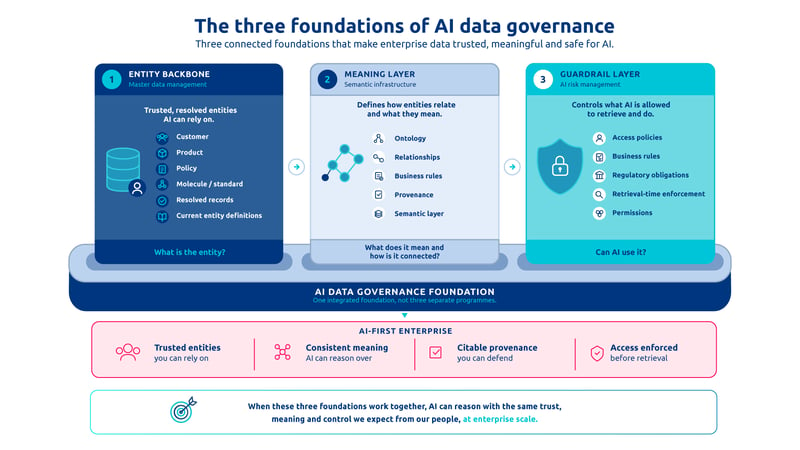
Three architectural foundations make this discipline operable, and they function as a single layer rather than three parallel programs.
The three foundations of AI data governance
Each foundation has its own artifacts and owners, but they operate together. Missing any of them tends to leave the foundation unable to carry AI at enterprise scale, whatever the model budget looks like.
Master data management as the entity backbone
Master data management resolves what your entities actually are: which customer, which product, which policy, which molecule, which standard. In an AI-forward enterprise, this layer is increasingly delivered through the knowledge graph and ontology rather than a standalone MDM platform, because AI systems query entities directly and need meaning attached to every record.
The practical outcome is worth the shift. AI systems read from the same trusted entity definitions, and when a record changes, downstream models tend to reflect it without a retraining pass. That removes a recurring cost most enterprises absorb quietly, and knowledge graph solutions are the usual route to that backbone.
The AbbVie iQ work shows the pattern in R&D. A knowledge platform spanning regulated quality documents, training content, and pharmacovigilance guidance was rebuilt on reusable modular architecture, with record-level harmonization replacing full-dataset reprocessing. Reusability paid off twice: other AbbVie teams adopted the same components to deliver prototypes faster, and maintenance costs fell as complexity was removed from the stack.
Semantic infrastructure as the meaning layer
Above the entities sits meaning: how they relate, which business rules apply, and what surrounding knowledge AI needs to reason correctly. Ontologies and the semantic layer live here, maintained through sustained ontology management as definitions and obligations change.
This is the layer AI reasons over to produce outputs that hold up under review. The practical outcome is traceability: outputs resolve to specific entities, relationships, and source documents, which is the precondition for explainability and for any audit trail expected in a regulated setting.
As business context evolves, enterprise ontologies must evolve with it. Read How to Keep Enterprise Ontologies Up to Date as Business Context Changes to explore strategies for maintaining AI-ready ontologies over time.
For a CDO, this layer is where AI readiness becomes measurable rather than aspirational. The same semantic platform that grounds one use case tends to ground the next, which is why the meaning layer is often among the better-returning lines in the data budget. It also tends to be the layer where teams benefit most from partners who have modeled regulated domains before, since early definition choices are expensive to revisit.
AI risk management as the guardrail layer
The third foundation encodes what AI is allowed to do with the entities and their meaning. Access policies, business rules, and regulatory obligations are enforced during retrieval at the semantic layer, so AI systems rarely reach data they should not see, or reason toward conclusions that policy does not allow.
The practical outcome changes the economics of oversight. Risk enforcement moves from downstream review of AI outputs toward a property of the foundation itself, which is how review effort can stay flat while output volume grows.
Regulatory data platforms in banking follow this pattern, pairing semantic enrichment with compliance logic applied as data moves rather than after, and the enforcement points are usually decided during data architecture work rather than retrofitted later.
Why AI-generated data requires governance
AI-generated content is no longer just an output category. It is entering the enterprise data estate as an input to other AI systems, dashboards, and reports, thereby creating a governance surface of its own.
The stakes are structural rather than statistical. Outputs entering the estate without provenance become hard to distinguish from human-authored source data within a few hops, and that ambiguity propagates through downstream models that read from them. Unwinding it later can mean auditing the estate record by record.
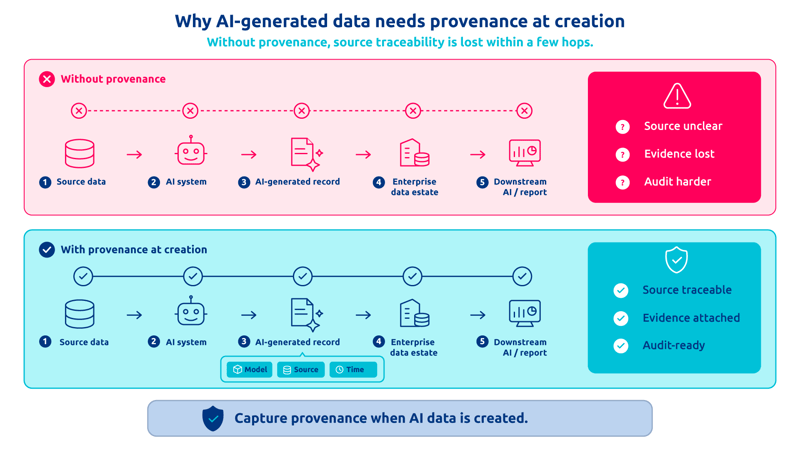
The foundation is better placed to act at the point of generation: attach provenance metadata as the record is created, tag AI-generated records with the model, prompt, and source documents used, and route them through the same semantic layer that governs human-authored data. That is as much a pipeline design question as a governance one, which puts it in data engineering territory. Retrieval built on GraphRAG services supports the same pattern, since citations attach to facts rather than passages.
The Roche Helios platform demonstrates proper provenance for regulated data. FAIR-aligned pipelines with automated reconciliation and audit trails delivered an 80% reduction in manual errors, 5x faster trial data processing, 40% lower operational costs, and on-demand audit readiness for the FDA and EMA.
How AI risk management shifts left into the data layer
Most programs treat AI risk management as a model-layer discipline: bias monitoring, drift detection, output review. That is where risk becomes visible. The data foundation tends to be where it is actually managed, and the distinction changes what a CDO funds and what that spending returns.
Three common AI risks are regularly misdiagnosed as model problems:
- Unauthorized data exposure is a retrieval-time access problem, not a model output problem.
- Reasoning on stale entities is an MDM currency problem, not a model reliability problem.
- Biased retrieval is an ontology coverage and source-selection problem, not a model fairness problem.
Shifting left looks concrete in operation. Access rules are enforced during retrieval by the semantic layer. MDM records carry currency and provenance metadata that models can read. Ontology coverage is treated as a risk artifact and reviewed on the same cadence as model performance, alongside the data governance program it extends.
The difference is easiest to state as two sentences an auditor might hear. "The model surfaced sensitive data" against "the retrieval layer declined to surface it in the first place." Only one of those tends to be defensible, and the gap between them is usually measured in remediation cost.
Signs your AI data foundation is ready for enterprise scale
These are signals to check the foundation against rather than a scorecard, and they read as descriptions of a mature foundation.
Your entities are cataloged with meaning attached, not just names. The ontology defines what a customer, product, standard, or policy is in terms other systems can consume.
Access is enforced during retrieval, not reviewed after output. The semantic layer declines to surface data the requester should not see, before an AI ever reasons over it.
AI-generated records enter the estate with provenance intact. Outputs are traceable to the entities, prompts, and source documents that produced them.
New AI use cases reuse the foundation instead of rebuilding it. The second and third GraphRAG or agentic workflow can land in weeks because the ontology, entity backbone, and access rules are already in place, which is where accelerators such as Datavid Rover tend to compress scoped builds.
If any of these read as aspirational rather than descriptive, the foundation is where the work is.
Building the foundation for AI-first enterprise adoption
AI-first business tend to be the ones whose data foundation can carry AI, and AI data governance is the discipline that keeps that foundation operable over time. For a CDO, the return is structural: governance built into the data layer is built once and reused, while governance that lives in review tends to scale with headcount. Which of those you are funding is usually clear from how long the second AI use case takes.
Is your data foundation ready for enterprise AI?

to evaluate the strength of your entity model, semantic layer, and governance framework before scaling your next AI initiative.
%20Why%20AI%20agents%20dont%20just%20need%20data.png)