

8 minute read
Quick answer
An AI governance framework is the set of policies, roles, controls, and evidence that keeps each AI system accountable from design to retirement. In a regulated enterprise, it tends to hold up when each control can be proved on demand. The governance framework defines the policies, roles, and controls, while a governed semantic/data foundation helps operationalize those controls and produce evidence.
An AI governance framework is expected to satisfy three audiences at once. An auditor wants evidence, a regulator wants traceability, and the board wants speed. That tension is the real design constraint.
For a CDO, much of that pressure lands on the data. Most published AI governance frameworks describe what to govern, while regulated enterprises also need to know what should be in place to prove it. That proof tends to come from the data foundation under the controls.
At a glance
- In regulated industries, evidence tends to be the hardest part of an AI governance framework to produce on demand.
- NIST AI RMF, ISO 42001, and the EU AI Act ask overlapping questions, so one control set can map to all three.
- Six controls cover what auditors tend to ask, and each depends on data with provenance, lineage, and access rules.
- Committees decide who signs off, while the semantic foundation largely decides whether they can prove what they signed.
- A governed foundation for the first use case can be in place within weeks.
AI governance framework components for regulated enterprises
An AI governance framework is the operating model for how your organization decides on, controls, and demonstrates the use of AI. It sits above any single tool or model and spans the full AI lifecycle. In a regulated sector, a CDO's scope question turns on what it can show when asked.
The four parts of an AI governance framework
- Policies: What is allowed, and under which conditions.
- Roles: Who decides and who is accountable.
- Controls: How rules are enforced across the AI lifecycle.
- Evidence: How do you prove the other three, on demand?
What changes with AI governance for regulated industries
Evidence becomes hard to treat as optional once a regulator is involved, and the regulator tends to set the timeline. Models also read more unstructured content, from protocols and policies to standards and trade records, which classic governance rarely covers.
Evidence is the part a governed semantic foundation helps make real. Mature data governance services supply the provenance, lineage, and access rules that make written policy enforceable, which is where the return on governance spending tends to show up first.
NIST AI RMF, ISO 42001, and the EU AI Act: which one anchors your framework?
In most cases, you don't have to choose. NIST AI RMF gives you a risk method, ISO 42001 gives you a certifiable management system, and the EU AI Act sets legal obligations by risk tier. Anchor on the standard your regulator or customers are likely to ask about first, then map the other two against it.
How the three AI governance frameworks compare
|
Standard |
What it is and who it binds |
What it expects you to evidence |
|
A US AI risk management framework built on four functions: Govern, Map, Measure, and Manage. Voluntary for any organization. |
That AI risks are identified, measured, and managed |
|
| An international AI management system standard on a Plan-Do-Check-Act cycle. Voluntary, with certification available. |
That AI policies and controls operate and improve |
|
| An EU regulation sets rules by risk level, with the heaviest on high-risk systems. Binds providers and deployers of AI in the EU market. |
Risk management, data quality, logging, documentation and human oversight |
Sector overlays you already work with
Your AI governance framework also sits atop the sector rules you already manage. In life sciences, that means GxP and FDA or EMA expectations for validated systems. In banking, it means MiFID II reporting and model risk management expectations.
The same governed data can serve all three standards and the overlays, so mapping tends to become a documentation exercise rather than a rebuild. AI data governance is the foundation side of that equation, and for a CDO it's what helps avoid funding EU AI Act compliance and ISO 42001 readiness as separate projects.
The six controls that regulated enterprises need to be in place
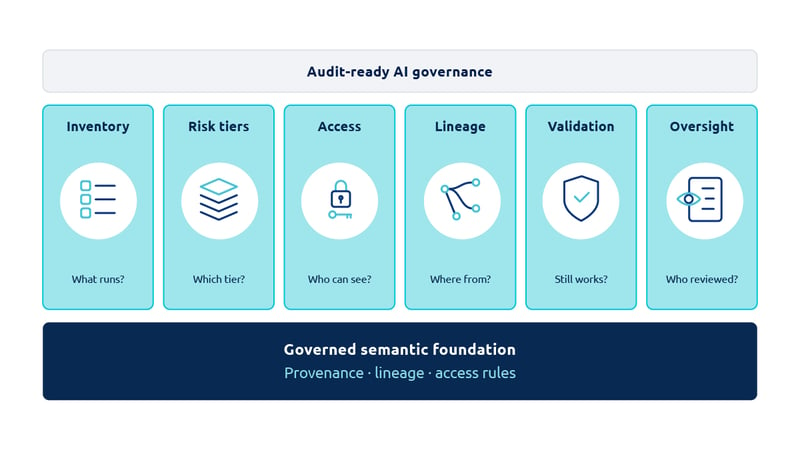
These 6 controls reflect questions that auditors frequently ask about AI, though the exact focus varies by regulator, sector, and use case. Each control tends to be as strong as the data it can point to, so each one pairs a common auditor question with what the data may need to carry. That pairing can help a CDO answer more readily on audit day, with less evidence to assemble afterward.
1. An AI inventory that includes the data each system reads
- The Auditor Asks: Which AI systems do you run, and what do they read?
Many inventories list models. A regulated inventory also lists the sources, entities, and documents each model or agent draws on, so the scope can be proved. Knowledge graph solutions can track which sources feed which systems and stay current as sources change, helping keep the inventory accurate without manual refreshes.
2. Risk classification tied to the decisions the AI touches
- The Auditor Asks: How did you decide this system was high or low risk?
Classification holds up better when it references the decisions and data classes involved. When entities and documents are classified in the semantic layer, risk tiers attach to what the AI reads and produces. Sustained ontology management keeps those classes up to date, which can spare your team a yearly reclassification exercise.
3. Access rules are enforced when the AI retrieves
- The Auditor Asks: Can this system reach data that the user could not?
Access is easier to evidence when it's enforced at retrieval on behalf of the requesting user. In the Roche Policy Assistance work, a semantic knowledge base built on Rover reached a working prototype in 6 weeks, with role-based access integrated with legacy databases.
It targets more than 100,000 annual policy-related inquiries that previously saw delays of 24 hours or more. Governed retrieval at the semantic layer helped make self-service answers workable for a compliance team.
4. Provenance and lineage from each output back to its source
- The Auditor Asks: Where did this number, answer or recommendation come from?
Document-level citation rarely satisfies a regulated review, since reviewers tend to expect a path from output to source to version. At ABN AMRO, an existing MarkLogic-based TradeStore was extended with real-time compliance logic and end-to-end traceability. It now supports daily MiFID II reporting with straight-through processing.
The same pattern carries across data compliance work. When provenance is captured at ingestion and carried through GraphRAG services, answers can arrive with their evidence attached, so reviewers spend less time reconstructing sources.
5. Validation and monitoring of governed data
- The Auditor Asks: How do you know it still works?
Beyond drift and bias monitoring, regulated validation can also check the data a model reads against business rules and controlled vocabularies at ingestion. At Roche Helios, study forms were mapped to a common semantic model, with ontology-based checks and business-rule validation in the pipeline.
Trial data processing became 5x faster, and manual errors fell by 80%. Operational costs dropped by 40%, with on-demand audit readiness for FDA and EMA. In clinical trial data programs, discrepancies tend to surface before an auditor does.
6. Human oversight with a record of each decision
- The Auditor Asks: Who reviewed this, and what did they see?
Oversight benefits from a record of the evidence in front of the reviewer, alongside the sign-off. For agentic workflows, that record helps keep human review meaningful at volume. AI services that keep agents grounded in enterprise knowledge make the record a by-product of the workflow, so review capacity can keep pace with AI volume. The review model itself sits within decision governance.
Who owns the AI governance framework: roles and the committee
A cross-functional AI governance committee sets policy and risk appetite, and named owners carry each control. The committee decides who signs off. The question many org charts leave open is which role owns the evidence behind each signature, and in regulated enterprises that gap tends to surface at the first audit.
Roles on an AI governance committee
|
Role |
What they own |
What they need to show |
|
Chief Data Officer |
The data foundation and its evidence |
Provenance, lineage and access records per AI system |
|
Chief AI Officer or Head of AI |
Use case approval and model lifecycle |
Approval records and model versions in use |
|
Compliance and risk |
AI governance policy and audit response |
Classification rationale and audit responses |
|
Data and enterprise architects |
Enforcement across the data architecture |
Where each control runs and how it's tested |
|
Business owners |
Acceptance of residual risk |
Signed risk acceptance per use case |
Why the CDO often becomes accountable for the data evidence
The other roles tend to sign off against the data your foundation produces, so accountability for the data evidence often falls to the CDO, even where it isn't formally assigned. If that foundation can't show provenance or access history, each sign-off can carry hidden risk. When a partner builds it, expecting named senior owners on their side, too, is reasonable.
How to implement an AI governance framework without a rebuild
Many AI governance best practices assume a clean start and a long program. A shorter path starts with the data foundation and one regulated use case, then reuses both as the scope grows. Five steps cover it, and the first governed result can arrive in weeks rather than quarters, which helps maintain board support.

Five steps to a governed first use case
- Inventory systems and sources: List the AI systems in use and the sources each reads, which becomes the scope your auditor tests.
- Classify decisions and data: Classify the decisions and data classes each system touches, so risk tiers rest on evidence.
- Model the first use case: Model the entities, rules and access policies for one regulated use case with a named owner.
- Enforce the six controls: Apply the controls and capture evidence as a by-product of normal operation, which tends to cost less than assembling it for an audit.
- Extend and map: Extend the model to the next use case, and map the controls to the standard your regulator requires.
Reusing the model for the next use case
The ontology, graph, and access rules built for the first use case carry into the next, so enterprise AI governance can scale without a program restart. With Rover and reusable accelerators, a first governed use case typically yields a working result in 6 to 8 weeks. For a CDO, that answers the board's questions about speed without giving up evidence.
AI governance framework checklist for regulated enterprises
An AI governance checklist gives you concrete material to bring to a steering meeting. Each row pairs a check with the evidence that satisfies it, two per control, so it doubles as a starting AI governance framework template. It works best ahead of an internal review rather than during an audit.
Twelve checks and the evidence behind them
|
Check |
Evidence that satisfies it |
|
A current register linked to each system's sources |
|
Source-to-system links that update automatically |
|
Classification records tied to entities and documents |
|
Dated reviews with owner sign-off |
|
Logs showing user-level filtering at query time |
|
Tested alignment between source and AI access |
|
Citations that resolve to a document version |
|
End-to-end lineage from ingestion to output |
|
Validation results captured at ingestion |
|
Reports with thresholds and actions taken |
|
Review records, including the evidence shown |
|
A role map with owners and escalation paths |
If the evidence column feels aspirational for more than two rows, the foundation is usually the place to start.
Put your AI governance framework on a foundation that can prove it
A written AI governance framework tends to satisfy a policy review. An evidence-based one is far more likely to hold up in an audit, and much of the difference sits in the data under the controls.
Test your AI governance framework against the six controls before an auditor does. Find out which controls your data can already evidence and which need a stronger foundation.