
7 minute read
.png)
Quick answer:
Enterprise ontologies need to evolve as business content changes, but manual ontology maintenance can become slow, repetitive, and difficult to scale.
Datavid Rover helps automate part of this process by extracting candidate terms from new content, matching them against existing ontology concepts, suggesting synonyms or new child terms, and routing uncertain cases to subject matter experts for review.
This allows organizations to keep their ontology current while maintaining governance, auditability, and expert control over the canonical layer.
How to keep enterprise ontologies up to date as business content changes
Business content is never static.
New reports are published. Market categories evolve. Product terminology changes. New technologies emerge. Regional definitions shift. Analysts introduce new terms as they describe what is happening in the business, the market, or the domain.
For organizations that rely on ontologies, taxonomies, or knowledge graphs, this creates a practical challenge.
The ontology that guides and reflects enterprise knowledge needs to evolve in parallel with the content it represents. But maintaining that ontology manually can quickly become a large and repetitive task.
In many cases, these updates are not major structural changes. The schema stays the same. The parent concept remains valid. What changes is the set of canonical child terms, synonyms, and related labels attached to existing nodes.
Examples include:
- New market sub-categories
- New product variants
- New geographies
- New technology types
- New company or industry terms
- New abbreviations or naming conventions
As content volume grows, so does the volume of ontology maintenance. Without automation, subject matter experts can spend too much time reviewing low-value additions and not enough time on higher-value semantic decisions.
This is where Datavid Rover can help.
Why manual ontology maintenance does not scale
Ontologies are most valuable when they are trusted, curated, and aligned with the way the organization understands its domain.
But that value depends on maintenance.
If new terminology is not added, search and retrieval become less accurate. If synonyms are not captured, relevant content may be missed. If new concepts are added inconsistently, the ontology becomes harder to govern. If updates are made without a clear audit trail, trust in the semantic layer starts to weaken.
The challenge is that not every new term requires the same level of human judgment.
Some terms are simply surface variants of existing concepts. Others are clear synonyms. Some may be genuinely new concepts that need expert review. A smaller number may point to deeper semantic drift in the corpus over time.
Treating all of these cases as manual ontology work creates unnecessary effort.
A better approach is to separate high-volume, low-judgment maintenance from decisions that genuinely require subject-matter expertise. Automating ontology maintenance while keeping experts in control
Datavid Rover can support ontology maintenance by combining content extraction, semantic matching, workflow automation, and governed review.
The goal is not to turn the ontology into a fully automated, unmanaged output. The goal is to automate the repetitive work around term detection and matching, while keeping experts in control of the canonical layer.
The approach combines five capabilities:
- Automated candidate detection during ingestion
- Similarity checks against existing ontology terms and definitions
- Automated handling of high-confidence synonyms
- SME review for uncertain or high-impact candidates
- Versioned, auditable persistence of ontology changes
Together, these create a practical workflow for keeping an enterprise ontology aligned with changing content.
Click to read: What is an ontology? How ontologies improve AI accuracy and reduce hallucinations
How the ingestion-time pipeline works
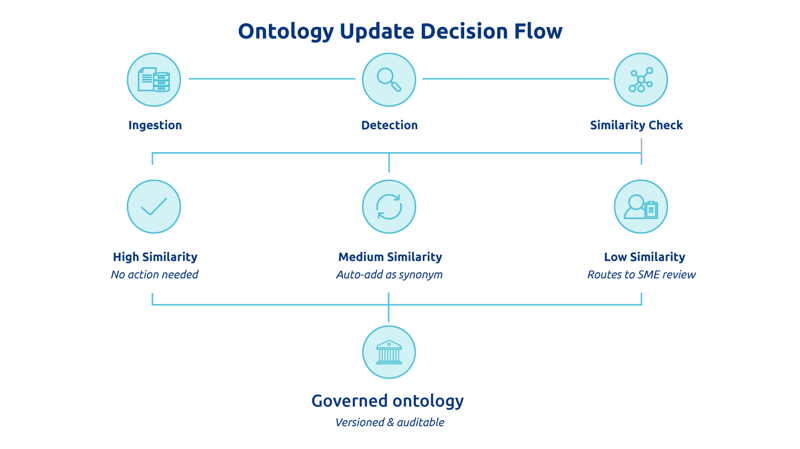
When a new document, report, or content item enters the ingestion pipeline, Rover can detect candidate terms that may need to be represented in the ontology.
This includes named entities, domain terms, noun phrases, market references, product categories, company names, technology terms, and other ontology-relevant concepts.
Each candidate term is extracted along with its source context, such as the sentence or paragraph in which it appeared. This context is important because it helps reviewers understand how the term is being used.
The extracted candidate is then compared against the existing ontology.
This comparison can include:
- Existing canonical labels
- Alternative labels and synonyms
- Definitions
- Related concepts in the relevant ontology branch
- String similarity for surface variants and abbreviations
- Embedding similarity for semantic variants
The outcome determines what happens next.
High-similarity terms
If the candidate term closely matches an existing canonical label or synonym, no action is needed. The term is already represented.
This avoids creating duplicate concepts or unnecessary review tasks.
Medium-similarity terms
If the candidate term has a clear closest match, it can be automatically attached as an alternative label or synonym of the existing node.
For example, a new abbreviation, spelling variant, or market phrase may not require a new concept. It may simply need to be captured as another way of referring to an existing concept.
For high-impact areas, such as markets, products, or strategic categories, the same item can be routed to subject-matter experts for review before acceptance. This gives organizations a conservative starting point and allows them to relax controls over time as confidence grows.
This is the key flexibility point: Rover can automate low-risk synonym handling while preserving expert review where it matters most.
Low-similarity terms
If there is no clear match, the candidate is routed to an SME review queue.
The system can suggest a parent node, provide a draft definition, show the source quote, and display the nearest existing matches. The reviewer can then decide whether to promote the term as a new canonical child, merge it as a synonym, or reject it.
This is where expert judgment matters most.
Keeping experts focused on the decisions that matter
The SME review interface is the control point where candidate terms become governed ontology changes.
A useful review workflow should show the reviewer:
- The candidate's term
- The source quote and document reference
- The suggested parent node
- A draft definition based on the source context
- Similarity scores
- Nearest existing matches
- Recommended action
- Approval, merge, or reject options
This keeps the review focused and practical.
Instead of asking experts to search manually through documents, interpret every new phrase, and update ontology files directly, the system presents only the terms that need attention, with the evidence required to make a decision. This changes the role of the SME.
They are no longer spending time on repetitive ontology housekeeping. They are making higher-value decisions about the canonical knowledge layer.
Detecting semantic drift over time
Not every ontology update is triggered by a single document.
Sometimes, a term or concept becomes important gradually. It may appear across multiple reports, increase in frequency over time, or start to shift in meaning as the business context changes.
It can also detect duplicate concepts, overlapping terminology, or conflicting terms that have emerged over time. Identifying these inconsistencies helps maintain a clean, consistent ontology and prevents multiple terms from representing the same concept.
To catch this, Rover can support periodic drift detection across the corpus.
A scheduled job can cluster extracted noun phrases across the full content set and compare them against the current ontology coverage. This helps identify concepts that are becoming more prominent but have not yet triggered an individual ontology update.
This is important for organizations working with fast-moving domains, such as market intelligence, life sciences, publishing, financial services, research, policy, or technology.
Over time, drift detection helps keep the ontology aligned not only with new terms, but with the changing shape of the domain itself.
Governance: the ontology remains a curated asset
Automation should not weaken ontology governance.
For enterprise use cases, especially in regulated or knowledge-intensive environments, the ontology needs to remain a trusted, curated asset. It should not become an uncontrolled by-product of content ingestion.
That is why accepted changes should be versioned and auditable.
Each approved update can record:
- The source document or proposal that triggered the change
- The SME who approved it
- The rationale for the decision
- Any rejected alternatives
- Tests showing that the new term resolves to the intended node
- The version of the ontology where the change was introduced
This creates a clear audit trail. It also supports rollback if a change later proves incorrect.
The same versioned ontology can then feed future similarity checks, enrichment pipelines, search experiences, analytics workflows, and AI applications. This closes the loop between governance and runtime use.
Why this matters for AI-ready knowledge
As organizations move toward semantic search, GraphRAG, and agentic AI, ontology quality becomes even more important.
AI systems need more than access to content. They need structured meaning, trusted relationships, and a governed context.
If the ontology is outdated, incomplete, or inconsistent, downstream AI systems inherit those weaknesses. Retrieval becomes less reliable. Answers become harder to explain. Business users lose confidence in the outputs.
Keeping the ontology current is therefore not just a data management task. It is part of building the semantic foundation for trusted enterprise AI.
Rover helps by connecting content change to ontology change in a controlled workflow. New terms can be detected automatically. Synonyms can be suggested or attached. Uncertain cases can be reviewed by experts. Approved changes can be versioned, tested, and reused across the knowledge layer.
This makes ontology maintenance more scalable without removing the governance that gives the ontology its value.
Where Rover fits
Datavid Rover is designed to help organizations turn fragmented enterprise content into trusted, AI-ready knowledge.
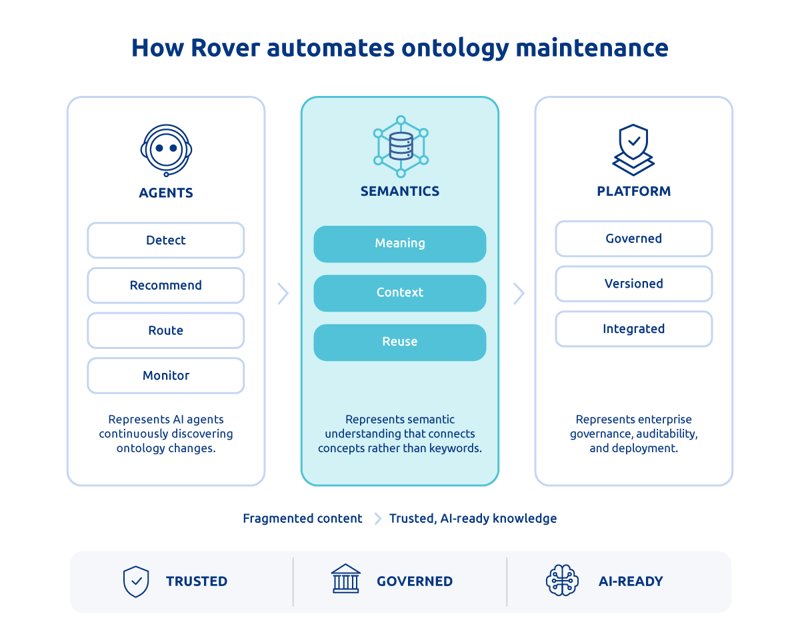
Rover brings together semantics, AI agents, and enterprise governance to simplify ontology maintenance.
AI Agents
Built on Rover's semantic intelligence, AI agents automate repetitive ontology maintenance tasks while keeping subject matter experts in control. They:
- Detect and match new terms
- Recommend ontology updates
- Route uncertain cases to SMEs
- Monitor semantic drift over time
Semantic Layer
The semantic layer is the foundation of Rover. It gives enterprise data consistent meaning and context by providing:
- Content ingestion and semantic extraction
- Candidate term detection and similarity matching
- Synonym suggestions and new concept identification
- Reusable semantic context across search, analytics, GraphRAG, and AI applications
- Versioned ontology updates
- Auditability and governance
- SME review and approval workflows
- Integration with enterprise AI applications
Enterprise Platform
The enterprise platform ensures ontology evolution remains governed, scalable, and production-ready through:
The result is a more sustainable approach to ontology management.
Instead of relying on manual updates after the fact, organizations can create a continuous feedback loop between new content, semantic enrichment, and governed ontology evolution.
Also read: How to make your enterprise data AI-ready?
The business value: less maintenance, more innovation
For teams responsible for ontologies, taxonomies, or knowledge graphs, the value is straightforward.
The repetitive work can be reduced. The review process becomes more focused. The ontology can evolve as its content evolves. Experts can spend less time maintaining terminology and more time designing better products, improving search, enabling analytics, or supporting AI use cases.
This is especially valuable when content changes frequently, such as in market intelligence, research, scientific literature, regulatory content, technical documentation, or news-driven domains.
The ontology remains curated. The workflow becomes more scalable. The knowledge layer stays aligned with the business.
Conclusion
Enterprise ontologies are not one-off assets. They need to evolve as the content, terminology, and business context around them change.
Manual ontology maintenance can work at a small scale, but it becomes difficult to sustain as content volume grows. A more scalable approach is to automate candidate detection, synonym matching, and definition drafting, while reserving expert review for the decisions that shape the canonical layer.
Datavid Rover supports this kind of governed ontology evolution by connecting content extraction, semantic matching, SME review, and versioned ontology updates into a single workflow.
The outcome is not an unmanaged automated ontology. It is a curated semantic layer that can keep pace with change.
That is what makes it useful for search, analytics, knowledge management, and trusted AI.
Explore how Datavid Rover helps organizations turn changing enterprise content into trusted, AI-ready knowledge.