
12 minute read
Quick Answer: Neural AI systems are powerful at finding patterns, but pattern recognition alone is not enough for regulated enterprise AI.
CDOs need AI systems that can explain why an answer was produced, validate outputs against domain rules, and provide a traceable path back to the knowledge used. That is where neurosymbolic AI becomes relevant.
Neurosymbolic AI combines neural models with symbolic reasoning systems such as knowledge graphs, ontologies, and rules. The neural side handles scale and unstructured data. The symbolic side adds structure, context, constraints, and explainability.
For Datavid, the important point is practical: neurosymbolic AI depends on the same semantic foundations many enterprises are already building for GraphRAG, AI-ready data, governance, and knowledge management.
The stronger your knowledge graph and ontology foundation, the better positioned you are to build AI systems that are more explainable, grounded, and trustworthy.
At a glance
- Neurosymbolic AI is an emerging approach that merges neural network learning with symbolic reasoning (rules, ontologies, knowledge graphs) to create AI systems that can both learn from data and explain their reasoning, giving CDOs the transparency that regulators and boards increasingly expect.
- Knowledge graphs serve as the symbolic backbone of neurosymbolic systems by encoding domain relationships, constraining AI outputs, and creating auditable reasoning paths that can help reduce compliance risk.
- Compared to neural-only or symbolic-only approaches, neurosymbolic AI offers a strong combination of scalability, explainability, and domain knowledge integration, making it an architecture worth evaluating for regulated enterprise environments.
- Life sciences, publishing, and financial services are among the earliest adoption areas because these industries face regulatory requirements that demand traceable AI decision-making,with potential value in faster research cycles, reduced review effort, and lower compliance exposure.
- Adoption requires upfront investment in ontologies and knowledge graph infrastructure, but organizations that already have structured data foundations, or work with partners like Datavid to build them, are well positioned to move from pilot to production.
What is neurosymbolic AI?
If you have been tracking the AI conversation from a data leadership seat, you already know the limits of the models your teams are running. Large language models and deep learning systems are good at finding patterns in unstructured data, but they struggle with structured reasoning, explainability, and adherence to domain-specific rules.
Symbolic AI (think rule-based systems, ontologies, and logic engines) handles those things well but cannot scale across noisy, real-world data the way neural networks can.
Neurosymbolic AI is an emerging approach that integrates both paradigms. It is increasingly discussed in enterprise AI circles as a way to combine the strengths of neural and symbolic systems without inheriting the full limitations of either.
How the two components work together
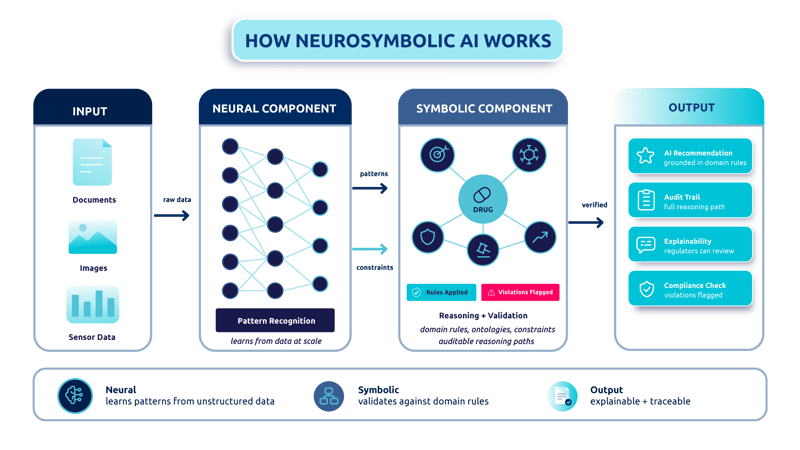
The neural component processes unstructured inputs (documents, images, sensor data) and identifies patterns. The symbolic component applies domain logic, validates outputs against known rules, and produces reasoning traces that your compliance and governance teams can review.
What makes this more than an academic concept is that most enterprises already have the building blocks on both sides. You likely have machine learning models running somewhere in your stack, and you have structured data, taxonomies, or ontologies sitting in your systems. Neurosymbolic AI connects these two worlds so they reinforce each other. The neural side learns and scales; the symbolic side constrains and explains.
Why this matters for CDOs
For CDOs evaluating AI architecture decisions, the practical implication is worth considering: you may not need to choose between powerful AI and explainable AI. Neurosymbolic architectures offer a path toward both.
That matters when your board wants returns from AI investments, your regulators want audit trails, and your business stakeholders want results they can trust enough to act on. In regulated industries, continuing to deploy black-box outputs without traceability becomes increasingly difficult to justify as AI adoption expands.
If your organization is already using or evaluating GraphRAG, you are closer to neurosymbolic AI than you might think. GraphRAG grounds LLM outputs in knowledge graph context, which is a practical form of combining neural processing with symbolic knowledge. Neurosymbolic AI extends that pattern by adding formal reasoning and constraint validation. GraphRAG gives your AI better answers; neurosymbolic AI gives your AI the ability to defend those answers against domain rules.
Why knowledge graphs matter
Knowledge graphs are the structured representation layer that makes the symbolic side of neurosymbolic AI work. They encode entities, relationships, and ontologies that capture what your organization knows about its domain: which drugs interact with which biological targets, how regulatory requirements map to specific data assets, or how content topics relate to each other across a publishing archive.
For CDOs, knowledge graphs are the asset that turns existing domain knowledge into machine-readable intelligence your AI systems can reason over.
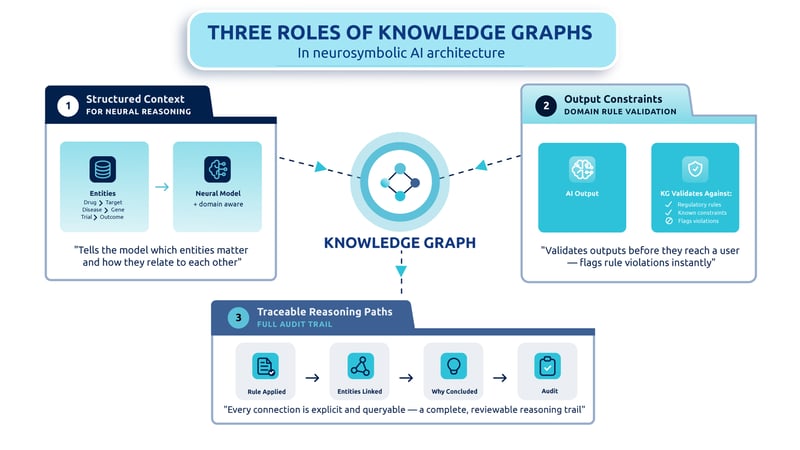
In a neurosymbolic architecture, knowledge graphs play three specific roles.
1. Providing structured context for neural reasoning
When a neural model processes unstructured data, it operates without inherent awareness of your domain rules. A knowledge graph supplies that context. If a model is analyzing clinical trial documents, the graph tells it which entities matter (compounds, endpoints, patient populations) and how they relate to each other. This contextual grounding means the neural component produces outputs that are relevant to your specific business domain rather than generic pattern matches.
2. Constraining outputs to align with domain rules
This is where neurosymbolic approaches can help reduce the risk of unsupported or domain-inconsistent outputs. A neural model might recommend an action or surface a result, but the knowledge graph validates that output against established rules and relationships before it reaches a user. If the recommendation violates a known constraint (a regulatory rule, a biological impossibility, a compliance threshold), the symbolic layer flags or corrects it. For CDOs who have been asked to explain an AI-generated recommendation to a regulator, this constraint mechanism is where the practical value sits.
3. Enabling traceable reasoning paths
Every connection in a knowledge graph is explicit and queryable. When a neurosymbolic system produces an output, the knowledge graph provides the trail: here is the rule that was applied, here are the entities involved, and here is why this conclusion was reached. For regulated industries where audit trails are non-negotiable, this traceability is one of the capabilities that helps move AI from controlled experiments toward production use.
Why knowledge graphs are a strategic investment, not just infrastructure
One of the most significant advantages is that knowledge graphs can be updated independently of the neural model. When a new regulation takes effect, a new drug interaction is documented, or your taxonomy evolves, you update the graph. The symbolic reasoning layer immediately reflects those changes without requiring model retraining. That decoupling means faster response to regulatory changes and lower ongoing AI maintenance costs.
This is where Datavid's GraphRAG and semantic AI services add the most value. Datavid builds the knowledge graph foundations that serve as the symbolic backbone for neurosymbolic systems, particularly for organizations in life sciences and publishing where domain knowledge changes frequently and accuracy is non-negotiable. The knowledge graph you build today does not just improve search or data governance. It becomes the reasoning infrastructure for your next generation of AI applications.
A real-world example of semantic AI infrastructure
Datavid's policy assistance work with Roche illustrates this in practice. Roche's compliance advisors were manually fielding upwards of 10,000 policy-related inquiries each year from employees across departments and geographies, with response delays of 24+ hours. Datavid deployed a semantic knowledge base using Datavid Rover in just six weeks, unifying policy content and enabling self-service access.
The result was a significant reduction in advisor workload and the foundation for AI-powered compliance support. For CDOs, this case demonstrates how semantic foundations can turn complex enterprise knowledge into trusted, self-service access for business teams,and how that same foundation can support more advanced AI capabilities, including GraphRAG, semantic search, and reasoning-oriented workflows.
Neurosymbolic AI vs. neural-only and symbolic-only approaches
Before committing resources to a neurosymbolic strategy, CDOs need to see where it compares to the approaches their organizations may already be using. The table below maps the key capabilities that matter for enterprise AI decision-making.
|
Capability |
Neural-only (deep learning) |
Symbolic-only (rules/logic) |
Neurosymbolic AI |
|
Learning from data |
Strong |
Weak |
Strong |
|
Logical reasoning |
Limited |
Strong |
Strong |
|
Explainability |
Low (black box) |
High (rule-based) |
High (traceable reasoning + learned patterns) |
|
Scalability |
High |
Limited with large rule sets |
High (neural scales, symbolic constrains) |
|
Handling unstructured data |
Strong |
Weak |
Strong |
|
Domain knowledge integration |
Requires retraining |
Manual rule encoding |
Combines both approaches |
The pattern is straightforward. Neural-only systems give you scale and learning but sacrifice explainability and structured reasoning. Symbolic-only systems give you precision and auditability but cannot handle the volume and variety of real-world enterprise data. Neurosymbolic AI brings the strengths of both together: neural components handle scale and unstructured data processing, while symbolic components provide the guardrails and reasoning traces that enterprise environments require.
For CDOs weighing architecture decisions, this comparison points to a practical consideration: if your use case demands both learning from large data volumes and producing explainable, auditable outputs, neurosymbolic AI is an approach worth evaluating. The case tends to be strongest in environments where a single unexplainable AI decision can trigger regulatory action, audit costs, or reputational damage.
Where neurosymbolic AI creates enterprise value
The industries where neurosymbolic AI is gaining the most traction share a common profile: large volumes of complex data, strict regulatory requirements, and a need for AI outputs that can be traced and explained. These are also the industries where Datavid's AI services and knowledge graph expertise tend to deliver the most measurable returns.
Life sciences and pharma
Drug discovery pipelines generate enormous data volumes across clinical, genomic, and molecular sources. Neural models are already being used to identify promising compounds and predict drug interactions, but without structured reasoning, those predictions often lack the supporting context regulatory and compliance teams require.
In a neurosymbolic architecture, knowledge graphs encode relationships between drugs, targets, diseases, adverse effects, and clinical outcomes. When a neural model identifies a potential compound or therapeutic relationship, the symbolic layer can validate that recommendation against known biological pathways, safety constraints, and regulatory requirements.
The result is an AI-assisted recommendation with a more traceable reasoning path that researchers, compliance stakeholders, and regulatory affairs teams can review and explain more effectively. Researchers have also explored how neurosymbolic approaches may support drug repositioning efforts by combining predictive AI capabilities with established pharmacological rules and domain knowledge.
For CDOs in life sciences organizations, the potential value is practical: better prioritization, fewer unsupported recommendations, and AI outputs that are easier to evaluate in regulated environments. Organizations investing in AI-ready data foundations are already building many of the semantic layers neurosymbolic systems depend on, and Datavid helps accelerate that process.
Real-world example: semantic AI in life sciences
Datavid's biobank metadata knowledge graph work illustrates how ontology-driven foundations can standardize research questions, connect fragmented metadata, and support more consistent AI-assisted analysis across complex research environments.
For organizations managing large-scale research data infrastructure, this type of semantic standardization creates the conditions needed for AI systems to reason across datasets rather than simply retrieve information from them. That distinction becomes increasingly important as enterprise AI initiatives move beyond search and summarization toward more advanced decision support and reasoning-oriented applications.
Publishing and content-intensive organizations
Publishers and standards bodies manage large content archives where relationships between topics, authors, citations, and taxonomies carry significant business value. Neural models can surface relevant content and identify patterns across unstructured text, but without ontology-driven reasoning, the results lack contextual accuracy.
Neurosymbolic approaches help transform unstructured archives into connected, queryable knowledge.
A neural model might identify that two documents are semantically similar, while the knowledge graph confirms whether that similarity is meaningful within your specific taxonomy. For CDOs at publishing organizations, this means improved content discovery, reduced editorial overhead, and the ability to build new revenue models on top of connected content that was previously locked in silos.
Banking and financial services
Financial institutions operate under some of the strictest regulatory and governance requirements for AI transparency. Neural AI models are already widely used for fraud detection, credit risk assessment, anti-money laundering monitoring, and transaction anomaly detection, but regulators increasingly expect institutions to explain how decisions were made and why specific transactions or behaviors were flagged.
Knowledge graphs help provide the structured context these environments require. They can encode compliance rules, entity relationships, transaction histories, ownership structures, and regulatory thresholds in ways that support more transparent reasoning workflows. In a neurosymbolic architecture, neural models identify patterns or anomalies while symbolic reasoning layers validate whether those findings align with established business rules, compliance definitions, and regulatory frameworks.
For CDOs and data governance leaders, the value is not simply better detection accuracy. It is the ability to support auditability, traceability, and explainability in environments where opaque AI-driven decisions can create significant operational and regulatory risk. In many cases, the cost of an unexplainable compliance decision, through fines, remediation, legal exposure, or reputational damage, can outweigh the investment required to build more structured semantic infrastructure.
Building the semantic foundations for explainable finance AI
Datavid's regulatory trade data hub work with ABN AMRO illustrates how semantic enrichment, traceable data architecture, and governed enterprise data foundations can support compliance operations in highly regulated financial environments.
For financial institutions evaluating explainable AI and neurosymbolic approaches, this type of governed infrastructure creates the foundation needed for symbolic reasoning and audit-ready AI workflows at enterprise scale. Without structured semantic context, even highly accurate neural systems can struggle to meet the transparency and governance requirements regulators increasingly expect.
Challenges and readiness requirements
Neurosymbolic AI is not a plug-and-play upgrade. CDOs should evaluate these considerations before committing resources:
- Integration complexity: Designing seamless interfaces between neural and symbolic components requires careful architecture planning. The two paradigms operate differently, and the handoff points (where neural outputs feed into symbolic reasoning and vice versa) need precise engineering. Organizations benefit from working with partners like Datavid who have experience in both data architecture and AI integration, reducing the risk of a poorly designed interface that undermines the entire system.
- Domain knowledge requirements: The symbolic component is only as good as the ontologies, rule sets, and knowledge graphs that power it. Building these takes upfront investment in domain modeling and data curation. Organizations that already have structured taxonomies or ontologies are significantly ahead. For those starting from scratch, Datavid's knowledge graph implementation services can accelerate the process by applying proven patterns from life sciences, publishing, and financial services engagements.
- Scalability considerations: Symbolic reasoning can become computationally demanding on very large graphs. Architecture choices around graph partitioning, query optimization, and caching matter at enterprise scale. This is a solvable engineering challenge, but it needs to be planned for rather than discovered in production.
- Talent and expertise: Neurosymbolic AI sits at the intersection of machine learning engineering and knowledge representation, two skill sets that rarely overlap in the same team. Partnering with a firm like Datavid that operates across both domains (building knowledge graphs and integrating them with AI systems) can reduce execution risk and shorten the path to production.
These are considerations, not blockers. But they are real, and CDOs who plan for them early tend to move faster than those who treat them as afterthoughts.
How to start with neurosymbolic AI
You do not need to redesign your full AI architecture on day one. Many organizations exploring neurosymbolic approaches start by identifying one use case where explainability, domain rules, and traceability are critical. Then they assess whether the supporting data has the semantic context required for reasoning.
1. Map the domain concepts and relationships involved
Before building anything, define the entities, relationships, and rules that matter for your chosen use case. In a clinical setting, that might mean mapping compounds to biological targets and regulatory endpoints. In financial services, it could mean mapping customers to transaction types, risk categories, and compliance thresholds. This conceptual mapping is the starting point for the ontology work that powers the symbolic layer.
2. Identify the rules or constraints that need to be enforced
Not every AI output needs symbolic validation. Focus on the outputs where getting it wrong has real consequences: regulatory submissions, compliance decisions, clinical recommendations, audit-facing reports. These are the outputs where symbolic reasoning adds the most value.
3. Assess your existing semantic infrastructure
Many organizations already have taxonomies, ontologies, controlled vocabularies, or knowledge graphs in some form. Before building from scratch, evaluate whether existing assets can be reused or extended. Datavid frequently works with organizations that have partial semantic layer foundations and need help connecting them to AI workflows.
4. Build a focused pilot
Start with a pilot that combines neural retrieval or prediction with symbolic validation. Measure whether the result improves trust, explainability, and decision quality compared to the neural-only baseline. A well-scoped pilot also helps build internal confidence and stakeholder buy-in before scaling.
5. Evaluate and iterate
The goal of a first pilot is not to build a production neurosymbolic system. It is to demonstrate that combining neural and symbolic components produces measurably better outcomes for your specific use case, and to identify what additional ontology work, data curation, or architecture changes are needed to scale.
Moving from black-box AI to explainable intelligence
Neurosymbolic AI is still an evolving area of research and enterprise experimentation, but the practical direction is clear. Organizations that invest in semantic foundations today, knowledge graphs, ontologies, and governed data architectures, are building the infrastructure that makes neurosymbolic approaches viable.
For CDOs, the strategic takeaway is that the path to more explainable, reasoning-capable AI runs through your data foundation. The knowledge graphs, ontologies, and semantic layers you build today are the symbolic infrastructure that neurosymbolic systems depend on. That investment continues to create value as AI use cases mature, whether through GraphRAG, agentic workflows, or neurosymbolic architectures.
Datavid helps enterprises build these foundations and connect them to AI systems that reason, explain, and scale. If your organization is evaluating how to move beyond black-box models toward AI your regulators and business teams can trust, that conversation starts with your data foundation.
Explore how Datavid helps build knowledge graph foundations for explainable AI →