
5 minute read
Enterprises want practical, safe, and explainable AI, not hype.
Yet many AI initiatives stall or fail, not because models are weak, but because enterprise data is not AI-ready.
Data is fragmented across systems. Context is missing. Metadata is inconsistent. Governance and permissions are bolted on after the fact.
Large Language Models (LLMs) struggle to deliver reliable results when the underlying data lacks structure, meaning, and trust.
MarkLogic 12 changes this equation.
By transforming enterprise data into an AI-ready, agentic foundation where large language models can reason, retrieve, and act over governed, contextual, and trusted data.
This article shifts the MarkLogic upgrade conversation from risk avoidance to innovation enablement, showing how MarkLogic 12 makes agentic AI possible in real enterprise environments.
Read the article: Top 3 fears of upgrading from MarkLogic 10
Why AI still fails in the enterprise (the gap MarkLogic 12 solves)
AI models are powerful. Enterprise data environments are not. The failure is rarely model intelligence; it is architectural misalignment between AI systems and enterprise data foundations.
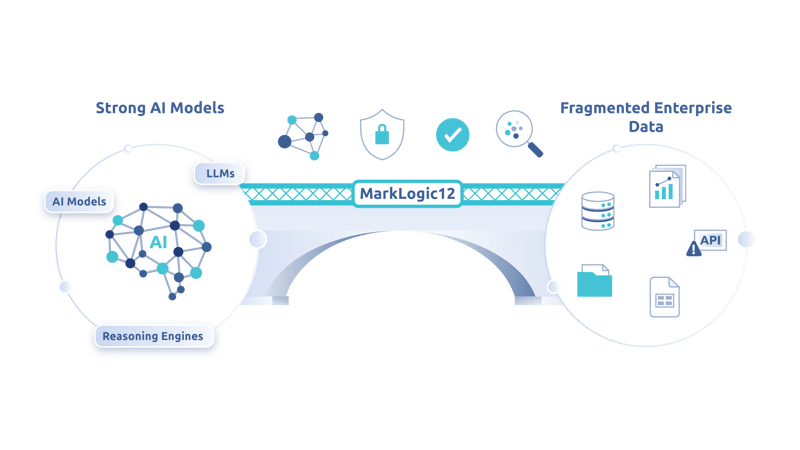
Most organizations face the same structural problems:
- Data is stored in silos, documents, databases, and APIs with no shared context
- Metadata is incomplete or manually maintained
- Relationships between entities are implicit, not explicit
- Permissions and lineage are difficult to enforce across AI pipelines
The result is that LLMs are forced to operate like powerful autocomplete engines, but blind to enterprise meaning, permissions, and intent.
Successful AI rollouts need context, structure, semantics, lineage, correct permissions and security model to produce reliable, explainable outcomes.
This is why many AI projects remain stuck at prototype stage.
Vector databases alone help with similarity search, but they lack semantics, governance, and enterprise-grade control for permissions and content security.
MarkLogic 12 is uniquely positioned to close this gap by unifying document and structured data, semantic triples and ontologies, vector search, and enterprise-grade security and lineage within a cloud-ready platform.
All in a single, integrated platform.
Vector features in MarkLogic 12: adding meaning to retrieval
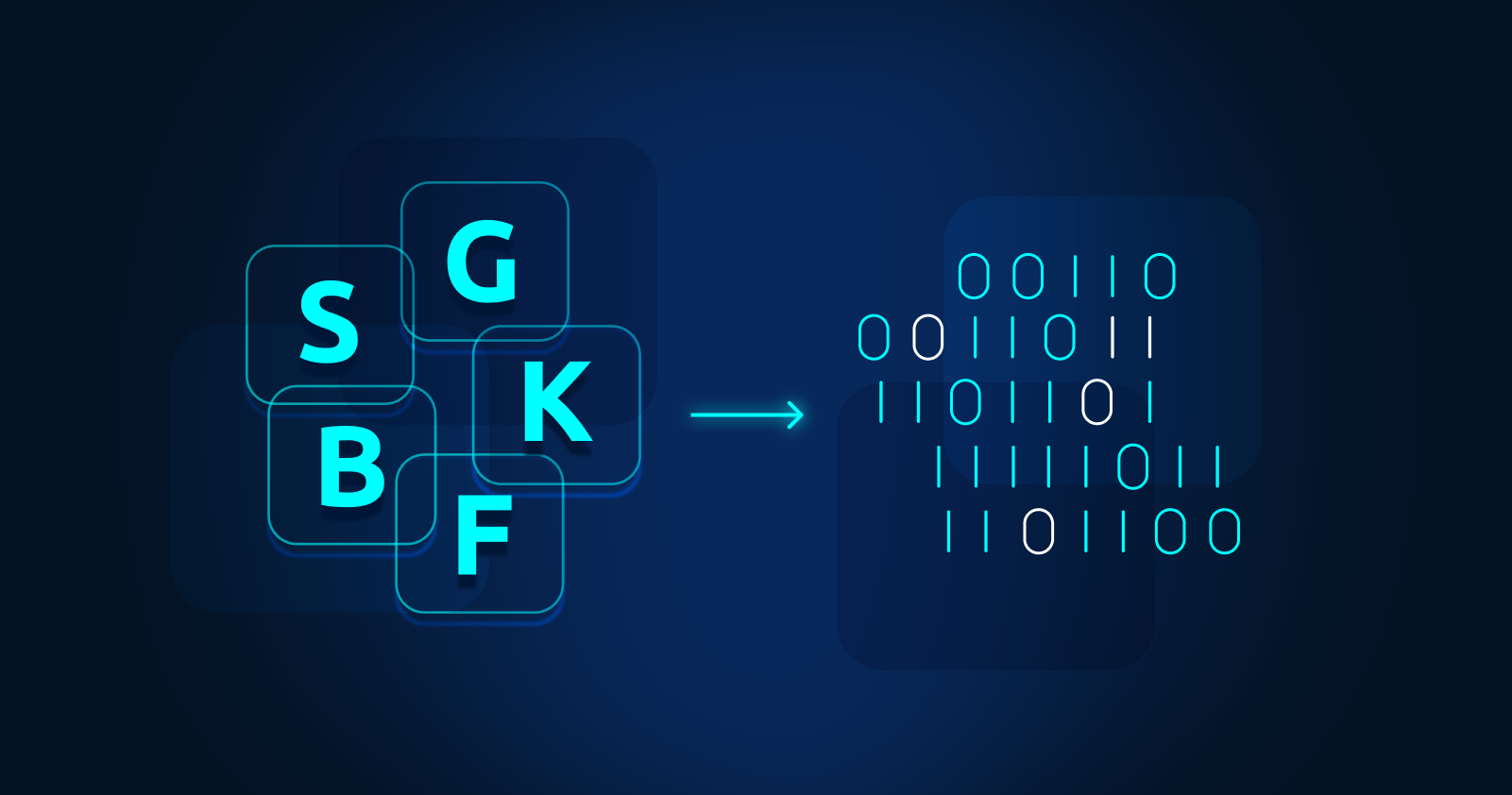
Traditional search matches keywords.
Vector search matches meaning.
%20Search.png?width=800&height=450&name=Keyword%20Search%20vs%20Semantic%20(Vector)%20Search.png)
In MarkLogic 12, vector search enables systems to retrieve content based on semantic similarity, not exact wording. This unlocks far more natural and intuitive interactions with enterprise data.
For example:
“Find products similar to this one”
“Retrieve regulations related to this paragraph”
“Show research papers conceptually related to this hypothesis”
What makes MarkLogic different is not just vector search itself, but how it is combined with semantic context and security.
With MarkLogic 12, vectors live alongside:
- Documents and structured data
- Ontologies and triples
- Fine-grained, role-based permissions
This means vector retrieval is:
- Context-aware
- Governed by enterprise security rules
- Explainable through linked metadata and entities
Unlike standalone vector stores, MarkLogic ensures that similarity-based retrieval remains trustworthy and auditable.
Vector databases optimize for similarity. Enterprises require similarity combined with semantic meaning, security enforcement, and policy-driven governance.
It also means that you can combine vector queries with traditional word based or index based searches and patterns.
GraphRAG: retrieval-augmented generation, but smarter
Traditional Retrieval-Augmented Generation (RAG) retrieves text fragments.
GraphRAG retrieves meaning, relationships, and context.
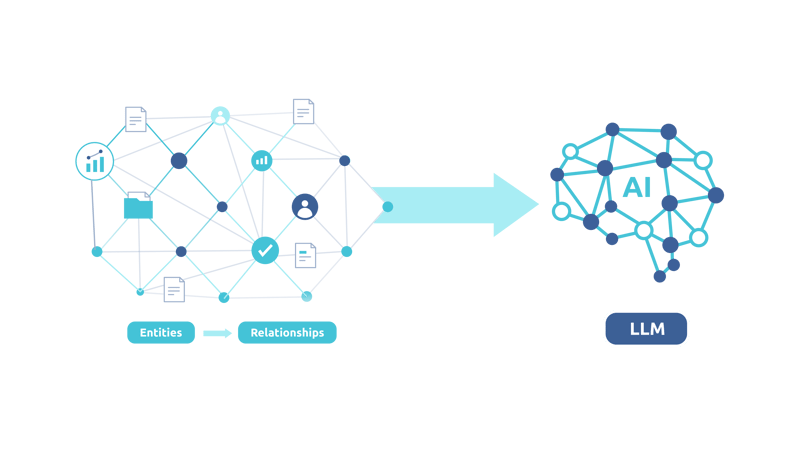
With GraphRAG, AI systems don’t just pull isolated chunks of content. They retrieve:
- Entities
- Relationships
- Hierarchies
- Connected facts
- Documents for rich content
- Triples and ontologies for explicit relationships
- Vectors for semantic similarity
MarkLogic enables this by combining:
This hybrid approach allows LLMs to reason over connected knowledge, not just text snippets. This is particularly important in regulated industries where relationships, dependencies, and traceability determine the accuracy and defensibility of AI-generated outputs.
Why this matters for enterprises?
- Life Sciences: Summarize connected clinical data, studies, compounds, and adverse events
- Financial Services: Trace relationships between transactions, customers, risks, and regulations
- Standards & Publishing: Navigate standards, clauses, references, and dependencies with context
Instead of hallucinated answers, GraphRAG grounded in MarkLogic delivers contextual, explainable responses backed by enterprise data.
Conversation memory and contextual reasoning
Most conversational AI systems are stateless.
They answer questions in isolation, forgetting prior interactions.
Enterprise use cases demand more.
MarkLogic 12 supports retrieval memory and contextual continuity, enabling AI systems to maintain awareness across multi-turn interactions.
Examples include:
- A compliance assistant that remembers previous regulatory questions
- A research assistant that builds understanding across sessions
- A customer support copilot that maintains case context across interactions
By leveraging semantic profiles, metadata, and governed retrieval, MarkLogic enables richer, more coherent agent behavior without compromising security or auditability.
This persistent, governed memory is what allows AI systems to behave like agents maintaining goals, context, and intent across interactions.
How MarkLogic 12 enables agentic AI workflows
Agentic AI requires more than an LLM.
It requires a data architecture that supports reasoning, action, and governance.
MarkLogic 12 enables this across four key layers (knowledge grounding, contextual retrieval, reasoning and task execution, governance and explainability) . Together, these layers form an AI-ready data architecture that supports autonomous reasoning without sacrificing governance.
1. Knowledge grounding
MarkLogic structures enterprise knowledge using semantic metadata, SKOS vocabularies, OWL ontologies, alongside harmonized documents and structured data. This ensures AI agents reason over trusted, explicit meaning rather than unstructured text.
2. Contextual retrieval
Agents retrieve the right context through a combination of vector search, graph traversal, and text and metadata queries. All retrieval is permission-aware, ensuring each response reflects both relevance and access control.
Agents retrieve the right context for the right user, every time.
3. Reasoning and task execution
Grounded in enterprise data, AI agents can generate insights, summarize complex information, support decision-making, and trigger downstream workflows - without detaching from source systems.
4. Governance and explainability
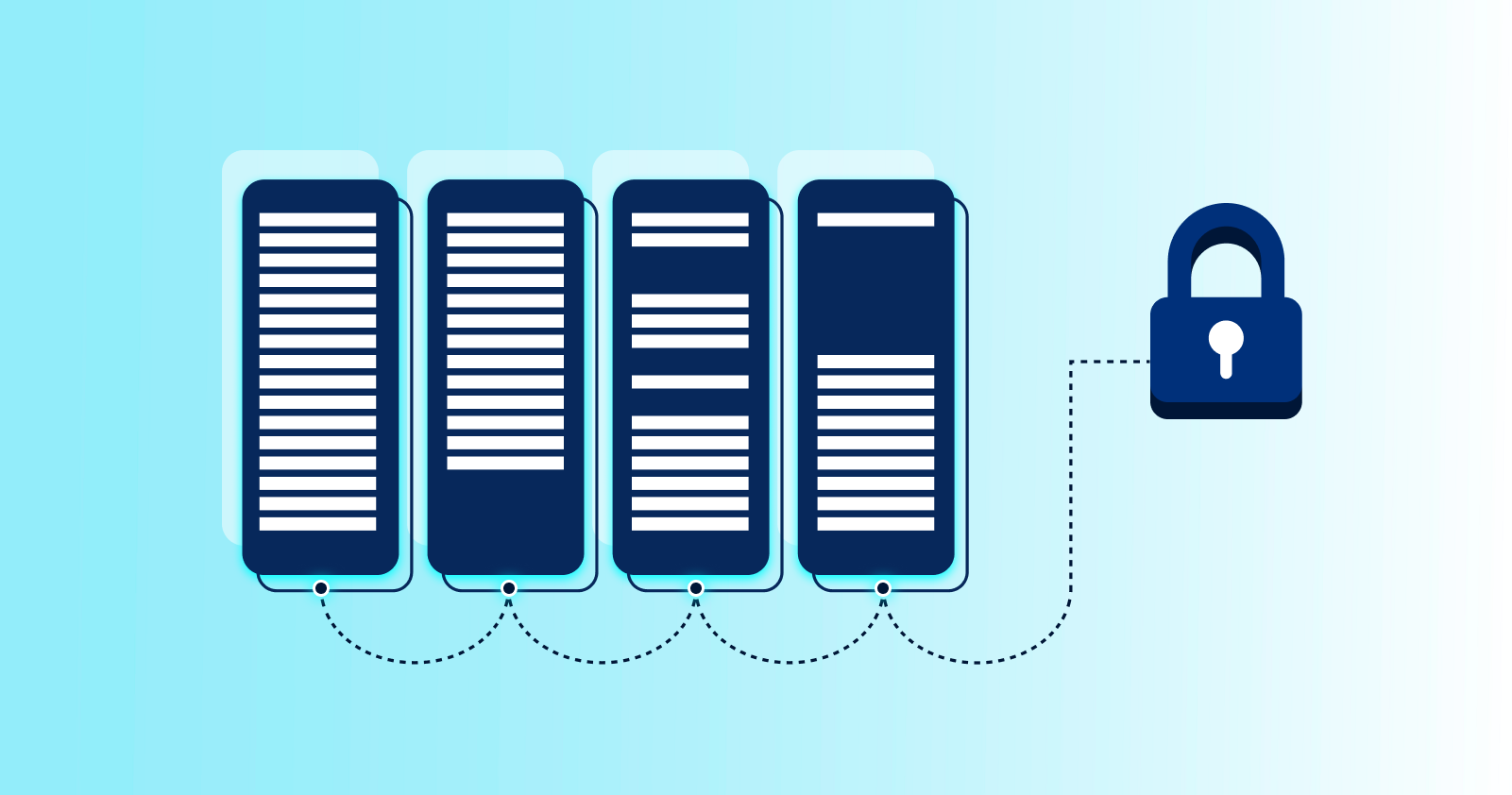
Every interaction is supported by audit trails, lineage, versioning, and security enforcement. These controls make agentic AI safe, explainable, and production-ready for regulated environments.
These capabilities are non-negotiable for enterprise AI adoption.
Real-world use cases with MarkLogic 12
MarkLogic 12 enables AI use cases that move beyond experimentation and into production by grounding AI systems in governed, contextual enterprise data.
- Semantic research and R&D copilots
Researchers can explore complex domains using natural language while AI systems reason over connected documents, entities, and relationships. This enables faster discovery, more accurate summarization, and traceable insights across studies, compounds, and findings. - Regulatory and compliance assistants
AI assistants can interpret regulations, trace obligations, and answer compliance questions using GraphRAG over governed content. Responses remain explainable, permission-aware, and auditable critical for regulated industries. - Intelligent enterprise search
Content-heavy organizations can deliver semantic search experiences that understand intent rather than keywords. Users find relevant information faster across documents, metadata, and relationships without navigating multiple systems. - Context-aware customer support and operations
Support and operations teams can use AI copilots that maintain case context across interactions, retrieve relevant history, and recommend next actions while respecting data access controls and audit requirements. - Standards and publishing platforms
AI-driven navigation, summarization, and cross-referencing of standards, clauses, and dependencies become possible through explicit semantics and relationship-aware retrieval, improving usability and trust.
Across all these use cases, the differentiator is not the AI model, it is the AI-ready data foundation that MarkLogic 12 provides.
Why now? Upgrading unlocks AI, not just maintenance
MarkLogic 10 cannot support vector search, GraphRAG, elastic cloud scaling, and conversation memory. Legacy versions slow innovation and limit AI adoption.
MarkLogic 12 is not just an upgrade. It is a foundation for enterprise AI.
To support your upgrade journey:
These resources help organizations move from legacy systems to AI-ready platforms with confidence.
Why Datavid?
Datavid is the most experienced and most awarded MarkLogic partner in the world.
- Progress MarkLogic EMEA Partner of the Year
- 60+ certified MarkLogic consultants
- 50+ successful enterprise upgrades
- Deep expertise in semantics, knowledge graphs, and AI readiness
Beyond platform expertise, Datavid brings deep experience in ontology engineering, metadata modeling, security architecture design, and enterprise migration strategy capabilities essential to successfully operationalize agentic AI.
As a long-standing strategic partner of Progress MarkLogic, Datavid collaborates closely on complex enterprise deployments, ensuring customers align platform capabilities with long-term AI strategy.
From upgrade strategy to AI enablement, Datavid helps organizations turn MarkLogic 12 into a business advantage, not just a technical milestone.
Conclusion: MarkLogic 12 is the AI layer enterprises have been missing
Enterprises don’t fail at AI because of weak models. They fail because their data is not structured, contextual, or governed enough to support intelligent systems at scale.
MarkLogic 12 changes this by unifying semantic intelligence, governed retrieval, and enterprise-grade control into a single AI-ready data foundation. It enables organizations to move beyond isolated pilots and deploy agentic AI that is explainable, secure, and production-ready.
For technology and data leaders, upgrading to MarkLogic 12 is not a maintenance decision, it is a strategic step toward enterprise AI readiness.
It represents a shift from managing data to activating intelligence across the enterprise.
 A complimentary evaluation to understand how MarkLogic 12 can support your AI roadmap.