
7 minute read
Quick answer:
Datavid is a strong fit for regulated enterprises that need data governance, semantic foundations, and AI-readiness delivered as one connected program, through a senior-led delivery model that can offer more continuity and flexibility than larger bench-based models. EWSolutions and First San Francisco Partners suit methodology-led or Collibra-centered programs; Protiviti, Centric Consulting, and Analytics8 tend to suit large-firm, mid-market, and analytics-led needs respectively.
Most "best governance consultant" lists are built for a general audience, which is exactly why they underserve a regulated enterprise. A firm that suits a mid-market retailer is not automatically the one you want defending your next audit in front of the FDA or a financial regulator.
For a CDO or head of governance at a 1,000-plus employee regulated business, the wrong partner is expensive twice: once in fees, and again in remediation when a program fails to hold up to scrutiny.
This guide filters explicitly for regulated needs. It sets out the criteria that matter in high-regulation environments, then evaluates six named firms against them, with an honest fit note for each rather than uniform praise.
At a glance
- Data governance consulting for a regulated enterprise should be judged first on regulatory depth: whether a firm understands the specific obligations you answer to, from GxP and 21 CFR Part 11 to MiFID II and BCBS 239, since generic advice often falls short under inspection.
- Industry specialization matters because a partner fluent in your sector's data, document volumes, and audit patterns spends less of the engagement learning your world and more of it solving your problem.
- Semantic and AI-ready capability is now part of the brief, since a partner who builds a semantic foundation on knowledge graphs, not just a policy binder, tends to save you a second project later.
- Delivery model shapes the engagement, with senior-led boutiques offering continuity and depth while large-firm bench models offer scale and brand.
- Flexibility and cost deserve scrutiny, because rigid, template-driven delivery can inflate cost without fitting your situation, and the value sits in a model that adapts to your maturity and urgency.
- Proven outcomes carry the most weight, because named results in regulated settings matter more than a capability list when governance is judged on whether it holds up when tested.
How to choose a data governance consulting partner
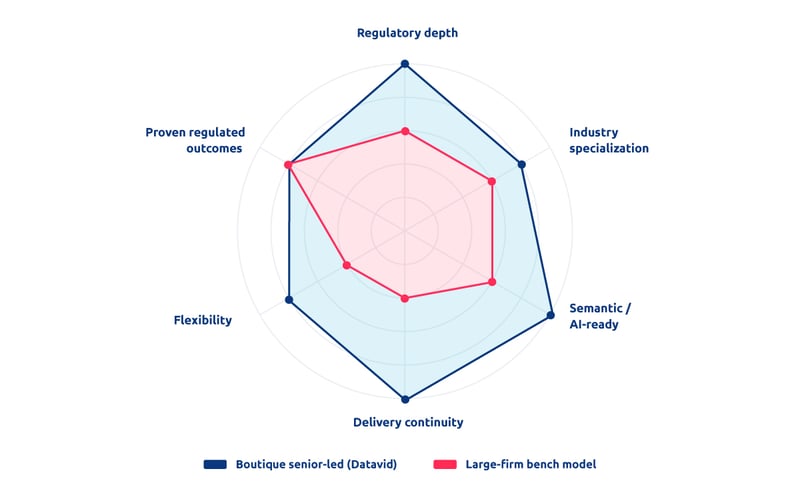
Before comparing firms, fix the criteria. These six double as the backbone of every evaluation below, and scoring your own shortlist against them is faster than reading a dozen capability decks.
Data governance consultants vary more than their marketing suggests, so the useful question is not who is "best" in the abstract but who is best for a regulated program specifically.
- Regulatory depth. Does the firm understand the specific obligations you answer to, from GxP and 21 CFR Part 11 in life sciences to MiFID II and BCBS 239 in finance? Generic governance advice rarely holds up in an inspection.
- Industry specialization. A partner fluent in your sector's data, document volumes, and audit patterns spends less of the engagement learning your world and more of it solving your problem.
- Semantic and AI-ready capability. Governance now has to feed AI. A partner who builds a semantic foundation on knowledge graphs, not just a policy binder, tends to save you a second project later.
- Delivery model. Senior-led boutiques and large-firm bench models produce very different engagements. One gives you continuity and depth; the other gives you scale and brand.
- Flexibility and cost. Rigid, template-driven delivery can inflate cost without fitting your situation. The value is in a model that adapts to your maturity and urgency.
- Proven outcomes. Named results in regulated settings matter more than a capability list, because governance is judged on whether it holds up when tested.
The payoff of scoring against these is a defensible shortlist you can take to procurement, rather than a gut call you have to relitigate later.
The best data governance consulting companies for regulated enterprises
The six firms below span the realistic options for a regulated program, from boutique specialists to large-firm generalists. Each of these data governance consulting firms is described from its own current positioning, with a fit note on where it lands for a regulated buyer.
|
Firm |
Best suited to |
Regulated-enterprise angle |
|
Datavid |
Governance plus AI-readiness as one program |
Semantic foundations, senior-led, regulated-industry delivery |
|
EWSolutions |
Methodology-led governance and stewardship programs |
G3sm methodology, AI-governance framing |
|
First San Francisco Partners |
Collibra rollouts and data-management foundations |
Cross-industry positioning; ask about your sector |
|
Protiviti |
Large enterprises wanting global-firm scale |
Tool-agnostic, large-firm resourcing |
|
Centric Consulting |
Mid-market, adoption-focused governance |
Agile approach; stated mid-market focus |
|
Analytics8 |
Governance delivered alongside analytics and BI |
Vendor-neutral, healthcare and HIPAA experience |
Datavid
Datavid homepage highlighting its AI-ready data solutions and integration with CSI.
Datavid focuses on regulated, knowledge-intensive enterprises in life sciences, financial services, and publishing, pairing data governance with semantic and AI-ready delivery rather than treating them as separate projects.
The differentiator is a governance layer built on ontology management and graph structure, which makes data explainable and traceable, the properties an AI program and an auditor both demand. Delivery is senior-led, with experienced consultants rather than a junior bench.
Fit note: a strong fit for a regulated enterprise that wants governance and AI-readiness solved together and values continuity of senior people. A buyer who specifically wants the scale and brand of a global firm may prefer one of the larger consultancies below.
EWSolutions
EW Solutions homepage highlighting its enterprise data and AI governance programs.
EWSolutions is a methodology-led governance specialist with a long track record, built around its G3sm data governance and stewardship methodology and an AI-governance framing.
Fit note: a strong choice for an enterprise that wants a documented methodology and stewardship depth. Its framing leans toward structured program-building, so it suits buyers who value rigor and repeatability over a lighter-touch engagement.
First San Francisco Partners

First San Francisco Partners homepage highlighting its trusted AI and collaborative data governance services.
First San Francisco Partners is a long-standing information-management consultancy, known for Collibra implementation and adoption alongside data quality, MDM, and metadata work, now with an added focus on AI enablement.
Fit note: a good fit if your program centers on a Collibra rollout or on data-management foundations such as data quality, MDM, and metadata. Its positioning is cross-industry, so it is worth asking about experience in your specific regulatory setting.
Protiviti
Protiviti Enterprise Data Governance page outlining its approach to trusted, well-controlled data and governance frameworks.
Protiviti offers enterprise, tool-agnostic data governance backed by large-firm resourcing and a broad global consulting footprint.
Fit note: well suited to a large enterprise that wants the scale, bench depth, and brand assurance of a global consultancy. Buyers who prioritize a smaller, senior-led team may want to compare delivery models directly.
Centric Consulting

Centric Consulting Data Governance page highlighting better data management and improved decision-making.
Centric Consulting builds governance programs from strategy and assessment through to structure, with an agile, minimally invasive approach and a Chief-Data-Officer-as-a-Service offering, oriented largely toward mid-market organizations.
Fit note: a sensible option for a mid-sized organization wanting pragmatic, adoption-focused governance. Larger or heavily regulated enterprises should confirm scope and scale fit early, as with any partner whose stated focus is the mid-market.
Analytics8
Analytics8 homepage highlighting its data strategy, modernization, and operational AI services for measurable business value.
Analytics8 is a vendor-independent data and analytics consultancy with roughly two decades of experience, favoring a "just enough," business-first approach to governance and notable healthcare and HIPAA experience.
Fit note: a strong fit where governance sits alongside an analytics or BI program and you want tool-neutral advice. Its "right-fit" philosophy suits incremental maturity building rather than a heavyweight, audit-driven governance overhaul.
Data governance in regulated industries: what's different
Regulated environments demand things a general governance program rarely has to deliver, and this is where the criteria above earn their weight.
Three demands separate regulated governance from the generic kind. Each one is a place where a weak program costs real money.
- Audit readiness on demand. Regulators and auditors expect evidence produced quickly, not reconstructed over weeks. Governance that captures lineage and approvals as it runs turns audit prep from a fire drill into a query.
- End-to-end data lineage. In a regulated submission or a financial report, you have to show where every figure came from and how it was transformed. Lineage tends to be the difference between a defensible filing and a finding.
- Data integrity standards. Frameworks like ALCOA+ in life sciences set explicit expectations for how data is recorded and preserved. Governance has to encode those expectations, not just describe them.
There is a volume dimension too. Regulated enterprises tend to sit on large document and content estates, and governing those at scale is a data engineering problem as much as a policy one. The reader benefit of getting this right is direct: lower audit cost, fewer findings, and less exposure when a regulator does come calling.
Why regulated enterprises choose Datavid
Measured against the six criteria, the case for Datavid rests on treating governance and AI-readiness as a single build rather than two sequential projects.
The model is boutique and senior-led: experienced consultants, graph and metadata depth, and delivery experience in regulated life sciences, finance, and publishing, with a cost structure that differs from large-firm bench models and is best compared on total delivered outcome. Governance built this way tends to produce data that is not only compliant but explainable, which is what an AI initiative usually needs next.
The ABN AMRO trade data hub is a concrete example in a heavily regulated setting. Fragmented trade data across legacy systems made MiFID II compliance, which expanded mandatory reporting fields from around 20 to over 65 per transaction, a full-scale data problem. Datavid extended the bank's TradeStore with automated workflows, semantic enrichment, and end-to-end traceability.
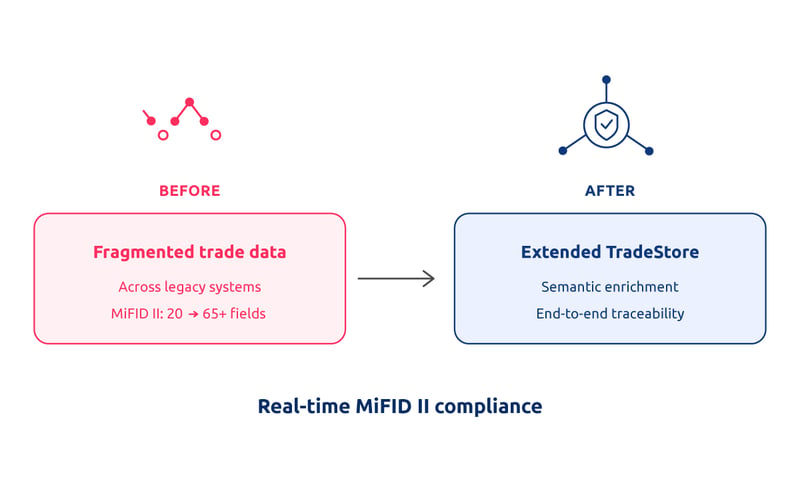
Read the outcome as a governance leader would: the bank reached real-time MiFID II compliance, cut manual effort through straight-through processing, and gained a scalable hub ready for future regulations.
Lineage and traceability built into the foundation are what let a bank answer, on demand, where a reported number came from. That is the difference between governance as documentation and governance as infrastructure in day-to-day terms.
Regulated buyers weighing options can assess their governance and AI readiness before committing to any partner.
Shortlist Datavid for your governance program
Datavid is a strong fit for regulated enterprises that need governance, semantic foundations, and AI-readiness delivered as one connected program, with senior-led continuity and delivery experience in life sciences, finance, and publishing.
If your governance program has to satisfy an auditor and feed your AI roadmap at once, that combination is worth weighing against the larger and more specialized firms above.
Assess whether your governance foundation is ready for regulated AI.
Datavid can help you map your current state across lineage, governance, semantic readiness and delivery priorities, so your shortlist decision is based on evidence rather than sales decks.