

6 minute read
Quick answer
An enterprise ontology can be developed top-down, bottom-up, or by reusing an existing ontology . Top-down approaches start with business requirements and domain knowledge, while bottom-up approaches build on existing data and structures. Ontology reuse involves assessing ready-made open-source or commercial ontologies for direct use, extension, or partial reuse.
Combining these approaches helps align business needs with available data, identify gaps, and create a relevant, interoperable model.
As organizations invest in knowledge graphs, semantic technologies, and enterprise AI, connecting data across systems is only the starting point. They also need a consistent way to define business concepts, establish relationships, and interpret information.
Choosing the right starting point is key: should you begin with business requirements, existing data, or an established ontology that may already address your needs?
This blog compares the three approaches: top-down, bottom-up, and ontology reuse, showing how they can be combined to create ontologies aligned with business goals.
What does building an enterprise ontology involve?
An enterprise ontology provides a structured representation of concepts within a business domain and the relationships between them. It establishes a shared understanding of business entities, their properties, and how they connect across the organization.
Developing an ontology involves defining the domain and its scope, identifying key concepts and terminology, establishing relationships, and specifying the attributes and constraints associated with these concepts and terms. The resulting model must also be validated against business requirements and mapped to enterprise data.
At Datavid, a C5i company, our ontology management solutions support enterprise ontology development through two complementary approaches. Semantic5i (formerly Datavid Rover) acts as an implementation accelerator, helping bootstrap an ontology alongside Datavid's expert services.
Datavid also implements ontologies using partner tools such as Progress Semaphore and Graphwise Graph Modeling, choosing the approach that best fits each organization's business needs and technology landscape.
How these elements are identified and organized depends on the starting point. Two established approaches offer different perspectives.
Top-down ontology development starts with the business domain rather than existing data structures. Domain experts, business stakeholders, and knowledge engineers identify key concepts, establish common terminology, and define relationships based on business operations.
Competency questions, questions the ontology is expected to answer, help define its scope and identify the concepts, properties, and relationships to represent. Semantic5i also uses this approach to support and automate aspects of ontology development.
For example, in a pharmaceutical organization, the process might begin with concepts such as compounds, clinical studies, research programs, and scientific evidence. The team defines their relationships before mapping them to available information sources.
The main advantage is business alignment. Domain expertise helps establish consistent terminology and a conceptual structure that reflects how different functions understand and use information. It also provides a foundation for multiple applications and knowledge graph use cases.
However, the model must be validated against available enterprise data. Otherwise, it risks becoming too abstract, describing concepts and relationships that existing information cannot support.
Top-down modeling is particularly useful when business requirements are clear, domain expertise is available, or an organization needs a shared conceptual foundation across functions.
The bottom-up approach: starting with existing data
Bottom-up ontology development begins with the data an organization already holds, including database schemas, metadata, information models, and existing system structures. Examining these sources helps identify recurring entities, attributes, relationships, and patterns that inform the ontology.
For instance, an organization integrating customer information across CRM, finance, and service management systems may find that each represents customers differently. Analyzing these structures alongside relevant business documents can reveal common entities, overlapping attributes, and relationships that require reconciliation.
This approach grounds ontology development in available information. It is particularly useful in complex enterprise environments where data is distributed across legacy systems and multiple platforms. It can also expose inconsistencies and opportunities for integration.
However, existing data does not necessarily represent the complete business picture. Systems may contain inconsistent definitions, historical assumptions, or structures shaped by application-specific requirements. Building an ontology solely around these structures risks reproducing existing inconsistencies rather than establishing a shared understanding of the business.
Bottom-up modeling is particularly useful when organizations have substantial existing data, complex legacy environments, or limited visibility into how information is structured across systems.
Top-down vs. bottom-up: which approach should you choose?
The top-down and bottom-up approaches differ in where they begin and what they prioritize. Top-down development starts with domain experts and business requirements, making it strong in business alignment and useful for new domains or strategic business models. However, it requires mapping to available data later and can become too abstract.
Bottom-up development starts with databases, metadata, and existing information structures, making it useful for legacy integration and complex data environments. Its main strength is its ability to reflect existing data realities, but it relies heavily on available data and may inherit inconsistencies from legacy systems. Ultimately, the right approach depends on the organization's business requirements, data maturity, and available expertise.
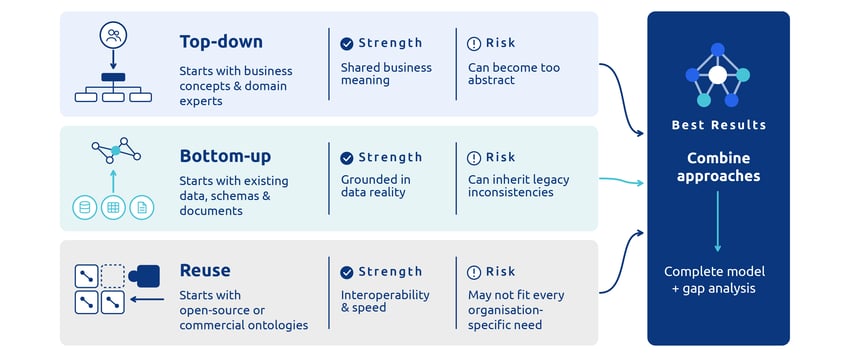
While combining top-down and bottom-up approaches helps align business understanding with existing data, these are not the only options. Organizations can also evaluate existing industry ontologies to determine whether they can provide a suitable starting point.
When should you reuse an existing industry ontology?
Developing an ontology from scratch is not always necessary. Organizations should first assess whether an established industry standard or domain ontology provides a suitable foundation.
Standard ontologies offer established terminology, concepts, and relationships within particular domains. Reusing or extending one can reduce duplication and support consistency, particularly when interoperability with external organizations, data providers, or other systems is important.
For example, organizations in regulated or specialized industries may need to exchange information with external partners using shared definitions. An established standard can provide a common foundation for this exchange.
However, industry standards may not address every organization-specific requirement. They can be extended where necessary to accommodate additional concepts while retaining alignment with their established foundations.
Industry-standard reuse is therefore another important option to evaluate alongside top-down and bottom-up development.
Why a hybrid approach works best
In complex enterprise environments, combining top-down and bottom-up approaches helps bridge the gap between business understanding and technical reality.
Rather than developing a conceptual model in isolation or relying entirely on existing data structures, organizations can move between business requirements and data evidence throughout the development process.
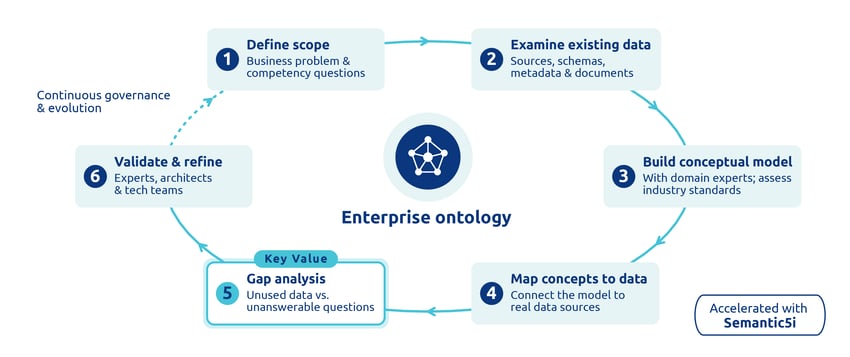
A practical methodology involves six steps:
1. Define the business problem and scope
Identify the business competency questions the ontology needs to answer. Establish the domain, intended scope, and expected outcomes before beginning detailed modeling.
2. Examine existing data
Review available data sources, schemas, metadata, information structures and business documents.
3. Develop an initial conceptual model
Work with domain experts to establish key concepts, terminology, and relationships. Where appropriate, assess whether an existing industry standard can provide a foundation.
4. Map business concepts to available data
Connect the conceptual model to actual data sources.
5. Conduct a gap analysis
Comparing business requirements with available data helps identify two important situations: valuable information that exists but is not being used, and business questions that cannot be answered because the required information is missing, inaccessible or fragmented.
For example, an organization may hold customer information across multiple systems but have no connection between those records and its sales or service processes.
This analysis helps distinguish whether the challenge lies in the ontology, data availability, information connectivity, or business requirements.
6. Validate and refine the ontology
Bring domain experts, data architects, and technical teams together to validate the model. Resolve inconsistencies, refine relationships, and extend the ontology as new requirements emerge.
Ontology development should not be treated as a one-time exercise. Ongoing validation and governance are necessary as business requirements, data sources, and applications evolve.
A hybrid approach is particularly useful when both business concepts and data evidence need to shape the model. However, where a domain is well understood, or a suitable industry standard already exists, another starting point may be more efficient.
Automating ontology development with Semantic5i
Applying an ontology development methodology across complex enterprise environments can be resource-intensive. Analyzing information, identifying concepts, establishing relationships, and validating models requires both domain knowledge and technical expertise.
With Semantic5i (formerly Datavid Rover), Datavid automates the ontology development methodology described in this article using Large Language Models (LLMs). This helps streamline the process by integrating business understanding with existing data structures through LLM-powered automation.
Automation does not eliminate the need for domain expertise or validation. Business stakeholders and technical teams remain essential to ensuring that the resulting model reflects organizational requirements and intended use cases.
Organizations can also explore Datavid's knowledge graph services and solutions to understand how semantic models and connected data can support enterprise knowledge initiatives.
Where should enterprises start?
For organizations planning an enterprise ontology initiative, the starting point should be a clearly defined business problem rather than an attempt to model the entire enterprise.
Begin with a manageable business domain, involve both domain and technical experts, and assess the information already available. Evaluate established standards where interoperability matters, and establish governance to define ownership, validation, and ongoing maintenance.
Building an ontology that connects business meaning with data
Top-down development brings business meaning into the model. Bottom-up development grounds it in existing information structures. Industry standards offer another starting point where domain alignment and interoperability matter.
For many complex enterprise initiatives, an iterative combination of these approaches can help identify gaps, validate assumptions, and build a model that evolves with business requirements.
The objective remains the same: creating connected enterprise knowledge that supports consistent data interpretation, knowledge graph development, and enterprise AI applications.
Explore how Datavid can help your organization build connected, AI-ready enterprise knowledge through effective ontology development.