

9 minute read
Quick answer:
Real ROI from generative AI banking initiatives is the return you can attribute to a specific decision, defend to an auditor, and reproduce across your portfolio. Most banks are past the pilot stage and now need to prove aggregate value across three areas: cost, revenue, and risk. The measurement gap that trips up most programs is not a missing metric. It is a data foundation that cannot trace AI outputs back to their sources.
Many banks have moved beyond asking whether generative AI can work in pilots and are now asking what it returns in production. They are asking what it returns, and whether that return holds up when someone senior asks for evidence.
For a Chief Data Officer, that question lands differently than it does for a line-of-business head. You are the one who has to stand behind the numbers when model risk, internal audit, or a regulator asks how a figure was produced.
This article gives you a three-dimensional framework for measuring that return, the KPIs that hold up in a CFO conversation, and the reason so many ROI numbers quietly fall apart the moment they are examined. The through-line is simple: how well you can measure AI value depends on how well you can trace it.
At a glance
- Measuring generative AI banking ROI starts with a single discipline: report only the value you can trace to the source, and treat everything else as a forecast.
- Traceability is the hidden variable in AI ROI, because a number attached to an output that no one can trace is an estimate rather than a measurement.
- AI investments pay back on three different clocks, so operational automation, risk decisioning, and revenue generation each need their own business case and evidence type.
- The KPIs that matter to a CFO are cost-to-serve per case, approval uplift at constant default rates, and the share of AI decisions with a full audit trail.
- GraphRAG can ground AI outputs in a governed knowledge graph context, making it easier to connect claims, sources, and decisions in an auditable way.
- Defensible ROI depends on a connected system of governed data, clear objectives, reliable evaluation, human oversight, and ongoing monitoring, not on any single technology.
- Four pitfalls erode measurable return: ungoverned point solutions, model metrics that mask business outcomes, governance bolted on late, and pilots mistaken for production.
Why traceability is the hidden variable in generative AI banking ROI
Most ROI debates in banking focus on which metrics to track. The harder problem sits underneath: whether the outputs being measured can be traced back to trusted source data at all.
A bank can only measure the ROI of decisions it can attribute to specific data, specific reasoning paths, and specific policies. When an AI output cannot be traced, the number attached to it is an estimate dressed up as a measurement.
That distinction is what separates a defensible business case from a hopeful one. It also explains why the audience for this question keeps widening.
The Chief Data Officer owns the number, but a Model Risk Lead has to validate it, an AI Governance Lead has to evidence it, an Enterprise Architect and Data Architect have to build the systems that produce it, and a CFO stakeholder has to accept it into a budget. Each of them is asking a version of the same question: where did this come from?
Traceability is not the only factor affecting AI ROI. Model quality, workflow design, adoption, and change management all move the number. What traceability does is determine whether the number can be believed. It supports four things senior data leaders need at once:
- Reliable performance measurement, because a baseline and a result mean little if you cannot confirm they were produced from the same governed inputs.
- Accountability, because a decision with a source trail can be reviewed, challenged, and corrected by a named owner.
- Regulatory confidence, because examiners increasingly want to see lineage rather than a summary of intent.
- Defensible ROI calculations, because the finance team can audit the arithmetic back to the data rather than accepting it on trust.
Three ways banks should frame AI ROI
AI initiatives in banking do not deliver ROI on a single timeline, and treating them as if they do is where most measurement programs go wrong. Grouping investments by payback profile lets you build separate business cases instead of averaging clean wins against slow-burn bets.
For a data leader defending a portfolio, that separation is what turns a vague AI budget line into a defensible set of investments.
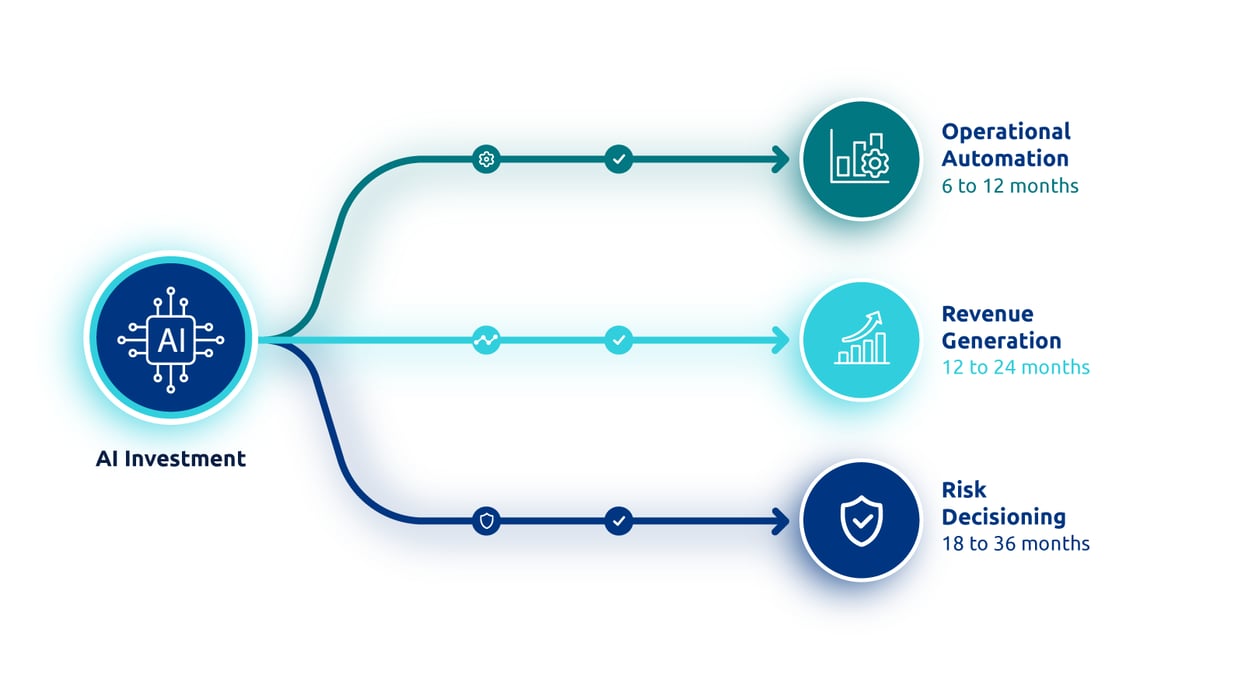
Three dimensions cover most of what a bank deploys.
- Operational automation delivers the fastest payback with the cleanest attribution, because you can measure the work before and after.
- Risk decisioning runs the longest cycle but produces the highest-value evidence, since better decisions compound across the book.
- Revenue generation is the hardest to attribute cleanly, because uplift is tangled up with market conditions and customer behavior.
|
Dimension |
Typical payback window |
Primary value driver |
Attribution difficulty |
Evidence type |
|
Operational automation |
6 to 12 months |
Cost removed per case |
Low |
Before-and-after process cost |
|
Risk decisioning |
18 to 36 months |
Losses avoided, better selection |
Medium |
Portfolio performance over time |
|
Revenue generation |
12 to 24 months |
Incremental share of wallet |
High |
Controlled uplift versus baseline |
Each dimension needs its own measurement discipline, and each depends on being able to trace its evidence back to the source. A single AI ROI number that averages across all three tends to hide more than it reveals, and it leaves you unable to say which investments actually earned their keep.
Sound data analytics consulting starts by separating these clocks before any number gets reported upward.
Key KPIs to track across the three dimensions
The framework tells you how to group investments. This section tells you what to actually measure inside each group. The reader here wants concrete KPIs, not a taxonomy lecture, so what follows is organized to match the three dimensions above and kept to metrics a Chief Data Officer can defend to a CFO stakeholder without hedging.
Cost reduction and operational efficiency KPIs
Operational KPIs are where generative AI finance use cases show their fastest, cleanest return. These are the numbers that tend to survive scrutiny, because the baseline is measurable and the change is visible in a workflow.
- FTE hours redirected from routine document processing, such as KYC, AML remediation, credit memos, and invoice extraction, into higher-value work.
- Reduction in cost per case for dispute resolution, onboarding, and servicing workflows.
- Straight-through processing rate for your top three highest-volume workflows.
- Reduction in vendor spend as AI absorbs work previously outsourced.
The return here is time recovered, not headcount removed. Much of that time is lost today to data silos that force people to hunt across systems for information that already exists. Clean data integration is what moves these numbers and makes them traceable once they do.
Revenue and decision-quality KPIs
Revenue KPIs need a quality metric alongside them, or speed gains end up masking credit deterioration. The discipline here is pairing every velocity number with a portfolio-health number.
- Approval rate uplift at constant or improved default rates, especially in thin-file and small business lending.
- Cross-sell conversion for AI-surfaced next-best-action recommendations, tracked as incremental share-of-wallet growth per segment.
- Time-to-yes for underwriting decisions, paired with a portfolio quality metric, so faster does not mean loser.
- Advisor productivity in wealth and private banking, measured as meaningful client interactions per advisor per week.
Risk, compliance, and trust KPIs
For a Chief Data Officer in a regulated bank, this is often the dimension that justifies the whole program. These are also the KPIs a Model Risk Lead and an AI Governance Lead will be asked to stand behind, because they measure whether your AI can be trusted under examination.
- Percentage of AI-driven decisions with a full traceable audit trail from output back to source data.
- Reduction in false positives in fraud and AML monitoring, tracked alongside false negative rates.
- Time to respond to regulatory data requests where AI-assisted retrieval is in play, covering MiFID II reporting, Basel disclosures, and SR 11-7 or SS1/23 model documentation.
- Model risk incidents are avoided, flagged early, or overturned after human review.
These KPIs are only as reliable as the data underneath them. A bank that has built audit-ready traceability for MiFID II reporting can report that last set of numbers with more confidence, because AI-assisted answers connect back to governed source data rather than a black box.
How traceable AI outputs turn into defensible ROI
Traceability is the argument, but it has to be built. It is produced by a stack of deliberate choices about how data is modeled, connected, and governed, and each choice makes the resulting ROI number easier to defend. No single component does this on its own.
This is where the underlying retrieval architecture matters more than most ROI conversations admit. Standard RAG retrieves text chunks and produces a plausible answer, but it cannot always show you why that answer is correct. GraphRAG services can ground outputs in a governed knowledge graph, exposing the entities, relationships, and sources used to reach a conclusion.
That makes ROI evidence easier to audit at the claim level rather than only at the report level. It is a stronger foundation, not a guarantee of accuracy, and it still depends on the quality of the graph beneath it and the review process around it.
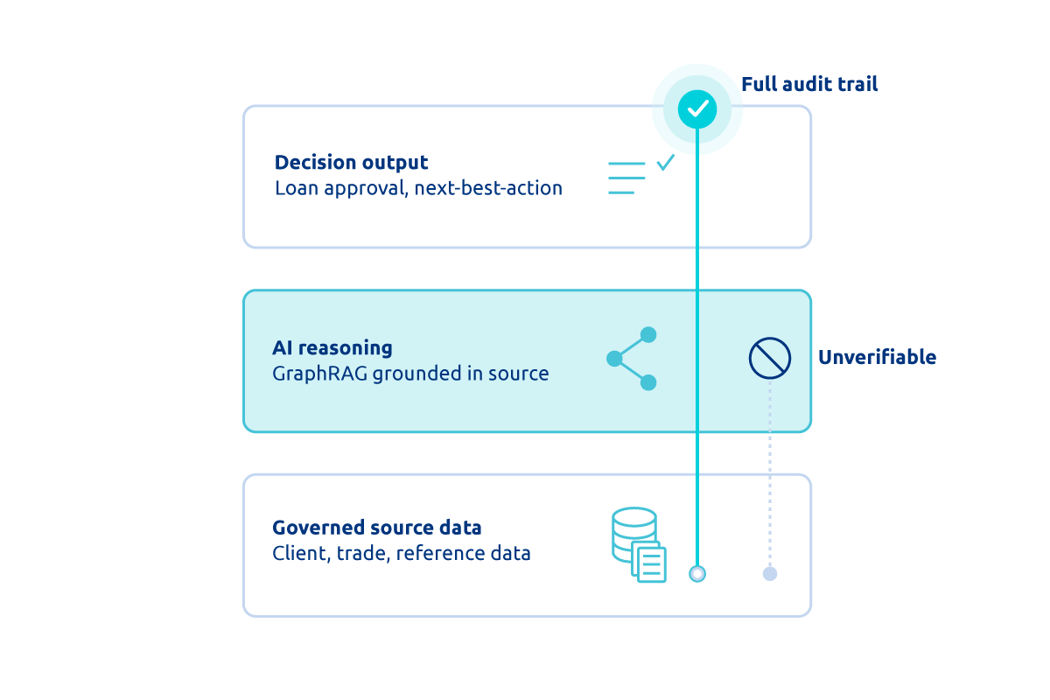
A knowledge graph and semantic layer for AI readiness is what helps turn an AI output into evidence rather than an assertion. This is the pattern behind the ABN AMRO regulatory trade data hub. The bank needed to consolidate client, order, trade, and reference data out of siloed systems, meet expanded MiFID II obligations across EU and post-Brexit UK jurisdictions, and give auditors real-time access with full traceability.
The solution extended the bank's existing TradeStore hub with smart ingestion, semantic enrichment using metadata and RDF triples, and granular capture of every action from ingestion to reporting to re-reporting. The result was daily MiFID II compliance across all entities, straight-through processing with minimal manual intervention, and end-to-end audit trails.
That is what defensible looks like: not just a working system, but a system whose outputs can be traced back to the source.
Banks that skip the semantic foundation may struggle to separate measurable ROI from estimated value. They are often measuring output volume and hoping the accuracy holds, and that gap tends to widen the moment a regulator or a model risk team asks for evidence. Building that foundation is the real work of enterprise data management, and it is easier to do before the first use case ships than after an audit finding forces it.
Grounding ROI in a governed data foundation
Proving AI ROI takes more than a retrieval architecture. It requires a connected system: governed data, clear business objectives, reliable evaluation methods, traceable outputs, human oversight, and ongoing performance monitoring.
Weakness in any one of them undermines the credibility of the number at the end. This is the layer most ROI conversations skip, and it is the layer that decides whether the metrics above hold up.
A few foundations matter more than the rest:
- A shared semantic model, often anchored in ontology management, so that "counterparty" or "exposure" means the same thing to every system and every AI agent that queries it.
- Consolidated storage through a data warehouse or content lake, so answers are drawn from one governed source rather than reconciled across copies.
- Embedded data governance that carries lineage and access rules into every answer, which is what helps make an output auditable by default.
- Human oversight and evaluation, because a traceable answer still needs a reviewer who can confirm it applies, and a monitoring loop that catches drift after go-live.
The same principle applies across industries. At the American Chemical Society, a governed content lake created a single authoritative source across decades of structured and unstructured content, improving search while reducing storage and processing costs. Govern the knowledge first, and measurable gains become easier to prove.
Four pitfalls that quietly erode measurable ROI
Most ROI leakage is not dramatic. It happens quietly, through architecture and process choices that look reasonable at the time and only show their cost when someone tries to prove value. Each of the four below ties back to the same root: the harder it is to trace a decision, the harder it is to prove its return.
1. Building point solutions on ungoverned data
Every new AI use case that rebuilds its own integration path adds a fresh attribution problem. Without shared semantic infrastructure, it becomes difficult to compare ROI across use cases, because the underlying data models are different every time. A shared data architecture is what makes cross-use-case comparison practical for an Enterprise Architect or Data Architect.
2. Measuring model performance instead of business outcomes
Accuracy and latency dashboards do not translate into a CFO conversation. ROI evidence needs cost-to-serve per case, origination cost per funded loan, and share-of-wallet growth per segment. A model that scores well on a technical benchmark can still fail to move a single number the finance team cares about.
3. Retrofitting governance after deployment
Every audit finding, rollback, or remediation cycle consumes months of accumulated return. Governance built into the semantic layer from the start can reduce repeated compliance efforts across use cases. Retrofitting is usually more expensive than it looks, because it competes with the ROI the system was supposed to generate.
4. Confusing pilot velocity with production ROI
Pilots run on clean data, curated prompts, and human oversight. Production runs on messy data, edge cases, and real volume. ROI that does not survive that transition was never real ROI, and mistaking one for the other is a common way a promising program loses credibility with the board.
Where to start: building a defensible ROI foundation
Measurable AI ROI in banking keeps coming back to one question: Can you trace the outputs, decisions, and insights your models produce back to trusted source data? Everything else is downstream of that. For a Chief Data Officer, the first move is usually not another pilot.
It is an honest look at whether your data foundation can support a number you would be willing to defend in front of model risk, audit, and finance.
That is the work behind governed knowledge graphs, semantic models, and a GraphRAG architecture that helps make AI outputs auditable.
Assess whether your data foundation can support defensible AI ROI measurement.