

5 minute read

A digital asset, on its own, is almost worthless. A logo, a product shot, a campaign video. None of it means much until you know what it represents, where it ran, who it was built for, and whether it actually moved the needle.
That context is the value. And here is the uncomfortable truth: I have watched play out across dozens of organizations, most digital asset management (DAM) systems manage the asset beautifully and barely manage the context at all.
That gap is rarely the platform's fault. It comes down to the quality and structure of the data feeding the DAM, and whether that data is shared across the rest of the business or trapped in a single tool.
I want to walk through both sides of that problem, because they are usually treated separately when they are really the same issue: a DAM is only as good as the data around it, upstream and downstream. Fixing that is what a real DAM data strategy is about.
The promise, and the reality
On paper, DAM platforms do exactly what marketing teams need. They centralize assets, speed up search, maintain brand consistency, encourage reuse, and feed omnichannel campaigns.
In practice, the story I hear is different. Metadata is inconsistent or half-finished. Search returns the wrong thing, or nothing. Adoption is low because people give up and just email files back and forth. Nobody can tell which assets are performing, and connecting any of it back to business outcomes feels impossible.
It is tempting to blame users or a rushed rollout. But those symptoms almost always trace back to something deeper: disconnected, poorly structured data on both ends of the DAM.
The missing layer upstream
Assets do not live in a vacuum. Every one of them ties back to a product, a campaign, a customer segment, a region, or a channel. That information already exists in your business, just somewhere else. It is sitting in your PIM, your CRM, your marketing automation platform.
When that upstream data is not modeled, governed, or connected to the DAM, cracks show up fast. Metadata stays manual and inconsistent. Taxonomies drift apart between systems. Search gets unreliable, and reporting loses its context.
A simple example. If “campaign” means one thing in your DAM and something slightly different in your marketing platform, the same asset gets tagged two ways, reused in the wrong place, and measured against the wrong numbers. Multiply that across thousands of assets, and you have a system that stores everything and tells you nothing.
This is exactly where a semantic data foundation earns its keep: it provides every system with a consistent definition of what things mean and makes the DAM's data usable by both people and AI.
The value most teams leave on the table downstream
We spend a lot of energy talking about feeding the DAM better data. We talk far less about letting the DAM feed everything else. That is the half of a DAM integration strategy that usually gets skipped.
Your assets and their metadata carry a real signal: how campaigns are executing, which content is actually getting used, how channels are performing, and where customers are engaging.
When that data stays locked inside the DAM, your marketing systems cannot see which assets are in play, your customer experiences drift away from your content strategy, and your analytics team has no way to tie assets to results.
Open that data up, and the picture changes.
Personalization and content delivery platforms get richer context to work with.
Marketing automation can select and optimize assets on the fly. Your analytics environment finally provides a single view of content, campaigns, and outcomes. The DAM stops being a warehouse and starts being an active part of the stack.
From metadata to meaning
To get both ends working, you have to move past basic tagging and toward a unified semantic layer. I know “semantic layer” sounds like a slide from a vendor deck, so let me be concrete about what it does.
It gives you one agreed definition of your core business entities, your products, campaigns, and customers. It standardizes how those entities relate to each other. It shares taxonomies and hierarchies across systems instead of letting each tool invent its own. And it gives both humans and machines a consistent way to interpret the data.
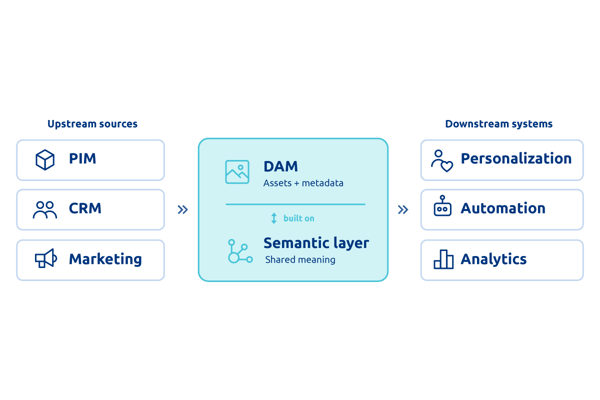 Upstream systems feed a connected core of DAM and a semantic layer, which in turn feeds downstream systems
With that foundation in place, metadata becomes structured and interoperable, search gets accurate, systems can exchange data that actually means something, and your AI and automation ambitions become realistic instead of aspirational.
That last point matters more every quarter. Without structured, connected metadata, AI cannot reliably select, generate, or optimize content. The DAM becomes the bottleneck.
A semantic layer is what turns labels into meaning and makes that meaning useful across the whole enterprise. It is also the backbone of solid DAM data governance, because consistent meaning is what makes governance enforceable rather than theoretical.
A data-first approach
Early in my career, I led an enterprise DAM rollout, and the lesson stuck: DAM is not really about assets or features. It is about data. Data is what makes the whole thing work.
If you are trying to get more out of your DAM, I would focus on 4 things.
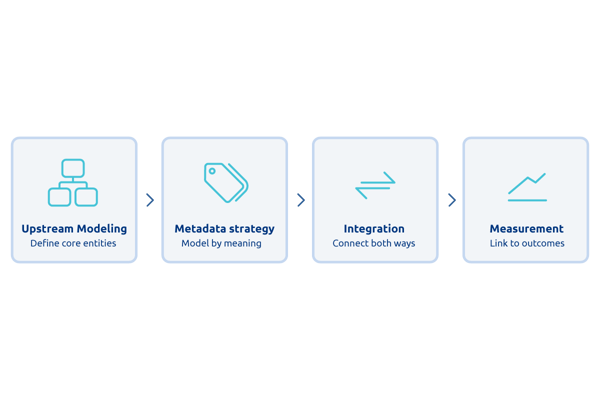 The 4-step, data-first approach
Start with upstream data modeling, defining and standardizing your core entities and their relationships so they reflect how the business actually runs.
Build a metadata strategy around business meaning, not just technical fields, and keep it consistent across use cases.
Then connect the pipes: integrate upstream systems so metadata stays enriched and up to date automatically, and extend those integrations downstream so delivery and analytics tools can access the DAM's data.
Finally, close the loop with measurement and reporting that link assets to engagement, conversion, and revenue, so you can see which content drives outcomes and which just takes up storage.
What's it worth
Organizations that invest in upstream data, a semantic foundation, and downstream integration tend to see the same set of wins, and they compound. Assets get easier to find and reuse, campaigns ship faster, and adoption climbs because the system finally earns people's trust. Personalization gets sharper too, and for the first time leadership can see real numbers on content and campaign ROI. Put together, that is how a DAM graduates from a content repository into something that actually drives growth and insight.
There is an opportunity here for the wider ecosystem as well. When DAM providers, integrators, and data specialists work together on upstream quality and downstream access, customers reach value faster, implementations succeed more often, and integrations across the marketing stack finally become useful rather than fragile.
All of which points to where this is heading. The next chapter for DAM will not be written by new features, but by how well these platforms connect to the broader data ecosystem. Remember that a DAM does not fail because something is missing from the feature list; it fails when the data around the assets lacks structure, context, and connectivity. So the teams that win will not be the ones with the most content. They will be the ones who turn content into connected, measurable, and actionable data.
That leaves one honest question worth sitting with: Is your DAM delivering measurable business value, or just storing files?
How Datavid can help
Most organizations do not struggle with DAM because they lack a platform. They struggle because the data on their assets is fragmented, inconsistent, and disconnected from the rest of the business. That is the problem we work on at Datavid.
We help enterprises build the data foundations that make a DAM actually deliver: upstream data modeling and metadata strategy, the semantic layer that gives every system shared meaning, and the integration that pushes that meaning both into the DAM and back out to the platforms that use it.
The result is assets that are easier to find and reuse, analytics that finally connect content to outcomes, and a DAM that earns its place in the stack.
If you are asking whether your DAM is driving measurable value or just storing files, that is exactly the conversation we are built for.
Is your DAM delivering measurable business value, or just storing assets?