
The Missing Layer Between Scientific Data and Breakthrough Ideas | Datavid x Graphwise
Learn how scientific knowledge management and semantic backbones help R&D teams connect fragmented data, preserve institutional memory, and support trusted AI.
-
 Resource type
On-demand video
In life sciences, biotech, materials science, aerospace, and other knowledge-intensive industries, breakthroughs depend on how quickly teams can find, understand, and reuse scientific knowledge.
But too often, critical data is scattered across disconnected repositories, documents, literature databases, lab systems, clinical platforms, and individual expertise.
The result is familiar: researchers spend too much time searching, repeating work, validating context, or waiting for specialist support before they can move forward.
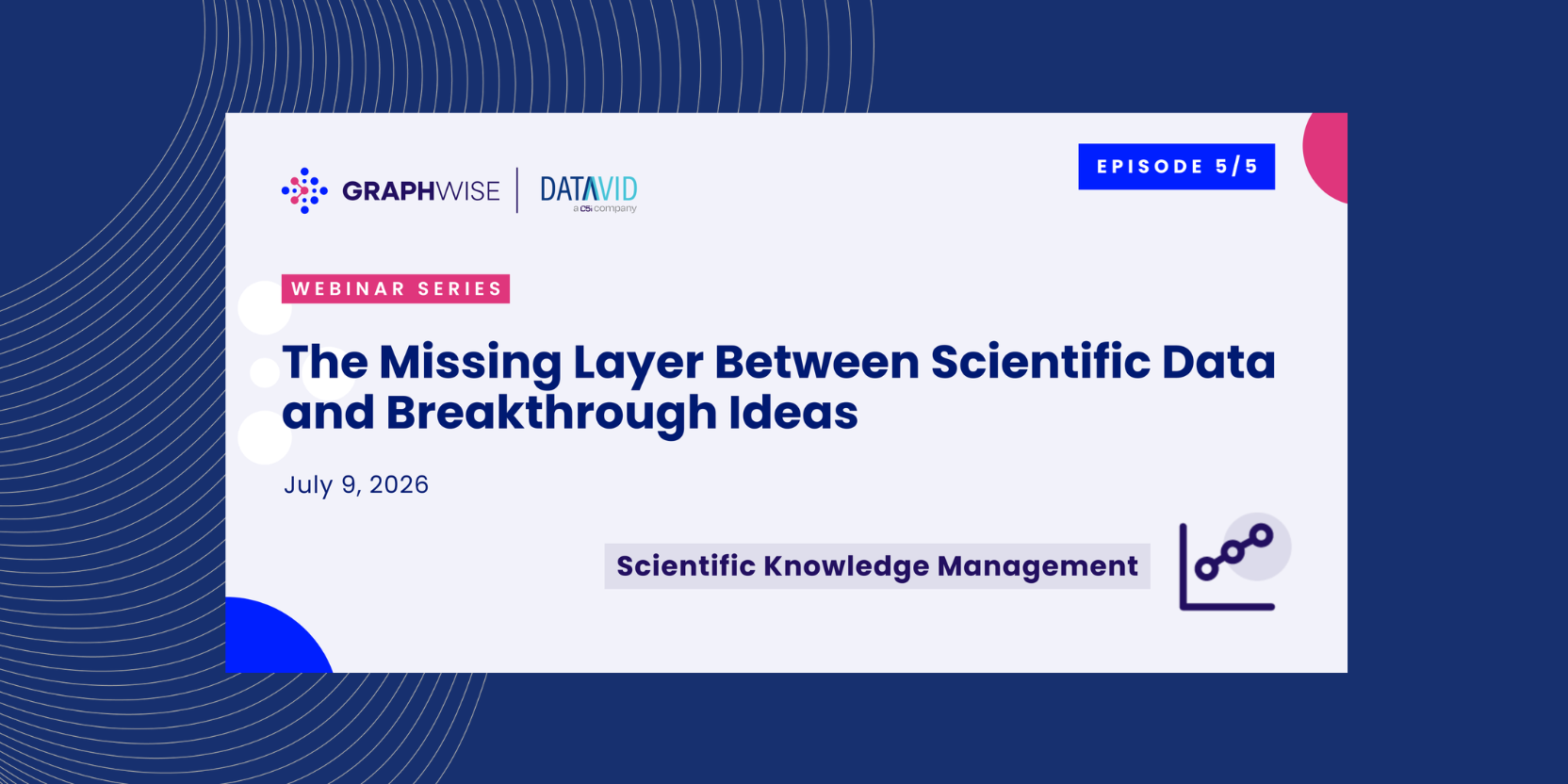
In this on-demand webinar, Datavid joins Graphwise for the final session of the Graphwise Strategic Use Cases series to explore how a semantic backbone can help solve this challenge.
Together, Todor Primov, Director of Life Sciences Solutions at Graphwise, and Clive Smith, Chief Revenue Officer at Datavid, discuss how scientific organizations can bring structure, context, and governance to complex R&D knowledge, making it easier for researchers and AI systems to find, reason over, and reuse trusted information.
About the resource
Scientific organizations are generating more data, documents, and research knowledge than ever before. Yet much of that knowledge remains difficult to use because it is fragmented across systems, formats, teams, and business functions.
A semantic backbone creates the missing layer between raw scientific data and breakthrough ideas. It connects structured and unstructured sources through shared meaning, domain ontologies, taxonomies, knowledge graphs, governance, and AI-ready context.
In this session, Graphwise introduces the scientific knowledge management use case and explains how a semantic backbone supports trusted reasoning, explainability, and GraphRAG-powered AI.
Datavid then shares real-world life sciences experience across the value chain.
The session also explores how organizations can connect knowledge across existing systems, rather than relying on a disruptive rip-and-replace approach.
Key takeaways
- Reduce time spent searching across disconnected scientific systems
- Preserve institutional knowledge and prevent loss of expertise
- Make research and enterprise knowledge easier to find, trust, and reuse
- Minimize duplicated effort by surfacing what has already been done
- Improve confidence in AI outputs with governed, traceable knowledge
- Understand how semantic knowledge management supports faster discovery and better R&D decisions
Key topics covered
Scientific knowledge management
The webinar explores why scientific knowledge management is becoming a strategic priority for life sciences and other R&D-driven organizations.
Rather than treating scientific data as isolated files, documents, datasets, or records, scientific knowledge management connects information through meaning, context, and relationships so it can be searched, reasoned over, reused, and trusted.
The semantic backbone
Graphwise explains how a semantic backbone brings together knowledge graphs, ontologies, taxonomies, structured data, unstructured content, NLP, LLM extraction, and governance.
The goal is not just better search. It is a connected, AI-ready knowledge layer that can support human experts and AI systems with trusted, explainable context.
GraphRAG and trusted AI
The session looks at why graph-based retrieval matters for AI in scientific settings.
By grounding AI outputs in structured knowledge and traceable sources, organizations can reduce the risk of unsupported answers and give researchers more confidence in the results.
Datavid’s life sciences value-chain experience
Datavid shares examples across the life sciences value chain, including:
- R&D knowledge management
- Biobank data access and metadata knowledge graphs
- Scientific data product development
- Regulatory and compliance response
- Post-market surveillance and analytics
- Policy assistance and enterprise knowledge access
- These examples show how semantic technologies can support different stages of scientific and regulated knowledge work, from early research to enterprise operations.
Who should watch
This webinar is especially relevant for:
- Life sciences and R&D data leaders responsible for making scientific knowledge usable
- Chief Data Officers (CDOs) and data strategy leaders
- Enterprise and data architects
- Knowledge graph, ontology, and taxonomy teams
- AI and innovation leaders working on GraphRAG or trusted AI
- Research informatics and scientific data management teams
- Organizations looking to connect scientific knowledge without replacing existing systems